Episode Details
Back to Episodes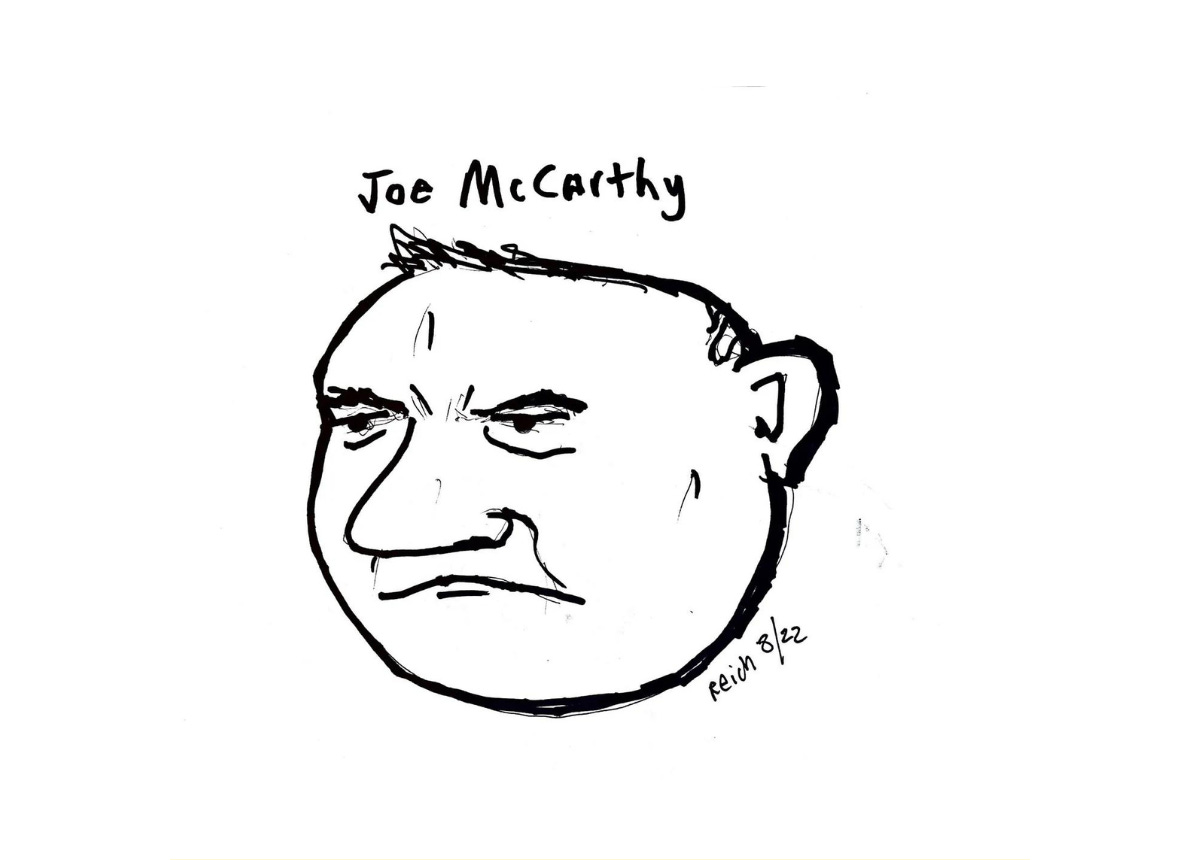
My father and Senator Joe McCarthy
Description
When Robert Draper of the New York Times recently asked Rose Sperry, a state committeewoman for Arizona’s G.O.P., to name the first Republican leader she ever admired, she immediately mentioned former Wisconsin senator Joe McCarthy. “I grew up during the time that Joe McCarthy was doing his talking,” Sperry said. “I was young, but I was listening. If he were here today, I would say, ‘Get him in there as president!’”
I also grew up during the time Joe McCarthy was “doing his talking,” and I was young and listening, too. But I would not want Joe McCarthy to be president. Neither, let me add, did my father.
Ed Reich called himself a liberal Republican, in the days when such creatures still existed. He voted for Thomas Dewey in 1948 (cancelling my mother’s vote for Harry Truman), and then for Dwight Eisenhower in 1952 and 1956 (cancelling my mother’s votes for Adlai Stevenson), and he thought highly of New York State’s Republican governor, Nelson Rockefeller, and its Republican senator, Jacob Javits — neither of whom would last a second in today’s G.O.P.
But Ed Reich could not abide bullies and he detested Joe McCarthy. My father thought that anyone who had to bully someone else to feel good about himself was despicable. Bullying led to antisemitism and antisemitism had led to the holocaust. In 1947, Ed Reich moved us from Scranton to a little village in the country some sixty miles north of New York City, called South Salem, so as to be within equal driving distance of his two women’s clothing stores, in Norwalk, Connecticut, and Peekskill, New York. Soon after we arrived, a delegation of older men from the village came by to inform us that South Salem was a “Christian community” and we were not welcome there. That was the day my father decided we’d stay put in South Salem. “I’ll show those b******s,” he said.
Senator Joseph McCarthy had a special place in Ed Reich’s pantheon of evil bullies. McCarthy didn’t just attack those he claimed were members of the Communist Party. He did it with malice. McCarthy’s crusade against “subversives” extended into the mainstream of America and American politics, as he ridiculed the “pitiful squealing” of “those egg-sucking phony liberals” who “would hold sacrosanct those Communists and queers.”
Every time McCarthy’s image came across the six-inch screen on the Magnavox television in our living room, my father would shout “son of a B***H” so loudly it made me shudder.
In Many are the Crimes: McCarthyism in America, historian Ellen Wolf Schrecker describes a movement that “punished thousands of law-abiding Americans and scared millions more into silence, destroying much of the left and seriously narrowing the political spectrum.”
McCarthyism was the byproduct of the Republican Party’s postwar effort to eradicate the New Deal by linking it to communism. The G.O.P. portrayed the midterm election of 1946 as a “battle between Republicanism and communism.” The Republican National Committee chairman claimed that the federal bureaucracy was filled with “pink puppets.”
According to John Nichols, in The Fight for the Soul of the Democratic Party, Southern segregationist Democrats joined the red-baiting rhetoric. Mississippi senator Theodore Bilbo, a Klansman who had filibustered to block anti-lynching legislation, described multiracial labor unions’ advocacy for civil rights as the work of “northern communists.” Representative John Elliott Rankin, a fiercely racist and antisemitic Mississippi Democrat who helped establish the House Un-American Activities Committee as a standing congressional committee, called the CIO’s Southern organizing campaign “a communist plot” and charged that it would lead to more Black voting rights. “We’re asleep at the switch,” he warned. “They’re taking over this country; we’ve got to st