Episode Details
Back to Episodes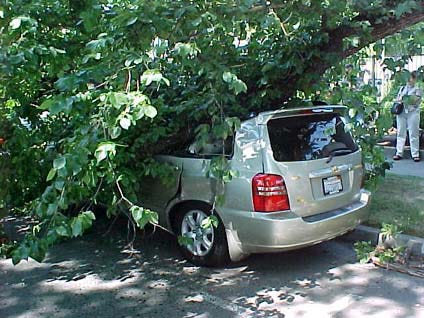
Kaboom! Sudden Tree Limb Failure
Description
It happens without warning every summer. A tree branch from an oak, eucalyptus, elm, ash, or other large, old tree crashes to the ground on a warm, non-windy day. It’s a phenomenon referred to as sudden limb failure or summer branch drop. According to the Butte County (CA) Master Gardeners newsletter:
“A break due to summer branch drop usually occurs three to twelve feet away from the trunk, along the length of the branch. The broken branches are usually long and horizontal, as opposed to upright, frequently extending to or beyond the average tree canopy. While some limbs that drop show evidence of wounds or decay, many of these failed limbs appear to be quite sound. Older, less vigorous trees seem to be more prone to this problem. Once a tree has lost a limb due to summer branch drop, it is more likely to lose another.”
Why sudden limb failure happens is not very well understood. The Butte County Master Gardeners newsletter goes on to discuss the possibility of the combination of drought and ethylene gas, a hormone found in all plants, as being part of the problem:
“Drought stress during a hot, calm afternoon reduces the flow of water in the branch, causing the branch temperature and the concentration of ethylene to increase. Ethylene is known to promote the process of cell aging. Elevated levels of ethylene may weaken the cell wall cementation, which when coupled with reduced transpiration and increased root pressure, increases internal sap pressure, moisture content of branches, and limb weight, resulting in branch failure. Old wounds and decay hidden inside a limb, possibly resulting from improper pruning, occasionally contribute to branch drop, but this does not account for the majority of summer branch drop failures. Pruning that encourages uneven growth at the end of a limb can put tremendous stress on the limb due to the added weight of the new growth.
Although there is no guaranteed way to prevent summer branch drop, several things can be done to mitigate this hazard in oaks and other commonly affected tree species such as eucalyptus, elm, and ash. On mature trees, shorten and lighten long horizontal branches and open up the tree by thinning to healthy lateral branches to reduce branch weight. Inspect the tree for externally visible defects and prune out damaged or sickly low-vigor limbs that have decay or cavities. Although watering is required to keep most ornamental trees healthy in hot summer climates, don't forget that summer moisture can encourage oak root fungus and other oak pathogens that can kill oaks when the summer-watered area is within 10 feet of the trunk. Finally, do not park cars or place play structures, benches, or picnic tables beneath older, susceptible trees. Falling limbs can't harm people - or property - if they aren't under the tree.”
If you own any large, old trees, it pays to hire an arborist to come out and examine your trees. Regular tree inspections every few years can spot trouble before it happens, especially weakly attached branches, injuries, or disease.
Many times, though, homeowners choose an arborist without doing their due diligence. Make sure whomever you hire is licensed, bonded, and insured. Under some circumstances you might be held financially responsible if an uninsured worker is hurt on your property, or damage is done to a neighbor’s property. Have more than one arborist submit an estimate.
Also, consider hiring a specialist, a consulting arborist. Their job is to tell you what’s wrong with your trees, in writing.
“I think a consulting arborist can provide the best value actually, in many cases for a homeowner, when they actually call us before they need us,” Bay Area-based consulting arborist
Listen Now
Love PodBriefly?
If you like Podbriefly.com, please consider donating to support the ongoing development.
Support Us