Episode Details
Back to Episodes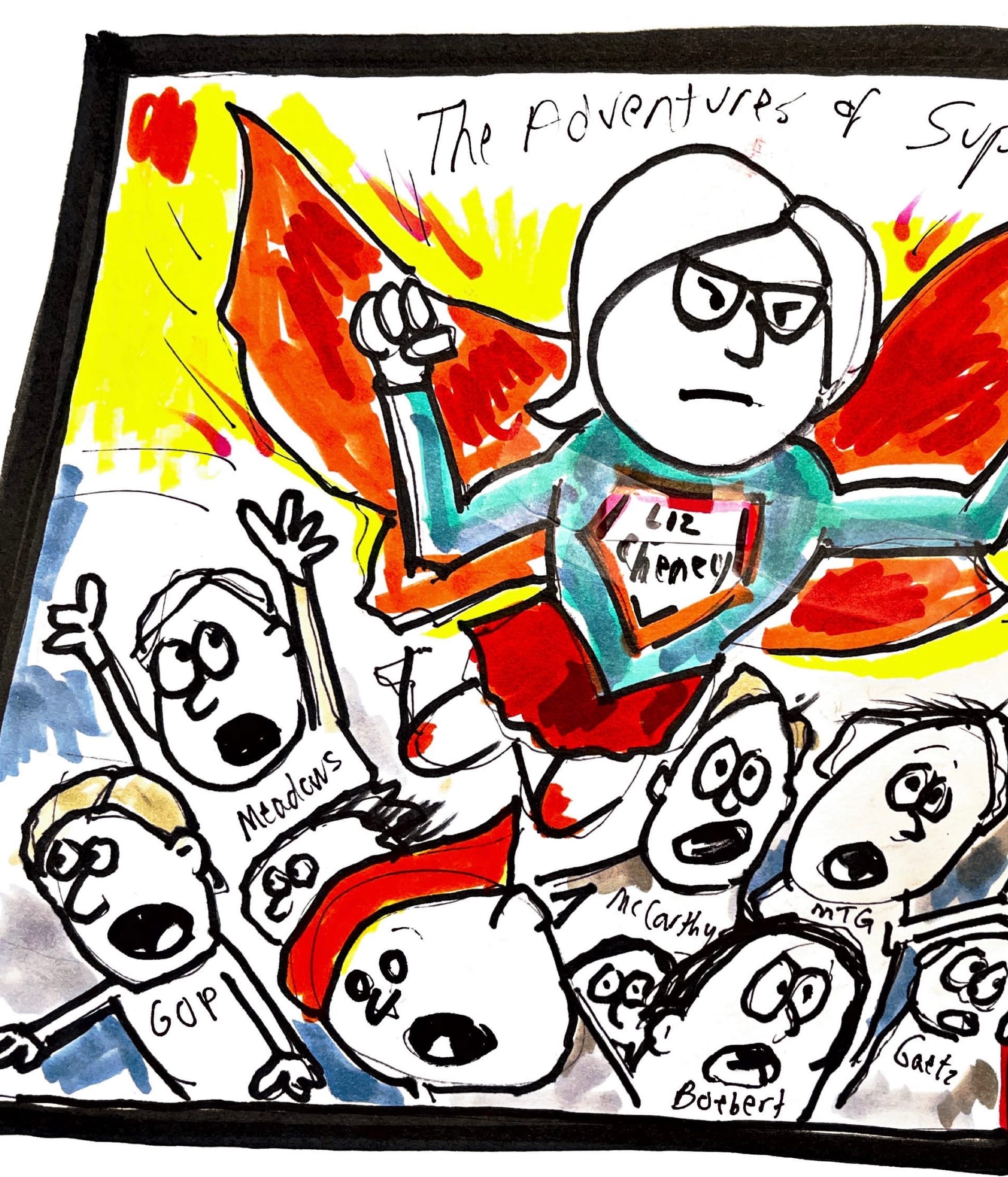
Liz Cheney and the Dick Morris paradox
Description
Tomorrow, Wyoming Republicans will determine the fate of Representative Liz Cheney — whom Trump has targeted for revenge ever since she criticized him for inciting the January 6 attack on the Capitol. Six days after that attack — when no other Republican in the House or Senate was willing to rebuke Trump — she said on the House floor: “The President of the United States summoned this mob, assembled the mob, and lit the flame of this attack. Everything that followed was his doing. None of this would have happened without the President. The President could have immediately and forcefully intervened to stop the violence. He did not. There has never been a greater betrayal by a President of the United States of his office and his oath to the Constitution.”
The very next day, on January 13, Cheney joined nine other House Republicans and 222 Democrats in voting to impeach Trump. So far, three of these ten principled Republican lawmakers have lost their primaries. Two have won them. The remaining four are retiring.
As vice-chair of the House of Representatives’ January 6 committee investigating the causes of that attack, Cheney has ceaselessly and tirelessly helped lay out the case against Trump during eight public hearings held in June and July, with more to come.
In response, Trump has done everything possible to end Cheney’s career. He made sure House Republicans revoked her status as the third-highest-ranking leader of the Republican caucus and that Wyoming Republicans censured her.
Her life has been threatened and she has a security detail. But she has not wavered.
Trump also selected Cheney’s opponent in the Republican primary, Harriet Hageman — who has rallied behind Trump and amplified his false claims that the 2020 election was stolen. Hageman has a commanding double-digit lead over Cheney. (According to some reports, Cheney has been reluctant even to venture into Wyoming to campaign, due to death threats.)
If Liz Cheney loses her House seat, as seems likely, I hope she doesn’t disappear from public life. Although her views on countless substantive issues are the opposite of mine, I salute her. She has displayed more courage and integrity than almost any other member of her party — indeed, given the pressure she was under, perhaps more than any lawmaker now alive.
The role Cheney has played raises larger issues about the meaning of representative democracy. Is it the responsibility of elected officials to represent the views of their constituents or their own principles? How far should they compromise their principles to get and retain power?
These questions aren’t limited to Republicans. As the midterms draw closer, some Democratic operatives and pundits argue that Biden and the Democrats must move to the “center” in order to win. But where is the center? Halfway between democracy and fascism? Midpoint between social justice and oligarchy? And if Democrats have to go either of these places in order to win, what’s the point of winning?
A personal note. In 2002, I ran for the Democratic nomination for governor of Massachusetts — the first time I’d run for elected office. (I don’t remember ever sleeping. I gained weight because I went to too many goddamn receptions and ate too many meatballs, pretzels, crackers and cheese. I talked so much I had to binge on throat lozenges. I smiled so much my cheeks ached. I got carsick from bouncing around Massachusetts in a cheap camper whose air conditioning continuously went out and whose springs were shot. I had to kiss the derrieres of too many rich liberals in order to finance the campaign.)
During my campaign I was asked lots of questions. Should Cardinal Bernard Law resign over allegations that he allowed priests to molest children? I said yes. My campaign manager had a fit. “This is a Catholic state. You’re Jewish. You can’t just say that!”
What would I do about Massachusetts’s ya