Episode Details
Back to Episodes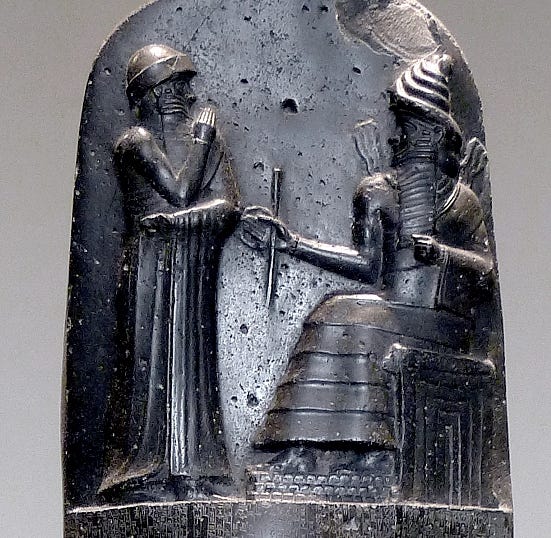
Why do we use the weights and measures we do?
Description
The Edinburgh Fringe Festival starts this week. It’s the world’s biggest arts festival, an event that sells more tickets than any other event in the world, with the exception of the Olympic Games.
I shall be making my way up to Scotland’s capital to make my own little contribution, a new show that I haven’t finished writing yet (!), “a lecture with funny bits”, about the eternal subject that is weights and measures.
Why do I say eternal?
Because people have been arguing about them, and trying to impose them since forever.
How French revolutionaries tried to decimalise time
The very first legal documents we have from Ancient Mesopotamia depict rulers with the rod and ring – a yardstick and a measuring string – usually being handed to them by God, as they try and standardise measures in law. Ancient Egyptian documents, illustrations and hieroglyphs abound with similar references. Scales are prominent too.
The opening words of the Bible establish our basic measures of time – the day and the week.
This is something the French Revolutionaries tried to do away with in 1792 when they decimalised time.
One week would be ten days. One day would be ten hours. One hour would contain 100 decimal minutes, and each decimal minute, 100 decimal seconds. Thus one day would be 100,000 decimal seconds per day.
When the proles discovered that meant one day off in ten, rather than in seven, the system began to meet with considerable resistance and duly kicked out. The revolutionaries may have got their metric weights and distances over the line, but time was a step too far.
What is a “step” by the way, but a measure? A vague but useful measure that fitbits and iPhones and health apps have become obsessed with. I did 14,126 steps yesterday. (It was a long day). What about you?
“There is to be one measure of wine throughout our kingdom, and one measure of ale, and one measure of corn,” proclaims Magna Carta. “One breadth of cloths … and let weights be dealt with as with measures.”
Even today, when Boris Johnson made announcements about being able to use imperial measures again, the culture wars kicked off. In his 2019 election manifesto Johnson pledged “an era of generosity and tolerance towards traditional measurements”. To the Guardian, however, this was xenophobia and pseudoscience.
Which is best – “free market” imperial or “central planning” metric?
I often go to the Edinburgh Fringe to do “lectures with funny bits”.
In 2016 I did one about tax, which would eventually become my book Daylight Robbery. In 2019, I did one about the philosophies of Adam Smith and how they related to the economics of the Fringe, which would eventually become a film, Father of the Fringe.
This time around I thought it would be interesting to do one about weights and measures. I’ve since discovered the subject is enormous and endless, which is why I haven’t finished writing it yet. (It’s going to be held in Adam Smith’s old front room at Panmure House, so a wonderful historic setting.)
The inevitable question that gets asked is: which system is better – imperial or metric? I would answer, with the bland neutrality of the on-the-fence politician, that they both have their place.
I grew up with the metric system. That was what I was taught at school. But as I’ve grown older, I’ve found myself thinking more and more in imperial.
Feet make more sense to me than 30, 60, or 90 centimetres, or 1.2, 1.5 or 1.8 metres. Inches – a thumb pressed down – make more sense than centimetres. A hair’s breadth means more than a micrometre.
I find it easier to orient myself around pints than I do litres, around pounds – the amount you can easily hold in your hand – th