Episode Details
Back to EpisodesAncient Necromancy
Description
Finishing up with our October theme of “talking to the dead,” we examine necromancy in the ancient world in this episode. While the word has been generalized in its present use to mean cover any form of magic of a sinister bent, in its original meaning, it was simply what the Latinized-Greek etymology suggests: “necro-” for “dead” and “-mancy” for “divination by.” Not that it wasn’t always regarded as a rather sinister activity. It certainly was, and particularly by the Roman era, we’ll see the practice associated with most ghoulish sort of atrocities imaginable. But it’s Halloween, so the more ghoulish, the better.
We begin around 630-540 BC when a necromancer was written into the Biblical book of 1 Samuel (or 1010 BC, if we are to date the figure by the time the events were alleged to have occurred — in any case, this is our oldest tale of a necromancer, known most commonly as the “Witch of Endor.” It’s also our first of several examples of not getting particularly good news when you consult the dead on your future. Much doom and gloom, when King Saul talks to the dead prophet Samuel, who never really liked him anyway.
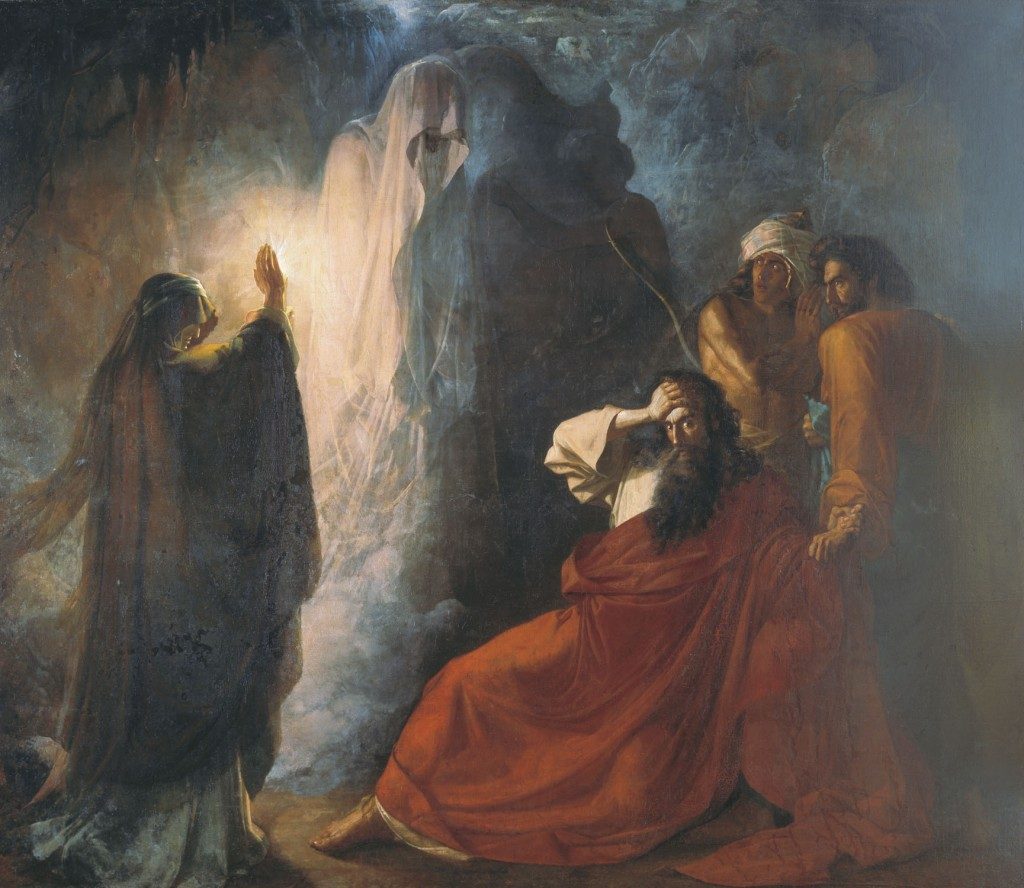
Our next tale of ancient necromancy comes from Homer’s Odyssey, and though there’s no actual necromancer in this story, Odysseus follows instructions for summoning the dead in Hades given him by a pretty legitimate enchantress, namely, Circe. We’ll see an interesting parallel here with the story of the Witch of Endor and learn of the vampiric love of blood attributed to the dead in ancient Greece.
Up next is a lesser known Greek tale of Periander, a tyrannical ruler of Corinth, who sends servants to consult the necromancers to discover the location of some money hidden on his estate, the location of which, only his deceased wife Melissa would know. Some interesting details here as we learn just why the late Melissa finds herself chilly in the afterlife and Periander demonstrates just how tyrannical a tyrant he really is.
A little background is then furnished the rather elaborate pantheon of the underworld and death-related spirits known to the Greeks, much of which was inherited by the Romans and one element even borrowed into a Sam Raimi film. Interesting etymological links to modern curiosities abound! Thanatos, Hypnos, Nyx, The Keres, Manes, Achlys, Lemures, and Lamia are all discussed.
Then there’s the story of Pausanias, King of Sparta, who led the Greeks in victory over the Persians in 479 BC. Troubles begin when he becomes infatuated with a beautiful virgin, Cleonice, in Byzantium. One tragedy and betrayal follows another in this sad tale, and following instructions from a ghost summoned by necromancers only makes things worse.
Then we turn to the Romans for the most gruesome stories.
Listen Now
Love PodBriefly?
If you like Podbriefly.com, please consider donating to support the ongoing development.
Support Us