Episode Details
Back to EpisodesThe Goblins Will Get You!
Description
Goblin lore from old folk tales, literature, ancient and modern legends is our topic this time around.
We begin with the poem from which we take our episode title, James Whitcomb Riley’s “Little Orphant Annie” in which the poet remembers his childhood nanny and her “witch tales” and threats about goblins coming.
Next, we take a quick look at the word “goblin” itself, and how it relates via the goblin-like “boggart” or “boggle” of the Northern England and Scotland to our word, “bogeyman” (hearing a snippet along the way of Henry Hall’s 1932 rendering of the song, “Hush, Hush, Hush, Here Comes The Bogeyman.”)
The word “goblin” seems to have made its way into English from Normandy. A 12th-century tale that from that region employs a latinzed version of the word, “Gobelinus,” to name a creature that menaces the 6th-century saint Taurinus in Orderic Vitalis’s Historia Ecclesiastica. The creature’s hapeshifting between a bear, a lion, and a buffalo is a trait we’ll see later with other goblins. We also hear of the first English usage of the word — one which appears in a translation of the Bible, of all places.
The root of the word, “goblin,” and German and Old French cognates, points to a connection with caves, or hollows in rocks, which takes us to the a certain species of goblin in Cornwall particularly, which is said to reside underground, specifically in mines. In England, these are known as “knockers” for the sounds they’re said to make with the tiny miners’ hammers, a words that evolved into “tommyknocker” for the spirits haunting American mines in the 19th century. We hear some examples of its playful and sometimes malicious interactions with miners, and of a particularly gruesome death attributed to these beings in Colorado.
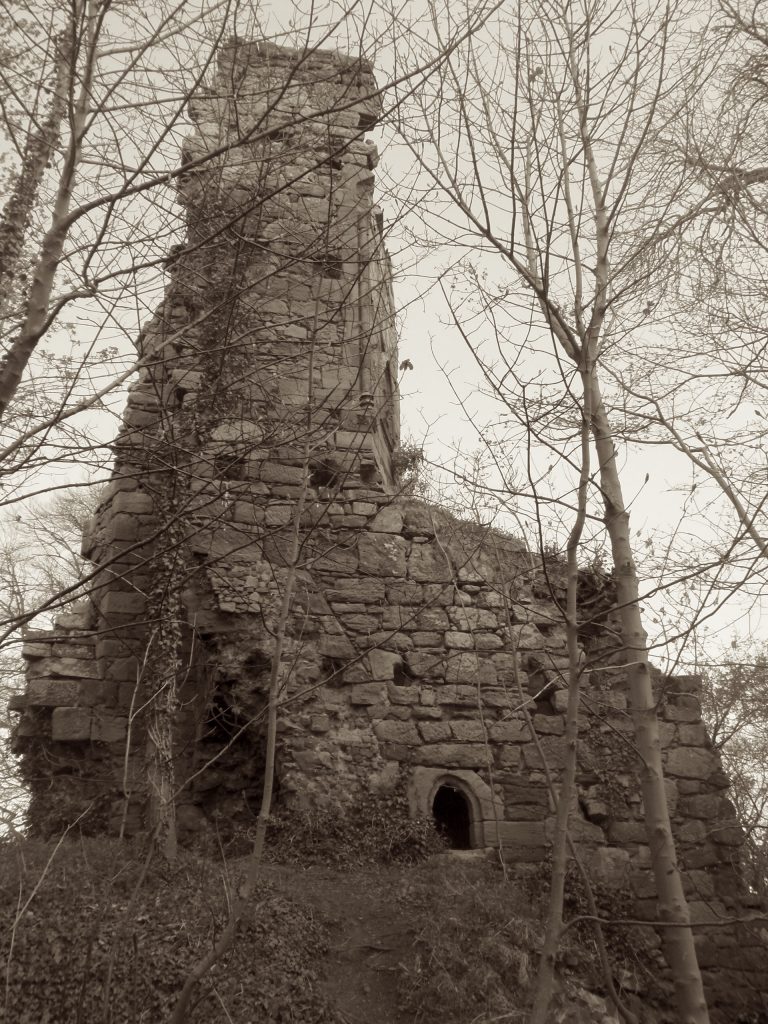
Our next section looks at several legendary goblins that made their way into the poems and folklore studies of Sir Walter Scott. The first example, appearing in the poem “Marmion,” involves “Goblin Hall,” a name given to Yester Castle in East Lothian, which was said to have been built by a sorcerer assisted by goblins. We also hear an additional tale associated with the magician featuring a magic fruit he’s said to have given his daughter. Taking a bite of the “Coulston pear” proves very, very unlucky.
Scott also mentions a “Goblin Cave,” in his 1810 poem, “The Lady of the Lake.” Near Loch Lomond, it was not only the legendary home of goblis but also served as a location for a scene in Scott’s poem and as unlikely inspiration for a well known Catholic hymn composed by Schubert.
Scott’s 1805 poem “The Lay of the Last Minstrel” adapts a local legend of a goblin named Gilpin Horner. It also features an undead warlock based on the historic scholar Michael Scott, who came to be regarded in the popular imagination as a sort of Dr. Faustus charcter. Mrs. Karswell reads a bit of the poem, in which the goblin meets a spectacularly melodramatic end.
Our last stop in Scotland is the imposing Herm