Episode Details
Back to EpisodesFrau Perchta, the Belly-Slitter
Description
Frau Perchta, sometimes known as “the Belly-Slitter” for the trademark punishment she’s said to inflict on disobedient or lazy children, is figure of Alpine folklore of Austria and Germany in many ways similar to the Krampus.
“Perchta” is only one spelling or name for this figure, who may also go by Pehrta, Berchte, Berta, and a myriad of other names. A particularly good representation of the figure, a woodcut from 1750, identifies her as the “Butzen-Bercht,” with the word “Butzen” coming from a word for “bogeyman.” This word also appears in a classic 19th-century German children’s song and game “Es Tanzt Ein Bi-Ba Butzemann,” or “A Bogeyman is Dancing,” from which we hear a clip at the show’s start.
The woodcut in question depicts a crone-like character with dripping, warty nose, who is carrying on her back a basket filled with screaming children, all girls. She stands before the open door of a house where more girls are screaming, and is holding a dangerous looking pronged staff as well as a distaff, the stick used to hold fibers that will be spun into wool or flax on a spinning wheel. The importance of the illustration is the way it emphasizes Perchta’s connection to spinning and to the females of the household responsible for this task. The woodcut also features some text delightfully detailing a series of horrid threats delivered by Perchta, dramatically read by Mrs. Karswell.
Perchta’s name it comes from her association with Epiphany or Twelfth Night, January 6, the last of the “Twelve Days” or nights of Christmas, the “Haunted Season,” we discussed last year in our episode of that name. “Perchta” is a corruption of the word giberahta in the Old High German term for Epiphany, “giberahta naht,” meaning, the “night of shining forth or manifestation.
Now there’s another name many of you will have encountered if you’re read up on Perchta: Perchten, figures very similar to the Krampus. (Perchten is plural. The singular is Percht.)
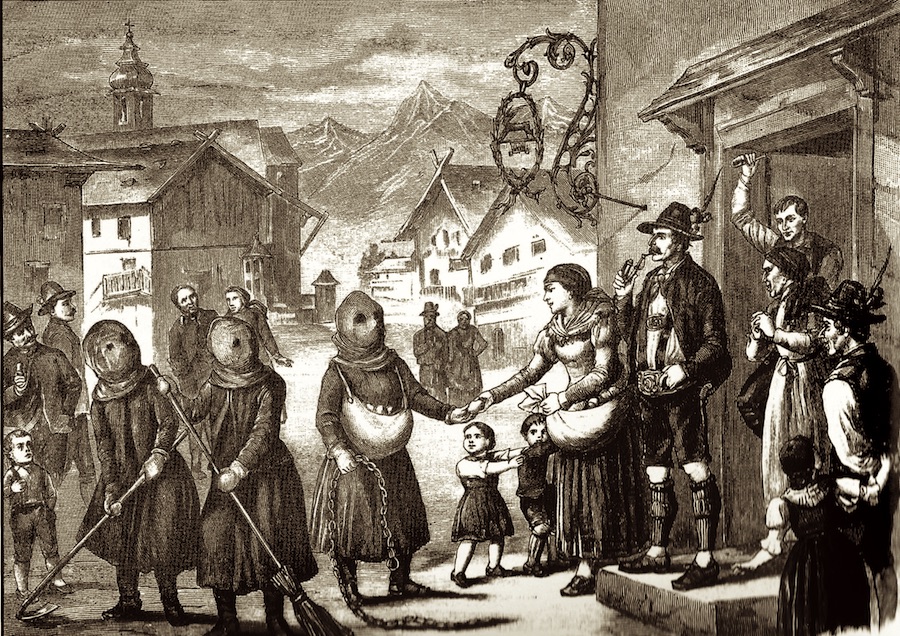
While the first mention of Perchta appears around 1200, the word “Perchten” is not employed until centuries later. In 1468, there appears a reference to her retinue, but its members are not called Perchten, nor do they explicitly resemble Perchten as we think of them today. At this stage in Perchta’s mythology, the company she leads is most often understood as spirits of the departed. With time, and frequent attacks from the pulpit, Perchta’s pagan company came to be commonly feared not as ghosts but as demons, something presumably closer to the horned figures we now know. By the 15th c