Episode Details
Back to EpisodesSlavic Mermaids: Water Ghosts and Goblins
Description
Quite distinct from their Western equivalent, Slavic mermaids might better be described as water ghosts, as they are almost always the spirits of departed females, while their male equivalent takes the form of a water goblin or water sprite. The Russian word for mermaid is rusalka (rusalki pl.) and male creature is a vodyanoy. Similar words are used in other slavic languages, though the Czech water goblin is known as a vodnik.
The rusalki are found not only found in Russia, Ukraine, and Belarus, but also Poland, the Czech Republic, Slovakia, Serbia, Slovenia, and Bulgaria. And they’re honored with their own holiday, Rusalka Week, just now coming up in early June.
While they are usually active only at night, during Rusalka Week, they emerge in the daylight when they may be seen dancing, singing, or playing usually in groups. As they lack the fish tail of Western mermaids, they may also venture into forests and fields for such activities, but while in the water, they may also pull swimmers, fishermen or others near the water to watery deaths. We open the show with a clip from Mermaid: Lake of the Dead, a 2018 Russian horror film about a rusalka, which depicts the creature in this malevolent aspect.
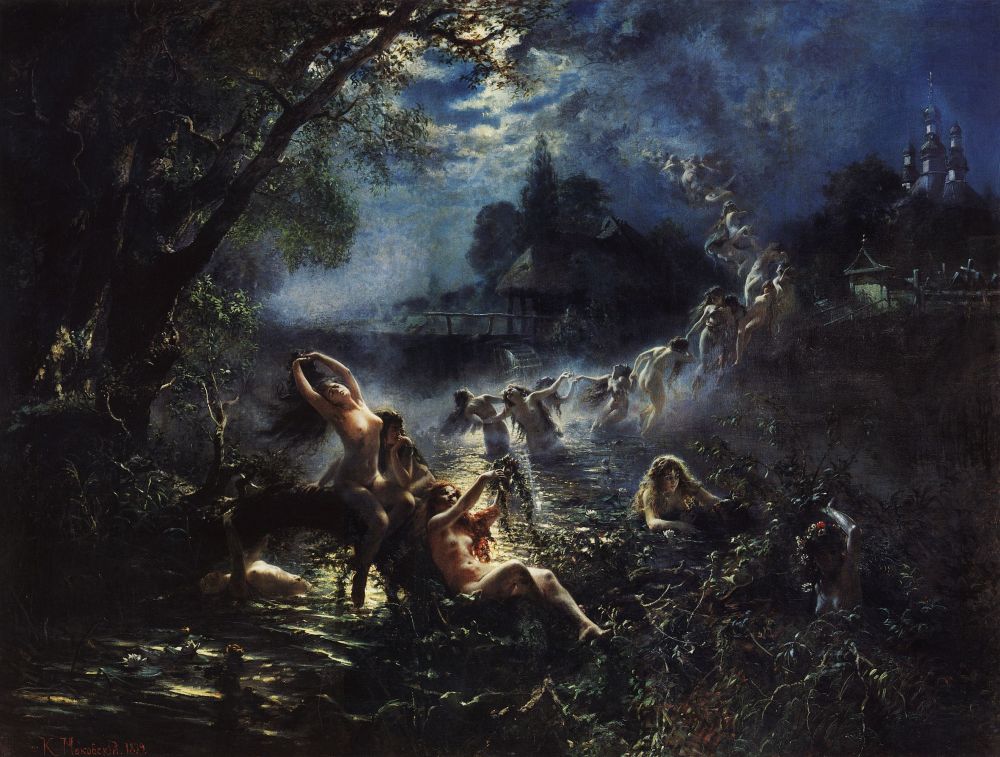
Not just any woman who dies will become a rusalka. Typically, she would have died by violence, suicide, or sudden accident, particularly drowning. Often these deaths are related to misfortunes in love, rejection by lovers, or suicides due to unwanted pregnancies. Because of this, the rusalka is particularly focused on capturing men with no interest in attacking adult females. Men who fall prey to them are either believed drowned or may live with them in a sort of underwater spirit limbo in their richly appointed palaces of crystal, gold, and silver. Occasionally, their would-be victims may overcome them by the power of the cross, or in rare cases, they may even be domesticated into mortal life (with varying success). Mrs. Karswell reads several typical and atypical tales describing the interactions of rusalki and men, ones collected from informants in turn-of-the-century studies by Russian ethnographers
While rusalki are most interested in men, they may sometimes capture girls and boys to be kept as the children they failed to have in life. Infants may also become rusalki if they die unbaptized, and will wander the earth in that form for seven years seeking someone who might free them by performing a christening. After that, like other rusalki, they remain in that undying form until the end of the world.
Prior to the 19th century, it’s not clear the rusalki were always regarded as the ghosts of unfortunate females. Instead, they seemed to play some role in connection to fertility. This is particularly clear in Ukraine, where the rusalki (or creatures nearly the same) are called mavka and a figure called Kostromo is both the cent