Episode Details
Back to EpisodesThe Jinn
Description
They Arabic mythology of the jinn is, not surprisingly, quite different than what you might glean from Western pop culture. Films such as 1940’s The Thief of Baghdad and 1958 Ray Harryhausen classic, The Seventh Voyage of Sinbad, which we hear sampled in our opening might have you believe these creatures function as nothing more than wish-granting slaves, but their existence needn’t be entangled with human wants and needs.
https://www.youtube.com/watch?v=ugMmyjCdpoQ&t=205s
One Thousand and One Nights, or the collection sometimes titled Arabian Nights, is the original Western source when it comes to our topic of the genies or the jinn. This begins with the word “genie,” an English rendering of the original French translation of the Arabic word, “jinn” (which can be used as both plural and singular, btw.) These tales are told within a frame story related by Scheherazade, a woman providing a cliff-hanger night-by-night narrative intended to delay the plans of her newly wed husband, who intends to execute her after the wedding night. (We hear a bit of Rimsky-Korsakov’s 1888 symphonic suite Scheherazade along the way).
After reviewing the evolution of these Arabian Nights stories from original oral forms (which were more often Persian, Indian, and Greek than Arab, actually), we have a look at some surprising misunderstandings about the story of Aladdin, which, like the stories of Sinbad, and Ali Baba, were not even part of the first collection of these tales assembled.
Jinn are a separate race, created between men and the angels. They are not immortal, and live in an invisible society organized like our own with similar social orders, marriages, and offspring (though sometimes humans are taken as marriage partners also). They are not necessarily good or evil, choosing their own path, which may include following the Muslim faith, as the Qur’an speaks of the Prophet preaching to this race of being. They may also follow other faiths as Christian, Jewish, and Zoroastrian jinn are also sometimes mentioned.
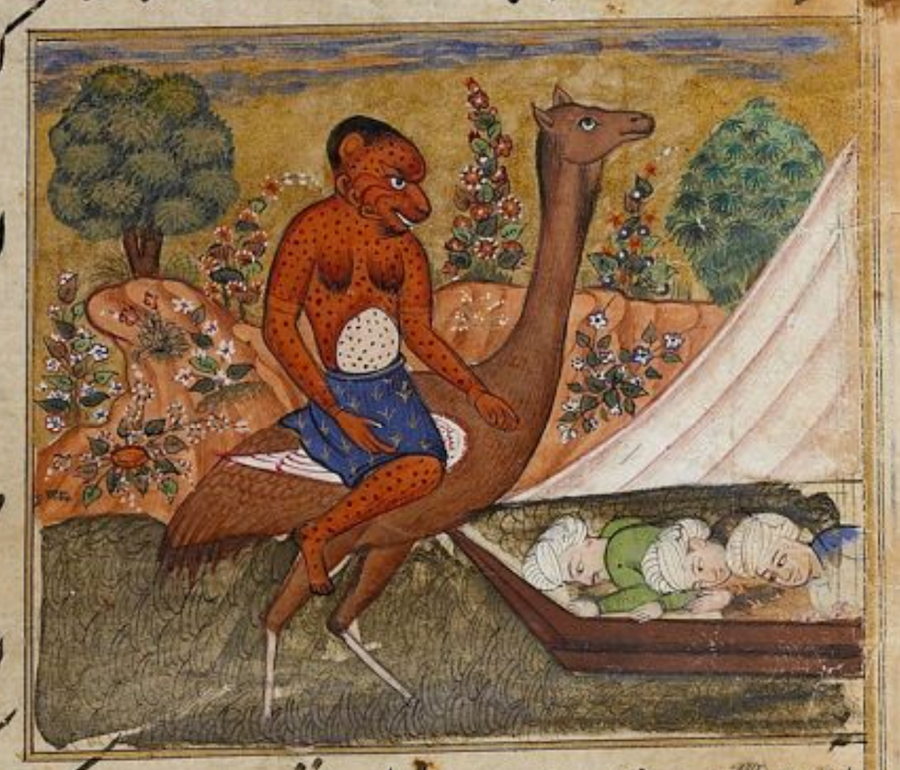
We spend some time looking at how their appearance has been described in literature, though no particularly definitive description emerges, as they are constant shapeshifters. They may appear simply as shadows or whirlwinds, but more often seem to take human form, albeit, often that of a human hybridized with various animals features (horns are common). Frequently, they may also simply take the form of animals, particularly dogs, and snakes. We hear some interesting anecdotes in this regard, illustrating the reverential treatment animals sometimes receive lest they reveal themselves to be dangerous jinn in disguise.
Listen Now
Love PodBriefly?
If you like Podbriefly.com, please consider donating to support the ongoing development.
Support Us