Episode Details
Back to Episodes
Cruelty Free International w/ Monica Engebretson
Description
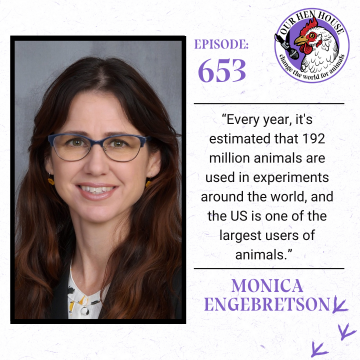
Monica Engebretson is working to end cruel animal testing practices, and this week, she joins the podcast for an in-depth conversation about the state of medical and cosmetic animal testing. The North American Head of Public Affairs for Cruelty Free International, Monica breaks down how the global organization is working to bring an end to animal testing worldwide. Plus, she explains the difference between animal research and animal testing, the most cogent arguments for its ineffectiveness, and the existing non-animal alternatives. She also gives us an overview of animal research and testing in the United States and discusses various legislative and regulatory initiatives on behalf of animals trapped in labs.
*We are thrilled to expand the accessibility of our podcast by offering written transcripts of the interviews! Click here to read Mariann’s interview with Monica Engebretson.*
Monica Engebretson is the North American Head of Public Affairs for Cruelty Free International – an organization working to end animal testing worldwide. Monica has worked in the field of animal protection since 1999 with a range of experience, including fieldwork, undercover investigations, lobbying, and media and public education campaigns. She has also worked on various issues in addition to animals in research, including human-wildlife conflicts, trapping, farmed animals, and captive birds. She has helped write and pass several state laws on many of these issues. Before working professionally in the animal protection movement, Monica earned a Bachelor of Science in wildlife with a minor in environmental ethics from Humboldt State University in Northern California. Monica’s work for Cruelty Free International has focused on initiatives in the US and Canada to end cosmetic testing on animals, working to accelerate the replacement of animals in FDA regulatory testing through the Make Alternatives a Priority (MAP) campaign, advancing humane science funded by the NIH with the Humane and Existing Alternatives in Research and Sciences Testing (HEARTS) Act, and maximizing the number of animals released from laboratories through the Companion Animal Release from Experiments (CARE) Act.
“Every year, it’s estimated 192 million animals are used in experiments around the world, and the US is one of the largest users of animals.” – Monica Engebretson
Highlights for Episode 653:
- The complexities of testing medical and cosmetic products
- The central criticisms of using animals in experiments
- Why animal testing is a historic methodology that has proved to be ineffective
- Other non-animal testing methods that are showing signs of being more useful
- The major objections to the use of non-animal testing alternatives
- A review of the current US state and federal research and testing laws and recent changes to those laws, including what the Animal Welfare Act requires from organiza