Episode Details
Back to Episodes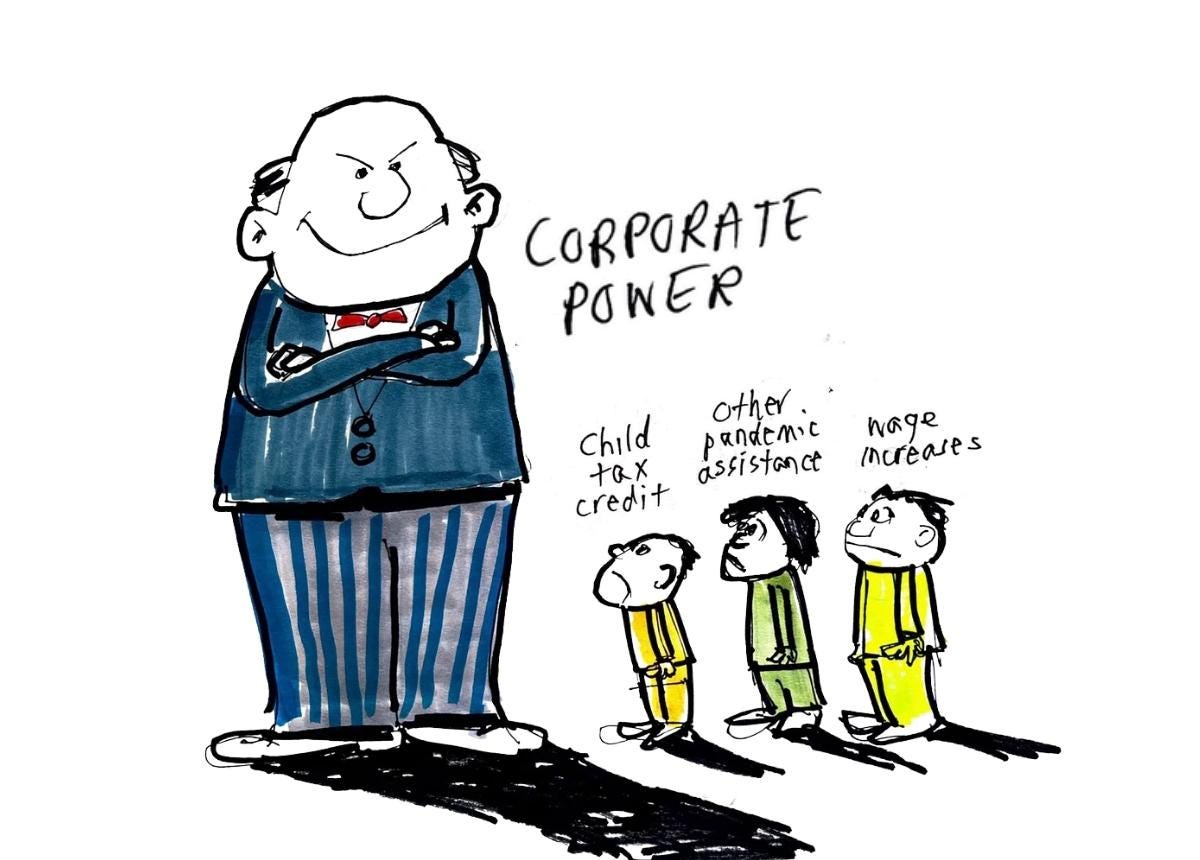
Trumpism and the myth of the "free market"
Published 3 years, 8 months ago
Description
The January 6 committee continues to do an excellent job exposing Donald Trump’s attempted coup. But, as I’ve noted, the question remains: why have so many Americans been willing to sacrifice American democracy to this man? Earlier this week, in The Roots of Trumpism (here), I began pulling the strands together. Today, I look at what’s happened to wealth and power, and how the dramatic consolidation of both at the top of America continues to fuel Trumpism.
Wealth and power are inseparable. Democracy depends on the support of a large and growing middle class that shares a nation’s growing wealth — and through that wealth, its power.
But for the last four decades, even as the American economy has tripled in size, the wages of most Americans have gone nowhere (in terms of real purchasing power) and America’s middle class has shrunk. An increasing portion of the nation’s wealth has gone to the top 10 percent — and a disproportionate amount of that to the richest 1 percent (and of that to the richest 1 percent of the richest 1 percent). Most Americans, by contrast, are now living paycheck to paycheck, and barely making it.
This vast consolidation of wealth and power at the top has not been due to neutral market forces. It is the product of a vicious cycle. With their wealth and influence, those at the top — Wall Street moguls, corporate CEOs and top executives just below them, venture capitalists, and private-equity mavens — have altered the rules of the American system in ways that have further enlarged their wealth and power, entrenching their dominance over the system. They have spent billions of dollars supporting the campaigns of candidates that will make changes in laws and regulations that further enrich them, billions more opposing the candidacies of those who will tax and regulate them, and additional billions seeking to sway public opinion in favor or policies that will benefit them and against policies that will harm them. In this way, increasingly over the last four decades, they have siphoned off economic gains that otherwise would have gone to the bottom 90 percent.
Let me be clear: Stagnant wages and insecure jobs for most people, and the erosion of the middle class, are not the consequences of the so-called “free market.” They are the results of a massive shift in power.
One of the most dangerously deceptive ideas is that we face a choice between the “free market” and government — between capitalism and socialism — and that the “free market” is preferable because the alternative would destroy freedom. Conservatives repeatedly say that the inequalities and insecurities we experience are beyond our control — the consequences of “market forces.” They argue that efforts to reduce inequality and insecurity are dangerous “constraints” on the market, likely to cause grave unintended consequences. By this view, if millions of Americans must work two or three part-time jobs with no idea what they’ll earn next month or next week, that’s just the natural outcome of market forces. If one out of five American children lives in poverty, the free market is to blame. If we are losing our middle class, that’s because too many people are lazy or unqualified for the “new economy.”
This is rubbish. In reality, the “free market” is nothing but a set of rules — about (1) what can be owned and traded (corporations? enslaved people? machine guns? nuclear bombs? babies? votes? the right to pollute?). (2) On what terms? (hostile takeovers? corporate monopolies? the right to organize unions? a minimum wage? the length of patent protections?). (3) Under what conditions? (uninsured derivatives? fraudulent mortgages? mandatory arbitration of disputes?). (4) How to repay what’s owed? (debtors’ prison? bankruptcy? corporate bailouts?). (5) What’s private and what’s public? (clean air and clean water? healthcare? good schools?). And (6) how to pay for what’s deemed public? (corporate taxes? property taxes? user fees and tolls? personal income taxes? a wealth tax?).
These rules do not exist in nature. They are human creations. Governments do not “intrude” on free markets. Governments organize and maintain markets. The choice is not market or government; governments make markets. Markets are not constrained by rules; the rules define them.
The real question — often hidden behind the jargon, behind the supply-and-demand curves, the blather about inflation and the Federal Reserve or federal budget deficits or trade deficits or economic growth, behind the monthly reports on unemployment and inflation — is whether the system is improving the lives of most people, including the least fortunate, or is mainly making the rich even richer.
The rules emerge from the decisions of people who occupy a wide variety of positions — judges, lawyers, administrators, politicians, advisers — and who are put into their positions by whomever has power in the system. The central issue is not more or less government. It is who is the system for? If democracy were working as it should, the people making the rules would be acting on behalf of the vast majority — especially the bottom 90 percent.
But in the vicious cycle that’s been accelerating for the last four decades, the rules are in effect made by those with the wealth to buy or bribe the politicians, regulatory heads, and even judges (and the lawyers who appear before them). As wealth has concentrated at the top, so has power.
Wealth is not a “zero-sum” game in which the more of it held by some, the less of it is held by others. But power is a zero-sum game. And therein lies the problem.
So taxes on corporations and wealthy individuals are lowered while taxes on estates on their way to the descendants of the wealthy are eliminated. An increasing portion of government revenue comes from Social Security taxes, sales taxes, property taxes, and user fees (such as tolls), which fall heaviest on the bottom 90 percent. Meanwhile, loopholes are created in tax laws for the partners of hedge funds and private-equity funds. Tax laws also contain special loopholes for the oil and gas industry, pharmaceuticals, Wall Street, Big Agriculture, and Big Tech.
Intellectual property rights — patents, trademarks, and copyrights — are continuously enlarged and extended, thereby creating windfalls for pharmaceutical, high tech, biotechnology, and entertainment companies. They’re all able to preserve their monopolies longer than ever. This also means higher prices for American consumers, including the highest pharmaceutical costs of any advanced nation.
Antitrust laws are relaxed, resulting in larger profits and bigger political clout for the most dominant corporations, and higher prices and less leverage for workers. (Corporate profits are driving the current inflation.) Financial laws and regulations instituted in the Depression decade of the 1930s are abandoned, allowing the largest Wall Street banks to acquire unprecedented influence over the economy. Corporations that make so-called “critical” technologies, such as semiconductor chips, receive huge government subsidies.
Bankruptcy laws are loosened for large corporations but tightened for homeowners and graduates laden with student debt. In a financial crisis, the largest banks and auto manufacturers get bailed out, but homeowners who can’t pay their mortgages — disproportionately low-income people of color — do not.
Contract laws are altered to require mandatory arbitration before private judges selected by big corporations, and permit “non-compete” clauses that reduce worker mobility. Securities laws are relaxed to allow insider trading of confidential information. CEOs use stock buybacks to boost share prices and cash in their stock options.
Labor laws are changed to make it harder to form unions.
Corporate governance shifts from all stakeholders (including workers and communities where companies do business) to solely shareholders. Bargaining power shifts from large unions to giant corporations. Financial power shifts from local and regional banks to Wall Street.
As these changes — and thousands like them — go into effect, wealth and power move upwards, with the result that subsequent changes in the rules are even more skewed toward benefiting those at the top. This vicious cy
Wealth and power are inseparable. Democracy depends on the support of a large and growing middle class that shares a nation’s growing wealth — and through that wealth, its power.
But for the last four decades, even as the American economy has tripled in size, the wages of most Americans have gone nowhere (in terms of real purchasing power) and America’s middle class has shrunk. An increasing portion of the nation’s wealth has gone to the top 10 percent — and a disproportionate amount of that to the richest 1 percent (and of that to the richest 1 percent of the richest 1 percent). Most Americans, by contrast, are now living paycheck to paycheck, and barely making it.
This vast consolidation of wealth and power at the top has not been due to neutral market forces. It is the product of a vicious cycle. With their wealth and influence, those at the top — Wall Street moguls, corporate CEOs and top executives just below them, venture capitalists, and private-equity mavens — have altered the rules of the American system in ways that have further enlarged their wealth and power, entrenching their dominance over the system. They have spent billions of dollars supporting the campaigns of candidates that will make changes in laws and regulations that further enrich them, billions more opposing the candidacies of those who will tax and regulate them, and additional billions seeking to sway public opinion in favor or policies that will benefit them and against policies that will harm them. In this way, increasingly over the last four decades, they have siphoned off economic gains that otherwise would have gone to the bottom 90 percent.
Let me be clear: Stagnant wages and insecure jobs for most people, and the erosion of the middle class, are not the consequences of the so-called “free market.” They are the results of a massive shift in power.
One of the most dangerously deceptive ideas is that we face a choice between the “free market” and government — between capitalism and socialism — and that the “free market” is preferable because the alternative would destroy freedom. Conservatives repeatedly say that the inequalities and insecurities we experience are beyond our control — the consequences of “market forces.” They argue that efforts to reduce inequality and insecurity are dangerous “constraints” on the market, likely to cause grave unintended consequences. By this view, if millions of Americans must work two or three part-time jobs with no idea what they’ll earn next month or next week, that’s just the natural outcome of market forces. If one out of five American children lives in poverty, the free market is to blame. If we are losing our middle class, that’s because too many people are lazy or unqualified for the “new economy.”
This is rubbish. In reality, the “free market” is nothing but a set of rules — about (1) what can be owned and traded (corporations? enslaved people? machine guns? nuclear bombs? babies? votes? the right to pollute?). (2) On what terms? (hostile takeovers? corporate monopolies? the right to organize unions? a minimum wage? the length of patent protections?). (3) Under what conditions? (uninsured derivatives? fraudulent mortgages? mandatory arbitration of disputes?). (4) How to repay what’s owed? (debtors’ prison? bankruptcy? corporate bailouts?). (5) What’s private and what’s public? (clean air and clean water? healthcare? good schools?). And (6) how to pay for what’s deemed public? (corporate taxes? property taxes? user fees and tolls? personal income taxes? a wealth tax?).
These rules do not exist in nature. They are human creations. Governments do not “intrude” on free markets. Governments organize and maintain markets. The choice is not market or government; governments make markets. Markets are not constrained by rules; the rules define them.
The real question — often hidden behind the jargon, behind the supply-and-demand curves, the blather about inflation and the Federal Reserve or federal budget deficits or trade deficits or economic growth, behind the monthly reports on unemployment and inflation — is whether the system is improving the lives of most people, including the least fortunate, or is mainly making the rich even richer.
The rules emerge from the decisions of people who occupy a wide variety of positions — judges, lawyers, administrators, politicians, advisers — and who are put into their positions by whomever has power in the system. The central issue is not more or less government. It is who is the system for? If democracy were working as it should, the people making the rules would be acting on behalf of the vast majority — especially the bottom 90 percent.
But in the vicious cycle that’s been accelerating for the last four decades, the rules are in effect made by those with the wealth to buy or bribe the politicians, regulatory heads, and even judges (and the lawyers who appear before them). As wealth has concentrated at the top, so has power.
Wealth is not a “zero-sum” game in which the more of it held by some, the less of it is held by others. But power is a zero-sum game. And therein lies the problem.
So taxes on corporations and wealthy individuals are lowered while taxes on estates on their way to the descendants of the wealthy are eliminated. An increasing portion of government revenue comes from Social Security taxes, sales taxes, property taxes, and user fees (such as tolls), which fall heaviest on the bottom 90 percent. Meanwhile, loopholes are created in tax laws for the partners of hedge funds and private-equity funds. Tax laws also contain special loopholes for the oil and gas industry, pharmaceuticals, Wall Street, Big Agriculture, and Big Tech.
Intellectual property rights — patents, trademarks, and copyrights — are continuously enlarged and extended, thereby creating windfalls for pharmaceutical, high tech, biotechnology, and entertainment companies. They’re all able to preserve their monopolies longer than ever. This also means higher prices for American consumers, including the highest pharmaceutical costs of any advanced nation.
Antitrust laws are relaxed, resulting in larger profits and bigger political clout for the most dominant corporations, and higher prices and less leverage for workers. (Corporate profits are driving the current inflation.) Financial laws and regulations instituted in the Depression decade of the 1930s are abandoned, allowing the largest Wall Street banks to acquire unprecedented influence over the economy. Corporations that make so-called “critical” technologies, such as semiconductor chips, receive huge government subsidies.
Bankruptcy laws are loosened for large corporations but tightened for homeowners and graduates laden with student debt. In a financial crisis, the largest banks and auto manufacturers get bailed out, but homeowners who can’t pay their mortgages — disproportionately low-income people of color — do not.
Contract laws are altered to require mandatory arbitration before private judges selected by big corporations, and permit “non-compete” clauses that reduce worker mobility. Securities laws are relaxed to allow insider trading of confidential information. CEOs use stock buybacks to boost share prices and cash in their stock options.
Labor laws are changed to make it harder to form unions.
Corporate governance shifts from all stakeholders (including workers and communities where companies do business) to solely shareholders. Bargaining power shifts from large unions to giant corporations. Financial power shifts from local and regional banks to Wall Street.
As these changes — and thousands like them — go into effect, wealth and power move upwards, with the result that subsequent changes in the rules are even more skewed toward benefiting those at the top. This vicious cy