Episode Details
Back to Episodes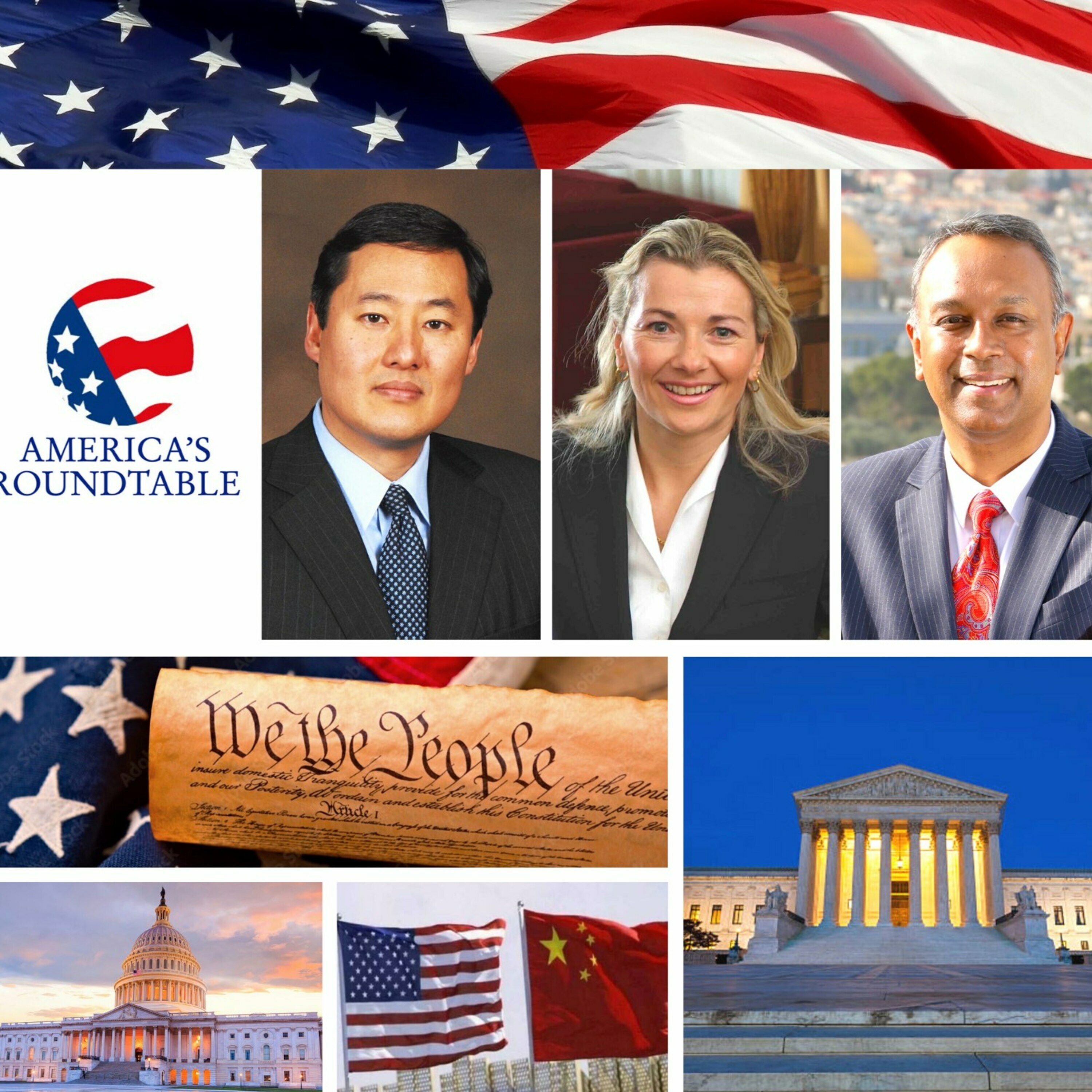
John Yoo | Reining in the Administrative State | The Significance of Natural Rights and the Future of America's Courts | Is China a Rival or an Adversary of the United States?
Description
Join America's Roundtable co-hosts Natasha Srdoc and Joel Anand Samy with Professor John Yoo, Emanuel Heller Professor of Law at the University of California at Berkeley, Nonresident Senior Fellow at the American Enterprise Institute, Visiting Fellow at the Hoover Institution, Stanford University and Former Deputy Assistant Attorney General at the U.S. Department of Justice. The enlightening conversation focuses on the vital issues impacting our nation including the inexorable growth of an unaccountable administrative state, the significance of "natural rights" and the future of the courts, the First and Second Amendments and on recent developments in China and the Indo-Pacific region.
From CSPAN: “What happened at the Court is tremendously bad,” remarked Justice Clarence Thomas about the recently-leaked draft of a Supreme Court opinion that would strike down Roe v. Wade. Justice Thomas elaborated, saying that the leak does damage to the rule of law and institutions in general. “You can’t have a civil society--a free society--without a stable legal system,” he added. His remarks came during an interview at the Old Parkland Conference in Dallas. He also discussed other issues including free speech at colleges and universities, the influence that his mentor Thomas Sowell had on him, his disagreement on always abiding by legal precedent, and his disapproval of protests that happen near public officials' homes.
Source: https://www.c-span.org/video/?517582-1/justice-thomas-leak-supreme-court-opinion-damages-rule-law
"Article I of the Constitution states that “all legislative powers herein granted shall be vested in a Congress of the United States.” That separates the law-making power of Congress from both the executive and judicial branches. By forbidding Congress to delegate its legislative authority elsewhere, this rule ensures that only elected legislators will make the laws that bind Americans or limit their liberties."
—The Supreme Court’s Chance to Restore Political Accountability, The Wall Street Journal commentary by Peter J. Wallison and John Yoo. They are the editors of “The Administrative State before the Supreme Court,” forthcoming in April.
Should Supreme Court Justices Believe in Natural Rights? — Newsweek
By John Yoo
Brief excerpt:
"In her answer, Judge Jackson accurately identifies the Declaration of Independence as one of the leading explications of natural rights in American history. But if she has no position on natural rights, as she wrote in response to Senator Cruz, then she has no position on the Declaration of Independence. Her answers did not come under the pressured circumstances of live hearings, but instead came as written answers to written questions after the end of her Judiciary Committee hearings. We should view them not as a mistake, but as her carefully considered views on the matter. Again, she puts herself in opposition to the Great Emancipator, who once said “I never had a feeling politically that did not spring from the sentiments embodied in the Declaration of Independence.” In an 1859 letter, Lincoln memorably wrote on the occasion of Thomas Jefferson’s birthday:
All honor to Jefferson—to the man who, in the concrete pressure of a struggle for national independence by a single people, had the coolness, forecast, and capacity to introduce into a merely revolutionary document, an abstract truth, applicable to all men and all times, and so to embalm it there, that to-day, and in all coming days, it s