Episode Details
Back to Episodes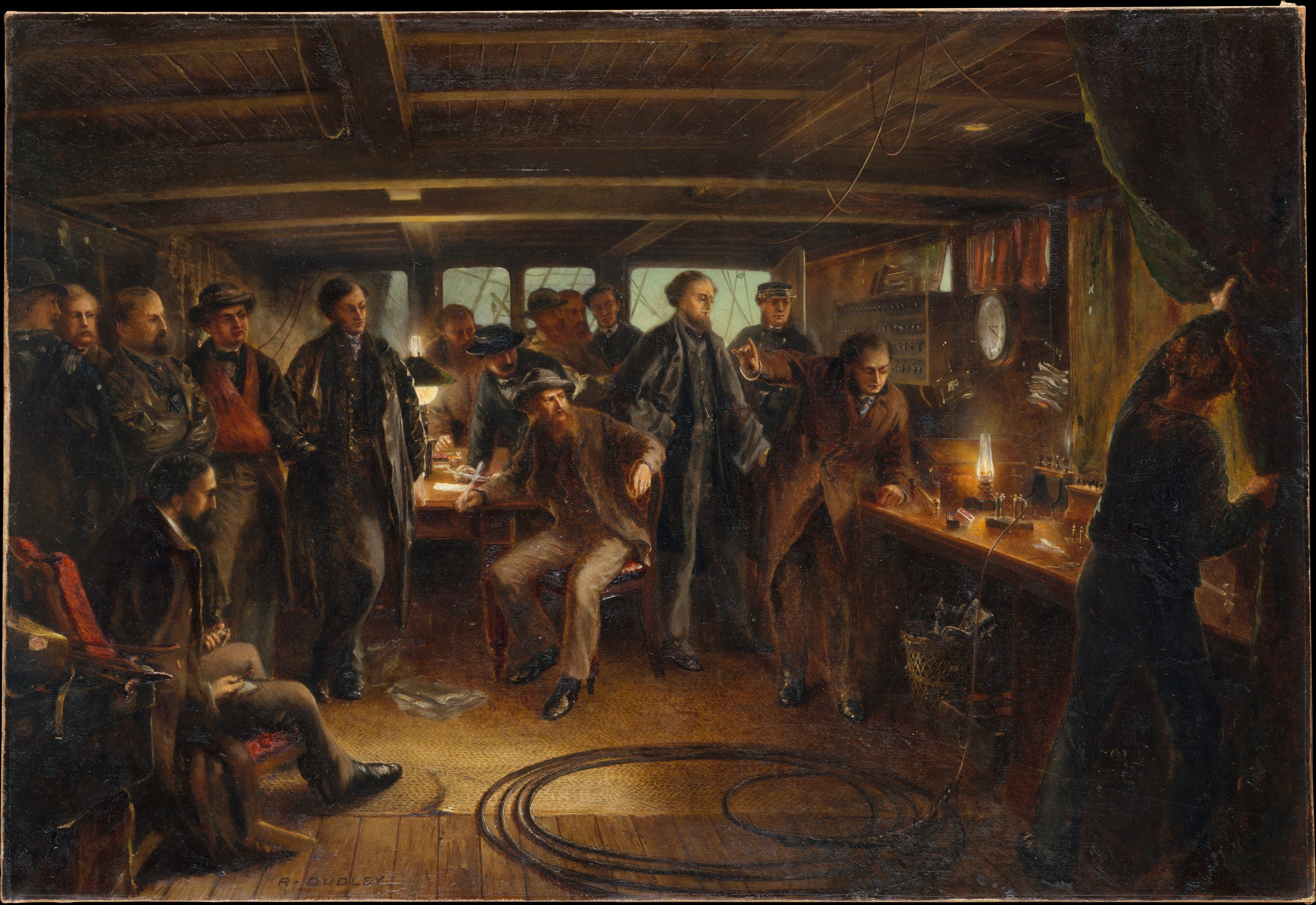
Money is language
Description
You might call it the cable that changed history.
In the mid-19th century there were various attempts to lay cables across the Atlantic Ocean between Britain (Ireland) and the US.
It took several failures, numerous bankruptcies and over ten years before they got it right.
But eventually they did and on July 27 1866 Queen Victoria broadcast a message to US President Johnson. Here’s what it said:
Osborne, July 27, 1866
To the President of the United States, Washington
The Queen congratulates the President on the successful completion of an undertaking which she hopes may serve as an additional bond of Union between the United States and England.
Johnson replied:
Executive Mansion
Washington, July 30, 1866
To Her Majesty the Queen of the United Kingdom of Great Britain and Ireland
The President of the United States acknowledges with profound gratification the receipt of Her Majesty's despatch and cordially reciprocates the hope that the cable which now unites the Eastern and Western hemispheres may serve to strengthen and perpetuate peace and amity between the governments of England and the Republic of the United States.
(Signed) Andrew Johnson
Money is a form of communication technology
To send a message by ship could take ten days or more. Now it was a matter of minutes. So somebody came up with the slogan "two weeks to two minutes".
Transmission speeds improved rapidly. Morse code became words. It was soon possible to send multiple messages at once. By the end of the 19th century, Britain, France, Germany and the US were all linked by cable.
Personal, commercial and political relations were altered for all time.
Back then gold was money of course, as were paper notes representing gold. You couldn’t send gold down the cable, however, nor paper.
But you could send a promise.
And, within a fortnight of Queen Victoria’s message, that’s what two parties who trusted each other did. An exchange rate between the dollar and the pound was agreed and then published in the New York Times on August 10.
That is why, to this day, the pound-dollar exchange rate, GBPUSD, is known as cable.
Promises, promises, promises
“All money is a matter of belief,” said Adam Smith. He had a point.
Look at a twenty pound note (if you still use them) and you will see the words “I promise to pay the bearer”. Money is promissory.
Of course, promises disappear. Gold doesn’t. The two are quite different forms of money: one is belief, the other is real.
Nevertheless, since the dawn of civilisation, we have been using promissory money. In Ancient Mesopotamia, man used mud tokens - a cone or a sphere- representing sheep or barley, baked inside clay balls to log debts owed.
Over time, he found it more efficient, rather than bake tokens in balls, to inscribe pictures of the tokens in the mud for the same purpose. That is how the first system of writing came about.
In Ancient China, man recorded his debts on bits of leather. After the invention of printing he started using paper.
Today the promises are recorded and exchanged between trusted third parties on computers.
Millions, probably billions of promises are sent across the internet every second, transferring as quick as words, probably quicker. Not only does (promissory) money evolve with communication technology, it is often the spur, the impetus for communication technology to evolve.
Now bitcoin, with its blockchain, obviates the need for trusted third parties altogether. That is one of many reasons it is so special. Here is a money communication network backed instead by mathematical proof and the most powerful and resilient computer network ever known to man: the trusted third party is the blockchain.
Why would you not want to own a share of s