Episode Details
Back to EpisodesTop Consults: Hemoptysis
Description
Pulm PEEPs hosts, Kristina Montemayor and David Furfaro, bring our first episode in our Top Consults series. In this series, we will bring in experts to work through the most common pulmonary and critical care consults. Whether you are the consulting physician, or a pulmonologist responding to the page, these episodes are geared to give you all the information you need to care for your patients!
Today, we are joined by Chris Kapp and Matthew Schimmel, two interventional pulmonologists, to discuss hemoptysis. Chris and Matt will help us work through two hemoptysis consults, and together we’ll provide a framework for thinking about hemoptysis, outline some key components of the evaluation, and delve into treatment options.
Key Learning Points
Hemoptysis Evaluation
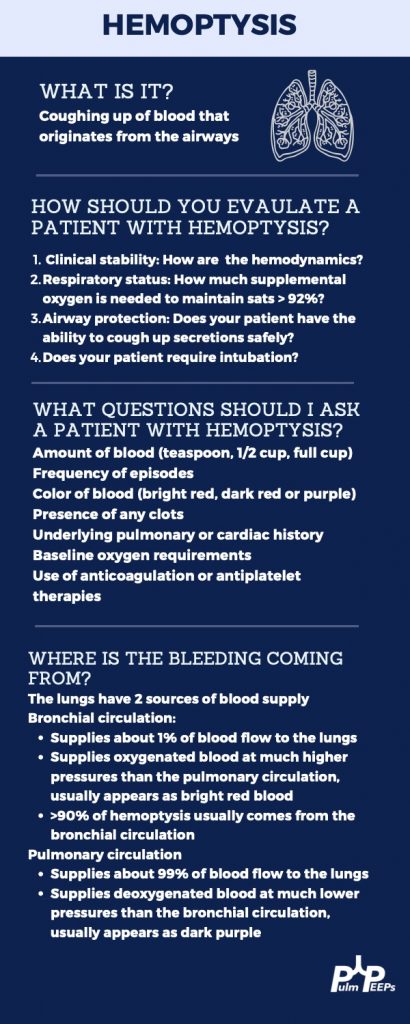
Hemoptysis Management
Life-Threatening or Large Volume Hemoptysis
- Stabilize the patient! Make sure the airway is protected either by the patient coughing themselves, or intubation if needed. Provide hemodynamic support with IVF, blood products, and pressors if needed. If it is known which lung has the bleeding the patient can be positioned so the lung with the bleeding is down. This protects the non-bleeding lung.
- Correct any bleeding diathesis If the patient is on anti-coagulation, or has any reversible bleeding diathesis, these should be corrected immediately to reduce further bleeding.
- Localize the bleed If the patient is stable, they should undergo a CTA to localize the bleeding. If they are not stable to make it to a CT scan, a bronchoscopy should be performed.
- Bronchoscopic treatment In addition to clearing blood from the airway, bronchoscopy can localize the bleeding. With available expertise, bronchoscopic treatments can be performed such as ice saline, topical epinephrine, or balloon tamponade to isolate the bleed.
- Definitiv