Episode Details
Back to Episodes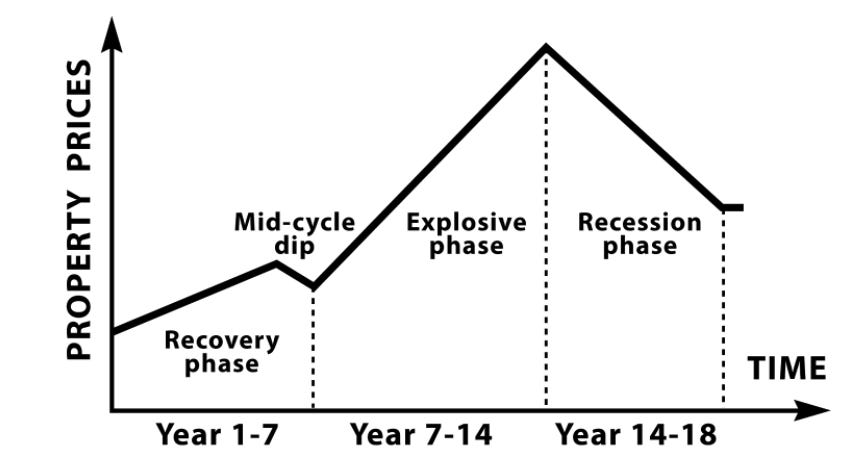
Why house prices will crash in 2025
Description
It’s a national religion for some, heresy for others.
Today we look at house prices.
But we do not consider property through the window of the estate agent’s, but rather through the prism of an 18-year cycle, one that was brought to public attention by economist Fred Harrison is his cult classic Boom Bust: House Prices, Banking and the Depression of 2010.
He published it in 2005 so, if you’re into forecasting, that’s some title…
Cycles are often what you want them to be
Before we start, let me issue my usual disclaimer on cycles.
Cycles exist everywhere: the seasons of the year, night and day, the life cycles of plants and animals. They exist within our own bodies in the form of circadian rhythms. They exist, sort of, in markets too – there are good times and bad times, bull markets and bear markets, four-year presidential cycles, commodity super-cycles and more.
Mining companies, in particular, go through clear cycles – perhaps phases is a better word – from exploration and discovery, through development and mine building, to actual production.
I’m a keen observer of hype cycles. How much of this story is known? How much more hype is left in the tin? Or is this story now tired?
And cycles can make for good copy. Kondratiev made his name pedalling them. We like reading about them because they bring a veneer of certainty where there is in fact, often none.
But cycles – especially in markets – are also arbitrary, random and uncertain. It’s easy for an academic to look back at history, find a pattern and declare it a cycle. When real life doesn’t fit the model, you’ll hear something like: “Well, the war upset the cycle”, or “they printed loads of money, so the cycle didn’t work out” or whatever. Cycles in markets are not fixed and predictable in the same way as the days and weeks of the year. And they are not so apparent in real time - only in the rear view mirror.
You get the point. There is a certain amount of salt to pinch when it comes to cycles.
Nevertheless they are useful instruments. I know some who swear by them, especially Harrison’s, whose book was clearly brilliant in its forecast.
I remember thinking in 2005: “This market is nuts. It has to crash”. Many felt the same way, including many of the brightest minds in the City. A whole website - housepricecrash.co.uk – sprung up around the theme. Many of us were certain the game was about to end.
Then I stumbled across this brilliantly prophetic article by Harrison in MoneyWeek saying, “No, we are a couple or three years from the top”. He was right.
After last week’s missive on house prices versus gold, I was thinking about our distorted property market and the spectre of rising interest rates. The thought occurred to me that we must be close to Harrison’s next peak. Lo and behold, Merryn Somerset Webb interviewed him in the latest MoneyWeek podcast.
Harrison’s short answer is that 2026 will see the top of the market. We have another three years, in other words.
A quick guide to the 18-year property cycle
Let me quickly explain how his thinking works. His idea – and it is more about land prices than it is house prices, though the two tend to rise and fall together – is that property tends to see 14 years of price growth, followed by four years of decline.
Broken down an 18-year cycle might something like this:
Harrison says he can follow prices back some 200 years to find this clear 18-year cycle at play.
I don’t have all the data to cross check back that far, but I do have the data going back to 1951 (care of Nationwide), so let us at least check that.
Before Wor