Episode Details
Back to Episodes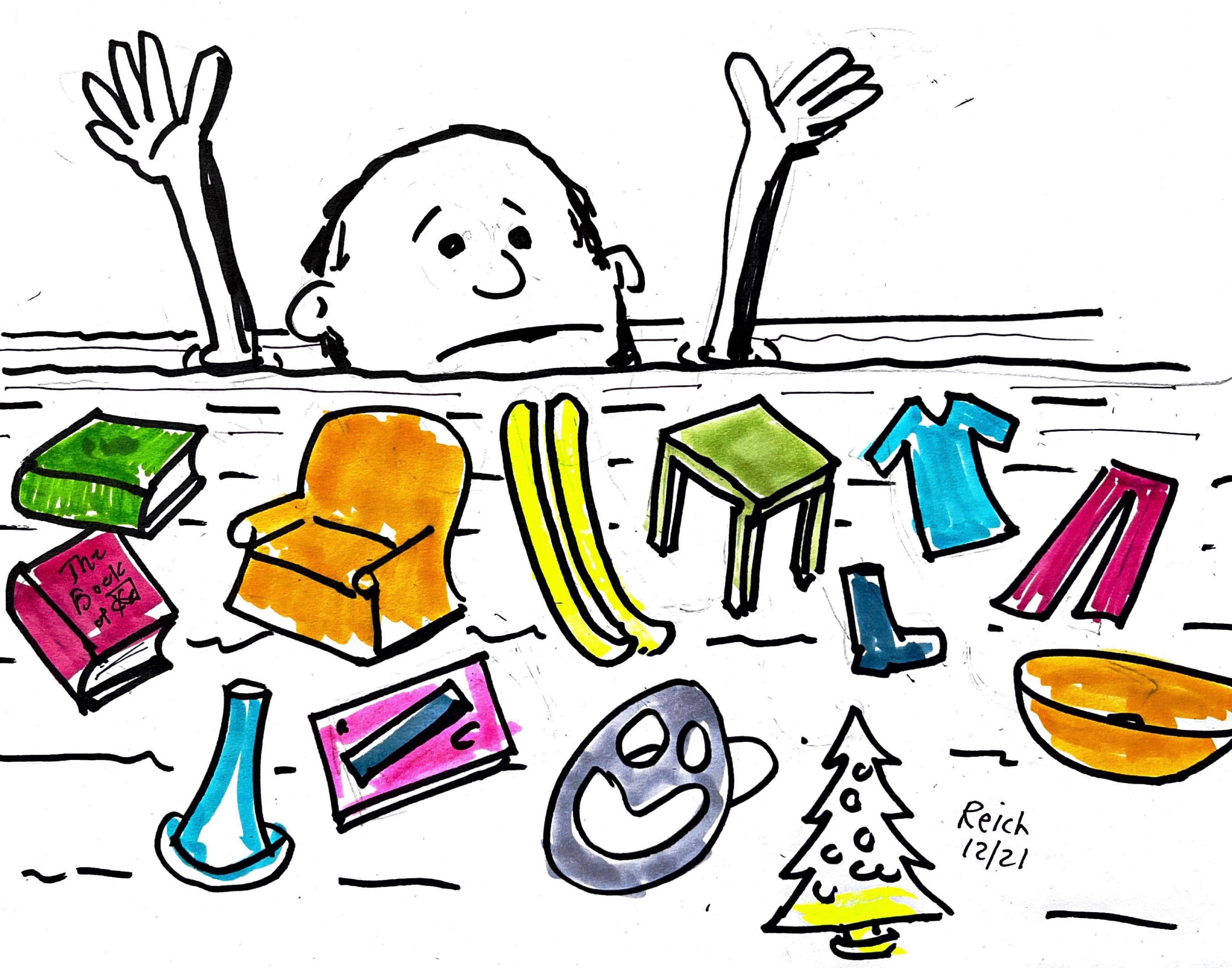
How to overcome the tyranny of stuff
Description
‘Tis the time to cash in gift certificates, shop for post-Christmas bargains, and fill shelves and closets with more stuff.
I for one don’t want anything more, thank you. My shelves are already overflowing with books. My attic is full of old chairs and tables, chafing dishes, pictures, games, children’s toys, ski equipment, stereos, a broken easel. My closet can’t fit any more clothes, most of which I haven’t worn in years. I’m drowning in stuff.
Once a year (usually around the holidays), I drop off as much stuff as I can at Goodwill Industries or the Salvation Army.
To be totally honest, I don’t just off-load stuff I no longer need. I also prowl around thrift stores on the off-chance I’ll find some quirky thing I’ve been looking for (or maybe a friend or relative would love to have) — say, a vinyl recording of Leonard Cohen from the late 1960s, a funny tie, memorabilia from one of FDR’s presidential campaigns.
A few months ago my neighbors began putting stuff they no longer want on the sidewalk at the end of the street, hoping others will pick it up. I’ve started putting stuff there, too. I’ve even picked up a few things there, like some exercise weights I’d been looking for.
In all these ways, I’ve become a small part of a recycled economy. Maybe you have, too.
At different times of our life we want different things. When kids are small, they have certain needs; as they grow up, different needs and wants. When they leave home and we downsize, lots of stuff goes into the attic. Tastes change over the years, too. Technologies alter or advance. Besides all this are the gifts that don’t suit, the clothes that no longer fit, the purchases that are later regretted. All create a need for recycling.
This got me wondering: What if we were all more intentional about recycling stuff? What if there were a systematic way of donating things we no longer need and of finding stuff we’d like to have?
I’m talking about something far more radical than just recycling our garbage or waste. Imagine an entire system based on continuously recycling stuff — without any of it being bought or sold.
Something like this already up and running in the form of “Buy Nothing” groups. Started in 2013 as a local network in Bainbridge Island, Washington, “Buy Nothing” groups now comprise 4.3 million members in 44 countries. Members can offer or request any item or service, as long as it’s legal. (Buying, selling and bartering are prohibited.) A Buy Nothing app, launched last month, has already been downloaded more than 125,000 times. If you’re curious, you might take a look here.
Economic systems tend to be divided into “capitalist” and “socialist,” with gradations in between. Under capitalism (to drastically simplify) people buy stuff with the income they get from selling stuff. Under socialism, people share stuff. To state another way: Capitalism focuses on production and consumption. Socialism focuses on distribution.
But what if there’s a third model — a recycling system in which all the stuff people no longer want is continuously recirculated to people who want it?
This third model could be increasingly important as we face a worsening clash between infinite wants on a planet with finite resources.
Imagine how much less waste there’d be if the stuff already out there were continuously recirculated. The United States now produces more plastic waste than any other country, according to the National Academy of Sciences. The average American generates about 287 pounds each year. And think of the greenhouse gas emissions we’d avoid in a recycled economy. A 2020 paper published in
Listen Now
Love PodBriefly?
If you like Podbriefly.com, please consider donating to support the ongoing development.
Support Us