Episode Details
Back to Episodes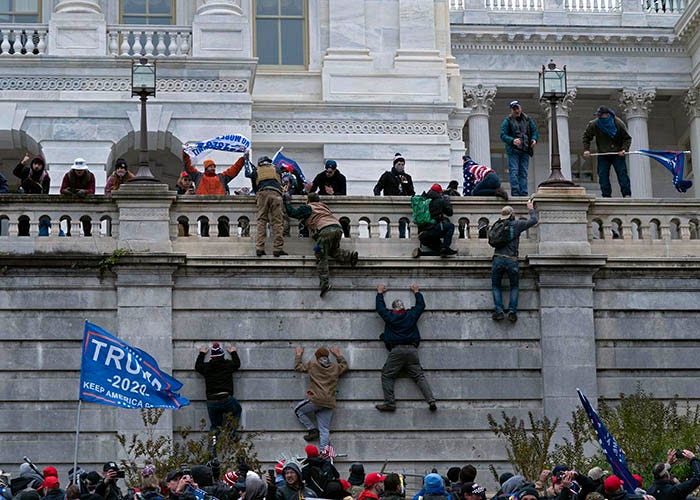
What is the real meaning of January 6?
Description
I’m sorry to intrude on your holiday week with this, but I want you to be prepared for what’s to come next week.
January 6 will be the first anniversary of one of the most shameful days in American history. On that date in 2021, the United States Capitol was attacked by thousands of armed loyalists to Donald Trump, some intent on killing members of Congress. Roughly 140 officers were injured in the attack. Five people died that day.
But even now, almost a year later, Americans remain confused and divided about the significance of what occurred. Let me offer four basic truths:
1. Trump incited the attack on the Capitol.
For weeks before the attack, Trump had been urging his supporters to come to Washington for a “Save America March” on January 6, when Congress was to ceremonially count the electoral votes of Joe Biden’s win. Without any basis in fact or law (60 federal courts as well as the Departments of Justice and Homeland Security concluded that there was no evidence of substantial fraud), Trump repeatedly asserted he had won the 2020 election and Biden had lost it.
“Big protest in D.C. on January 6th. Be there, will be wild!” Trump tweeted on December 19. Then on December 26: “See you in Washington, DC, on January 6th. Don’t miss it. Information to follow.” On December 30: “JANUARY SIXTH, SEE YOU IN DC!” On January 1: “The BIG Protest Rally in Washington, D.C. will take place at 11:00 A.M. on January 6th. Locational details to follow. StopTheSteal!”
At a rally just before the violence, Trump repeated his falsehoods about how the election was stolen. “We will never give up,” he said. “We will never concede. It will never happen. You don’t concede when there’s theft involved. Our country has had enough. We will not take it anymore.”
He told the crowd that Republicans are constantly fighting like a boxer with his hands tied behind his back, respectful of everyone — “including bad people.”
But, he said, “we’re going to have to fight much harder…. We’re going to walk down to the Capitol, and we’re going to cheer on our brave senators and congressmen and women, and we’re probably not going to be cheering so much for some of them, because you’ll never take back our country with weakness. You have to show strength, and you have to be strong…. We fight like hell. And if you don't fight like hell, you're not going to have a country anymore."
He then told the crowd that “different rules” applied to them. “When you catch somebody in a fraud, you are allowed to go by very different rules. So I hope Mike [Pence] has the courage to do what he has to do, and I hope he doesn’t listen to the RINOs [Republicans in Name Only] and the stupid people that he’s listening to.”
Then he dispatched the crowd to the Capitol as the electoral count was about to start. The attack on the Capitol came immediately after.
2. The events of January 6 capped two months during which Trump sought to reverse the outcome of the election.
Shortly after the election, Trump summoned to the White House Republican lawmakers from Pennsylvania and Michigan, to inquire about how they might alter the election results. He even called two local canvassing board officials in Wayne County, Michigan’s most populous county and one that overwhelmingly favored Biden.
He phoned Georgia’s