Episode Details
Back to Episodes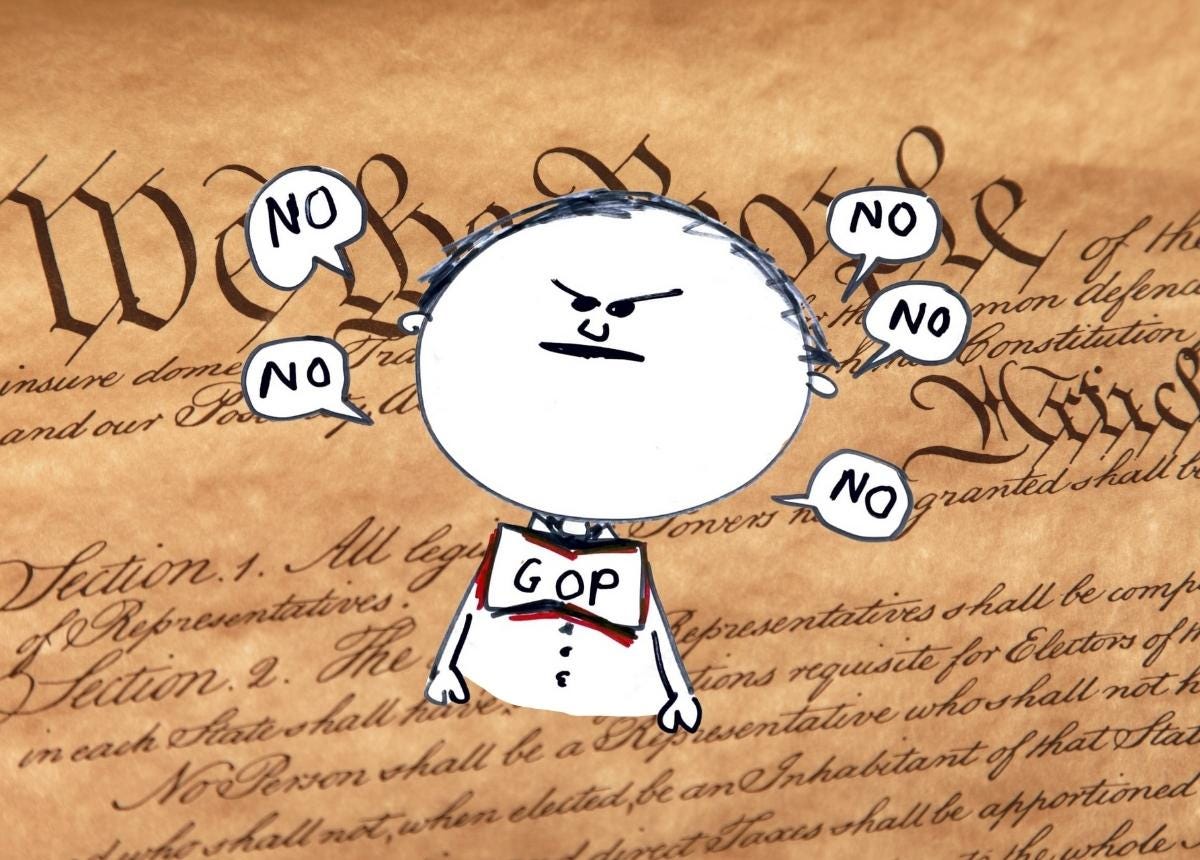
What would the Supreme Court's "originalists" think of the filibuster?
Description
Yesterday, a member of our group named Emmet Bondurant, a distinguished constitutional lawyer from Georgia, commented on this page about the filibuster:
The biggest lie of all is the Senate’s claim that it “is the greatest deliberative body in the world.” The filibuster makes the Senate the least deliberative legislative and least democratic legislative body by allowing a minority of Senators to prevent the Senate from debating, much less voting on, any legislation that is opposed by the minority party.
A decade ago, when Emmet and I served on the board of Common Cause, he brought a case before federal courts, arguing that the filibuster is unconstitutional. He didn’t get very far. (The Court of Appeals for the District of Columbia decided against Common Cause on dubious grounds, and the Supreme Court refused to hear the case.) But this was before the high court became crammed with so-called “originalists” who believe the Constitution should be interpreted to mean what the Framers thought when they drafted it.
Originalism is an absurd position, of course. American society is so different today from what it was in the eighteenth century that any attempt to apply precepts from that time to this time is doomed to failure. But why not test the sincerity of the originalists sitting on today’s Supreme Court with an issue that the Framers would find a no-brainer? All evidence suggests they would agree with Emmet that the filibuster violates the Constitution.
The Framers went to great lengths to ensure that a minority of senators could not thwart the wishes of the majority. After all, a major reason they convened the Constitutional Convention in 1787 was because the Articles of Confederation (the precursor to the Constitution) required a super-majority vote of nine of the thirteen states, making the government weak and ineffective.
This led James Madison to argue against any super-majority requirement in the Constitution the Framers were then designing, writing that otherwise “the fundamental principle of free government would be reversed,“ and “It would be no longer the majority that would rule: the power would be transferred to the minority.” And it led Alexander Hamilton to note “how much good may be prevented, and how much ill may be produced” if a minority in either house of Congress had “the power of hindering the doing what may be necessary.”
This is why the Framers required no more than a simple majority in both houses of Congress to pass legislation.
They carved out only five specific exceptions requiring a super-majority vote only in rare, high-stakes decisions: (1) impeachments, (2) expulsion of members, (3) overriding a presidential veto, (4) ratification of treaties, and (5) amendments to the Constitution. By being explicit about these five exceptions to majority rule, the Framers underscored their commitment to majority rule for the normal business of the nation. They would have rejected the filibuster, through which a minority of senators continually obstructs the majority.
So where did the filibuster come from? The Senate needed a mechanism to end debate on proposed laws and move to a vote. The Framers didn’t anticipate this problem. But in 1841, a small group of senato