Episode Details
Back to Episodes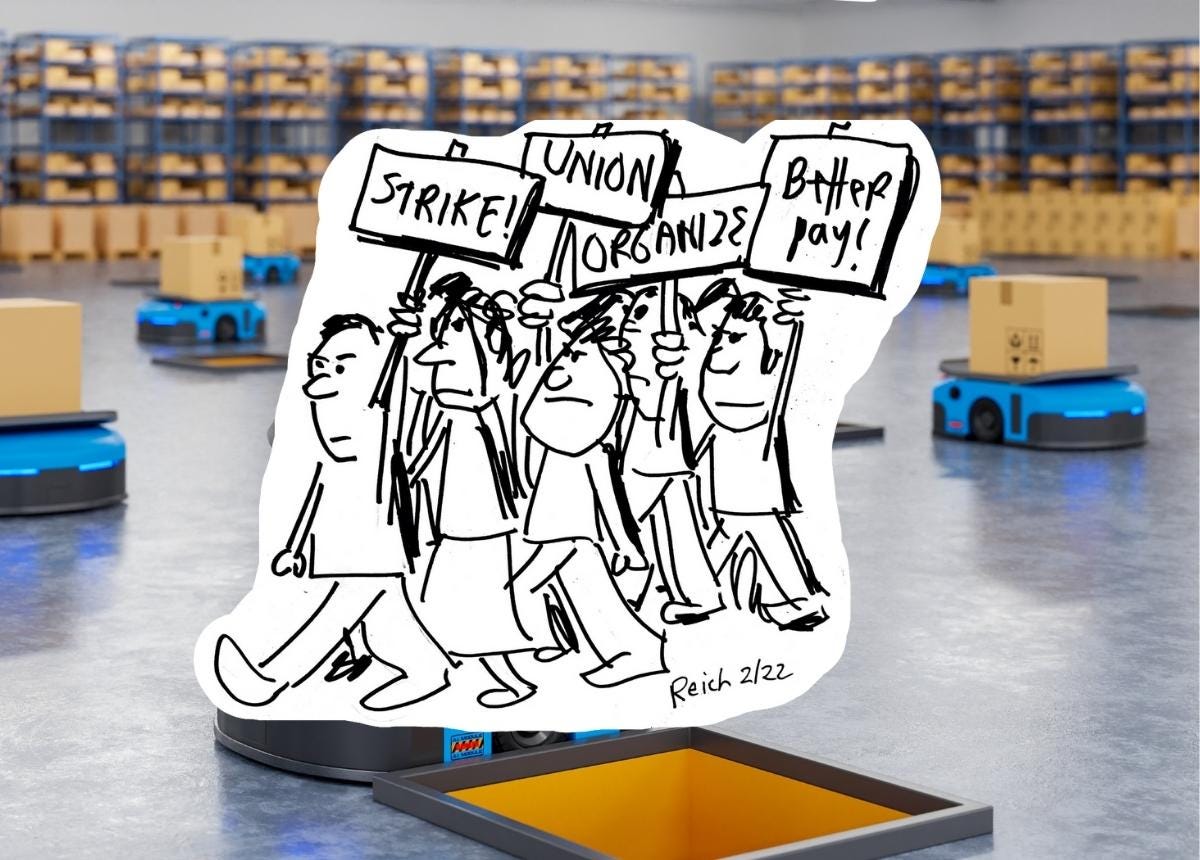
So you don't think labor unions have a future?
Description
As former secretary of labor, I’m always interested in the annual count of unionized workers issued by the Bureau of Labor Statistics. This year’s count shows that the 70-year decline of unions continues. The share of unionized American workers dropped from 10.8 percent last year to 10.3 percent now. The rate among private-sector workers hit a new rock bottom of 6.1 percent — about one-seventh of its level in the middle of the 20th century.
How to square this with the huge surge in labor activism that began last fall? From Alabama to the Midwest to California, workers have headed to the picket lines. 10,000 John Deere workers. Over 1,000 Alabama coal miners. New York City taxi drivers. Health care workers. Food production plant workers at multiple companies. Workers at media outlets, think tanks, museums, and universities. At worksites staffed predominantly by millennials and GenZ’s — among whom support for unions hovers near 80 percent — unionization is soaring (Starbucks baristas, graduate student workers, and so on).
Oh, and public support for unions is at a 50-year high.
The answer to this seeming paradox is found in the law.
The 1935 National Labor Relations Act (NLRA) once ensured workers’ right to form unions and bargain collectively. But the Act has been steadily weakened by the 1947 Taft-Hartley Act, court decisions, Ronald Reagan’s repudiation of unions, and decades of inaction by Democratic politicians.
Today, corporations typically intimidate and even fire workers seeking to unionize. These tactics are illegal under the NLRA, but companies don’t care because the penalties are small — at worst, rehiring and giving backpay to workers who have been fired, and allowing new elections. Many companies consider these little more than costs of doing business. (Consider last year’s failed organizing drive at Amazon’s Bessemer, Alabama warehouse, when the company intimidated its workers into rejecting the union.)
Both Bill Clinton and Barack Obama promised they’d make it easier for workers to unionize by pushing legislation to increase penalties against employers who violate the Act and speed the process of forming unions. But neither followed through on those promises, even though both had Democratic congresses during their first two years in office.
Why didn’t they follow through? I know because I spoke with each of them (and tried to get Clinton to support such legislation). They didn’t want to spend the political capital necessary to get the legislation through Congress. They also took union voters for granted. “Who else are they going to vote for?” I was told over and over again by political advisers to Clinton and Obama.
This has proven to be a huge mistake. Unionized workers used to be the ground troops of the Democratic Party. And they made sure Democrats paid attention to the concerns of America’s working class — which is why we have a 40-hour workweek, unemployment insurance, a minimum wage, Medicare and Medicaid, and the Affordable Care Act.
Now, much of the non-college working class votes Republican. These voters no longer believe Democratic politicians are on their side, and have succumbed to GOP-Fox News cultural and racial paranoia.
At least Joe Biden made his promise to strengthen unions tangible by supporting the Protecting the Right to Organize Act (also known as the PRO Act). It passed in the House earlier this year. But — as with Build