Episode Details
Back to Episodes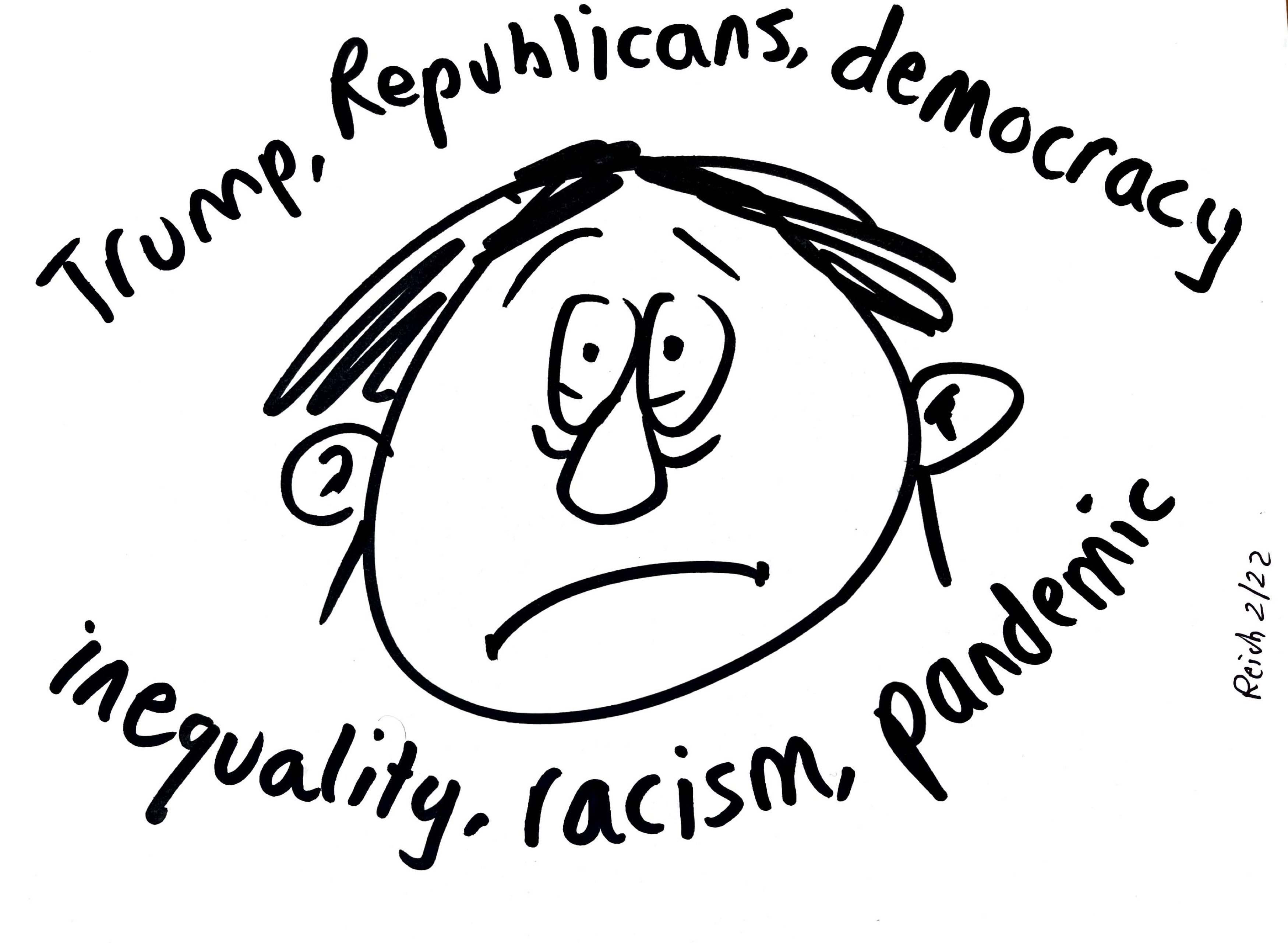
How can we be so publicly miserable and so privately happy?
Description
Many people tell me America is going to hell.
But when I ask them how their own lives are going, they say pretty well.
This discrepancy between how people feel about America’s public life and their own private lives is wider today than it’s been since the late 1960s. Then, our public life was marked by assassinations, riots, an escalating war in Vietnam, and the deeply flawed Lyndon Johnson and Richard Nixon. But our private lives featured love-ins, Woodstock, and the Beatles. (I know; I was there.)
The latest Gallup poll show that just 17 percent of Americans are satisfied with the way things are going in the country. That’s the lowest percent since Joe Biden became president – and it coincides with his lowest job approval rating, as well as a rock-bottom 18 percent congressional job approval, sagging economic confidence, and the expectation that inflation will rise in the coming months.
But wait. At the same time we’re so down on America, our satisfaction with our own lives has ticked up to 85%. That’s just five points shy of the January 2020 record-high point. Take a look:
Why such a huge gap between public and private now?
It’s easy to understand why we’re so dissatisfied with the way things are going in America. The news from the mainstream media is unrelentingly bad — and those negatives are amplified by an angry, nasty (and often paranoid) social media. We’ve endured more than two years of a deathly pandemic, with all its accompanying confusions and fears. Inflation is high. Politics is meaner and more partisan. An astonishingly large portion of the country seems to have turned Trumpish. And last year’s high expectations for helpful measures from Biden and the Democrats have been dashed by Manchin, Sinema, and senate Republicans.
But given this, how can we be so satisfied with the way things are going in our personal lives?
Plenty of us remain hugely stressed – essential workers, parents of young kids who aren’t able to get childcare, poor people who can’t afford the rent, those of us who have gotten horribly sick or lost loved ones during the pandemic.
Yet the pandemic has also allowed almost half of us to work from home, which has proven to be a huge boon -- giving us, on average, a full extra hour each day, far more flexibility in how we use our time, and escape the daily agonies of commuter traffic. While I’d rather teach in person, I far prefer to attend all tiresome meetings on Zoom rather than in bland conference rooms.
We’re also spending less money on stuff, partly because we can’t afford it but also because we can’t get it Supply bottlenecks are forcing us to do without — and to simplify our lives as a result. My TV set is tiny by today’s standards, my car is a dozen years old, and my dryer doesn’t work half the time. But guess what? I can live without them. I’m exercising more, listening to more music, started to learn another language.
We can’t socialize as much — but this has forced us to be choosier about whom to spend our time with, allowing us to deepen those relationships. My wife and I are doing more together, just the two of us. I’ve seen more of my close friends and less of people I merely feel obliged to see.
We also worry less about clothing, haircuts, makeu