Episode Details
Back to EpisodesWitchcraft in Southern Italy
Description
In southern Italy, belief in witchcraft has a long history, much of it centering on the town of Benevento, about 30 miles east of Naples.
From a 1428 testimony by accused witch Matteuccia da Todi, we have the first mention (anywhere in Europe) of witches flying to their sabbats — their gathering spot, in this case, being Benevento. Matteuccia was also the first to speak of flying ointment as a means to achieve this. We include a musical setting by the southern Italian band Janara of the incantation that was spoken while applying the ointment.
Sermons of the Franciscan monk Bernardino of Siena seems to have introduced the idea of Benevento as a mecca for witches, mentioning a certain tree as the center of these gatherings, one later identified as a walnut.
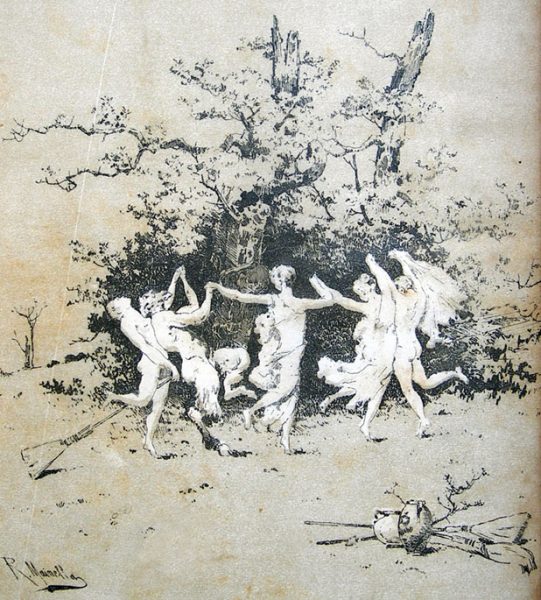
Though no tradition around a specific location for this tree has survived in Benevento, the legend has been wholeheartedly embraced by the local distillers of Strega (witch) liqueur, created in 1833 and now distributed worldwide. This seems to have been part of a 19th-century revival of interest in the legend, which saw the composition of a popular poem, “The Walnut Tree of Benevento,” which added a serpent living in the tree’s branches, and probably inspired Niccolo Paganini to compose his signature piece, Le Streghe, (The Witches) from which we hear a snippet. (Yes, that’s a real clip about Strege liqueur and elections from the film Kitty Foyle).
What really locked down the local mythology was an essay written in 1634 by Benevento’s chielf physician, Pietro Piperno, one titled “On the Magical Walnut Tree of Benevento.” This is the first mention of the species of tree in question. Piperno also places the walnut at the center of a curious rite conducted by the Lombards occupying the region in the 10th century, a rite he sees as a model for the Benevento witch tales of his own day. Mrs. Karswell also reads for us a retelling from Piperno’s text of a hunchback who stumbles upon a sabbat, only to have the hump on his back magically removed.
The discovery of a the ruins of a temple to Isis in Benevento in 1903 led to further speculation as to possible origins of the region’s witchcraft myths, but it was the Roman goddess Diana most strongly associated with southern Italy’s witches, in part because the name used there for a type of witch is janara, believed to come from the Latin dianara, a servant of Diana.
We hear snippet form a 2015 Italian horror film called Janara (retitled in English “The Witch Behind the Door”), a bit abou