Episode Details
Back to EpisodesGrottos: Caves of Wonder
Description
Grottos are a peculiar subset of caves, usually small and picturesque, and often associated with wonders both otherworldly and manmade.
NOTE: Details on our Patreon raffle for the 15-disc set, All The Haunts Be Ours: A Compendium Of Folk Horror, are at the bottom of this post.
We begin with what is likely the best known example of the sacred grotto, the Catholic shrine at Lourdes, France, where in 1858, the Virgin Mary was said to have appeared to a 14-year old Basque girl by the name of Bernadette Soubirous. Particularly of interest to our show is the regional folklore that provided a background for these apparitions, especially the association between a variety of supernatural beings and caves.
While the grotto at Lourdes is a natural structure, the grottos we examine through the rest of the show are artistic constructions, the first of these being the “grottos”formerly created by British children on Grotto Day. The choice of material for constructing these is oyster shells, as the day coincides with the Feast of St. James, patron of oyster harvesters. The connection between St. James and shells is explored via the pilgrimage route leading to his tomb, the Camino de Santiago de Compostela, one for which the symbol of the “pilgrim’s scallop” serve as prominent way-markers.
We then move into the classical world to examine the nymphaeum, a grotto dedicated to the nymphs, specifically the Naiads or water nymphs, a combination of cave and spring as was the case with Lourdes. From this Greek concept grew the Roman notion of the purely secular “pleasure grotto,” such as the famous (and ill-fated) example created by Emperor Tiberius for his villa on the Italian coast at Sperlonga. Mrs. Karswell reads some remarks by the historian Suetonius on this.
After hearing a bit from the 15th-century architect Leon Battista Alberti on a revived interest in artificial grottos during the Renaissance, we look at the grotto’s evolution into the “water theaters” of the 16th and 17th century, their “trick fountains” and water-driven automata. Here we citing two Italian examples (Villa Aldobrandini in Frascati and Tivoli Gardens in Florence) and one from Austria, Saltzburg’s Hellbrunn Palace.
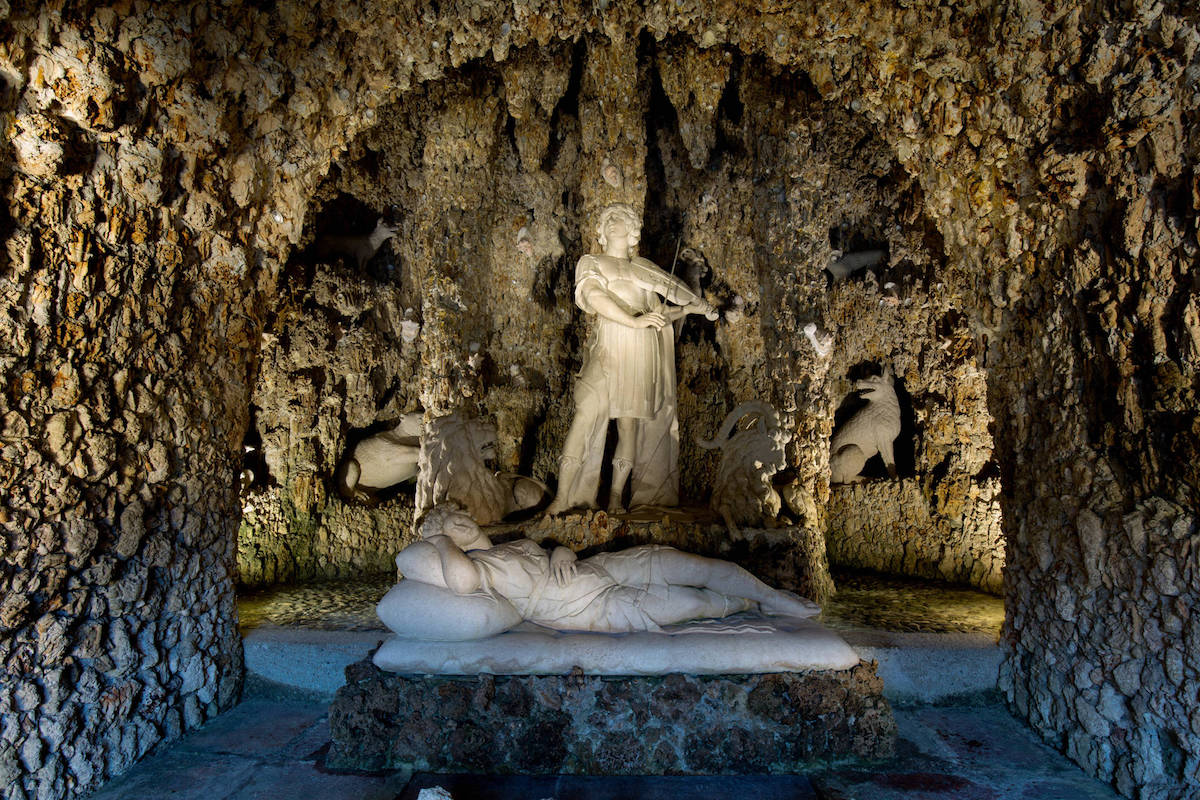
We then hear a bit about the return during the Romantic era to the earlier classical preference for constructing grottos that simulated natural caves, hearing in this case a quote from the British poet and satirist Alexander Pope enthusing over his grotto completed in 1725. We also hear about England