Episode Details
Back to Episodes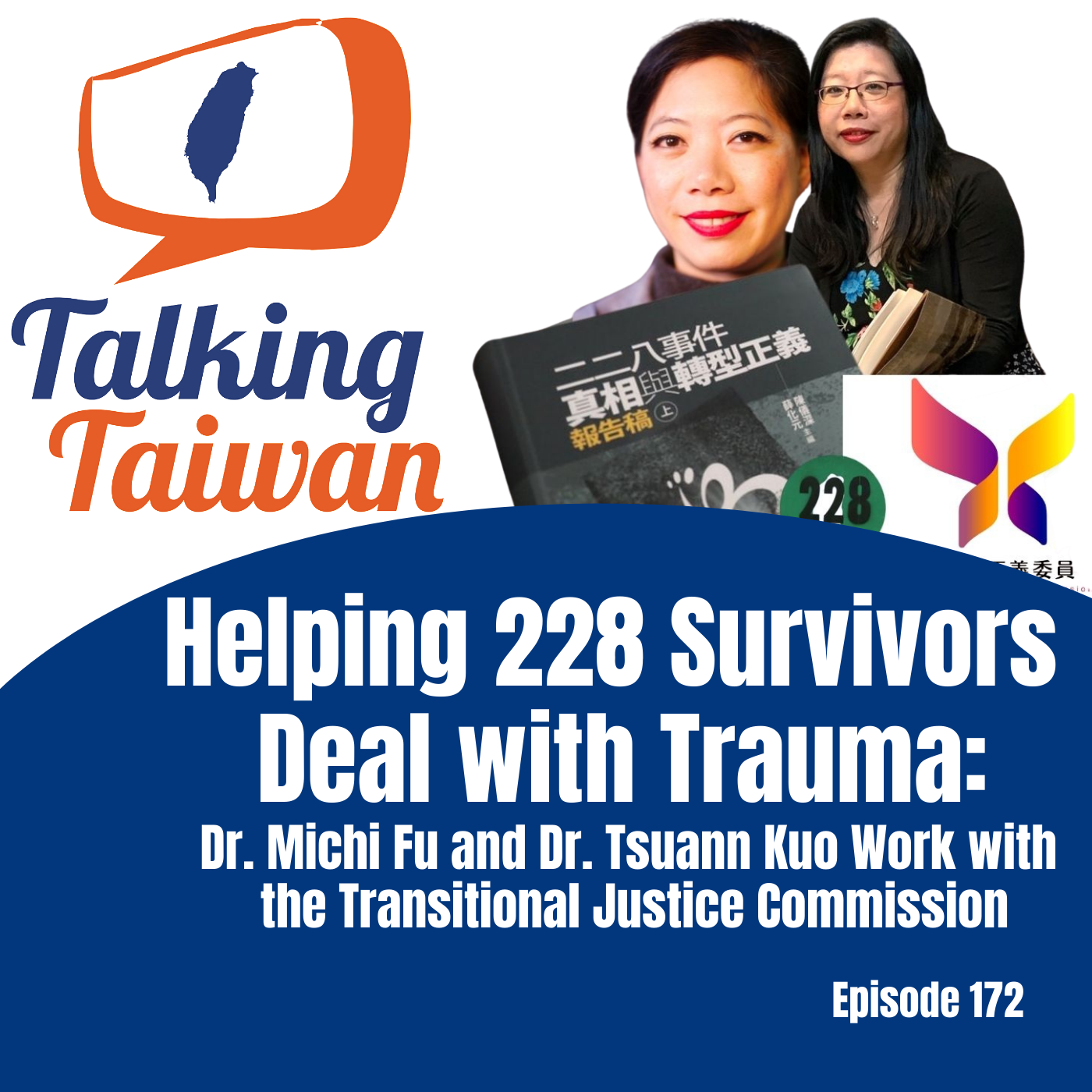
Ep 172 | Helping 228 Survivors Deal with Trauma: Dr. Michi Fu and Dr. Tsuann Kuo Work with the Transitional Justice Commission
Description
Last week we talked about the lasting impact of 228. Under the subsequent authoritarian rule of the Chiang regime, there was 38 years of martial law and the White Terror era. Anyone could be disappeared, executed or worse for just saying or doing the wrong thing, or for what was seemingly wrong in the eyes of the authorities. The people of Taiwan were horrified and terrified. Generations dared not speak of 228.
If you haven't already listened to last week's episode, I encourage you to listen to it first to understand the trauma that 228 has inflicted on generations of Taiwanese.
My guests on this week's episode will talk about some of the ways they have helped 228 survivors and their relatives to start to heal their trauma.
I am welcoming back Dr. Michi Fu and Dr. Tsuann Kuo to talk about the work they did with the Transitional Justice Commission's "caring projects" that were set up specifically to help 228 survivors and their relatives. Three sites were set up for the "caring projects" and Tsuann and Michi were at the Taichung site at the end of 2020 up until February 28, 2021. Please note that the comments and experiences they share are limited to the work that they did through the "caring project" in Taichung and their personal opinions. They are not representing the Transitional Justice Commission, which as you'll hear in the interview, has a much broader scope with five main objectives.
The Transitional Justice Commission was set up in 2018 to investigate the actions taken by the Kuomintang between 15 August 1945 and 6 November 1992 (This includes 228, the martial law era and White Terror era).
Special thanks to Michi for her help in assembling all the guests for this episode and the previous one, both dedicated to discussing the topic of 228.
This episode of Talking Taiwan has been sponsored by the Taiwan Elite Alliance 優社 and the Taiwanese United Fund.
The Taiwan Elite Alliance 優社was established in 2000 to promote Taiwanese and Taiwanese American arts and literature, and to protect and enhance the human rights, freedom and democracy of the people in Taiwan.
The Taiwanese United Fund is an arts and culture foundation that celebrates the cultural heritages of Taiwanese Americans. Established in 1986, the foundation's mission is to facilitate cultural exchange between the Taiwanese American community and other American cultural communities, hoping to enrich and expand our cultural experiences. To learn more about TUF visit their website http://www.tufusa.org/
About this episode's guests
Dr. Michi Fu is a second-generation Taiwanese American and a NATWA II member. She became a Taiwanese citizen after spending a sabbatical year as a mid-life adult. As a Taiwanese returnee, identity politics was an inevitable part of the ethnic identity development process. As such, she has been educating herself on Taiwanese history, including the 228 Massacre, that her family has traditionally remained silent about.
Tsuann Kuo, Ph.D. was trained as a gerontologist and has had both clinical and managerial work experiences in the United States