Episode Details
Back to Episodes2028 Volkswagen Golf R Gets an Electric Supercharger to Cut Turbo Lag
Description
An electric Volkswagen Golf may be unnecessary for now, but as more stringent emissions regulations go into effect in Europe, the entire world is about to benefit from an electrified hot hatch anyway. Speaking with Auto Express, Volkswagen’s head of R products, Reinhold Ivenz, announced that the Golf R “will […] change in the middle of next year with Euro 7 [emissions regulations].” While chasing efficiency was a chief priority, Ivenz added that the new turbocharged powertrain will also deliver “more power” (he means torque) from zero rpm and be quicker than the current Golf R it replaces, thanks, in part, to an electrically driven supercharger. But that’s not all.
2028 VW Golf R: More Fuel Pressure Than a Ferrari
The engineers behind modern high-performance turbocharged engines are constantly trying to find ways to improve the atomization of air/fuel mixtures for a cleaner burn, and one of the keys to achieving this is an incredibly high rate of fuel delivery. The 3.0-liter twin-turbo V6 in a Ferrari F80 hypercar, for example, directly injects fuel at 350 bar, or roughly 5,076 psi, and the revised Golf R’s 2.0-liter four-cylinder eTSI EA888 setup (expected to closely mirror the evo5 powertrain of the recently unveiled T-Roc R) will go even further: 500 bar, or approximately 7,251 psi. Here, a 48-volt mild-hybrid starter-generator replaces the conventional alternator, while an electrically powered compressor, or supercharger, reduces lag on a new variable geometry turbocharger, helping make the most of that extra fuel pressure.
The T-Roc R’s peak torque arrives at 1,900 rpm, down from 2,100 in the evo4 engine, and while the peak figure of 328 horsepower is no greater than before, the crossover’s 310 lb-ft is an improvement over the hatch’s 295 lb-ft, a torque bump the Golf R will likely benefit from. Finally, the iron block is designed around the Miller combustion cycle, which closes the intake valves early in the intake stroke to help cool the air within the cylinders before compression starts. Expanded and cooled, the air helps reduce combustion temperatures more efficiently than intentionally running rich (dumping extra fuel in the combustion chamber) would.
Autoblog’s Take
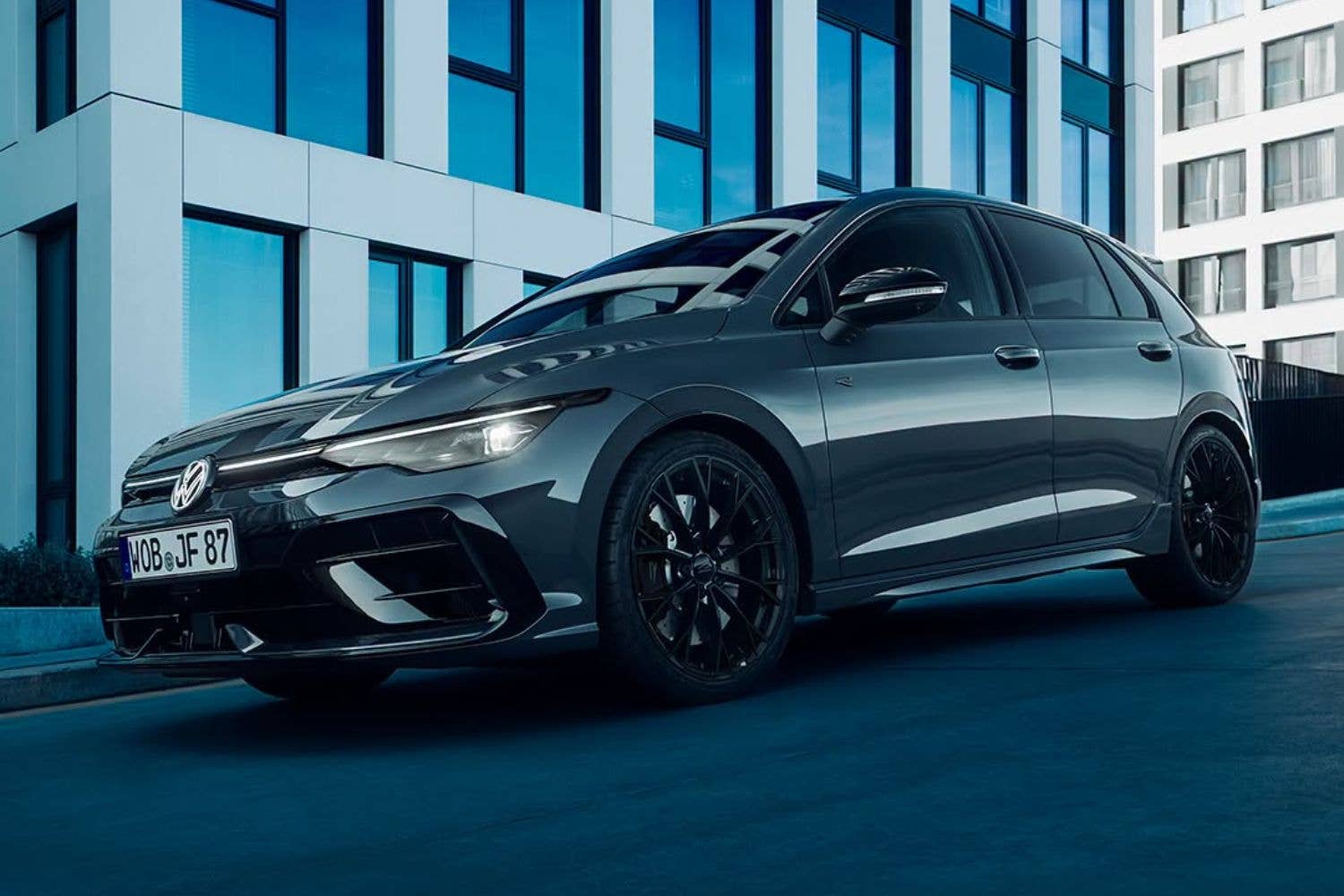
Volkswagen
As a result of all these measures, Volkswagen is targeting stoichiometric combustion, where λ=1, or an ideal air-fuel ratio of approximately 14.7:1 (for gasoline; other fuels have different energy densities). Also known as theoretical combustion, it means VW expects the engine to completely burn all the oxygen and gasoline it pumps into a cylinder, neither running lean (λ > 1.0) and potentially causing engine knock, nor running rich (λ < 1.0) and wasting fuel. This is how the GTI and R wi