Episode Details
Back to Episodes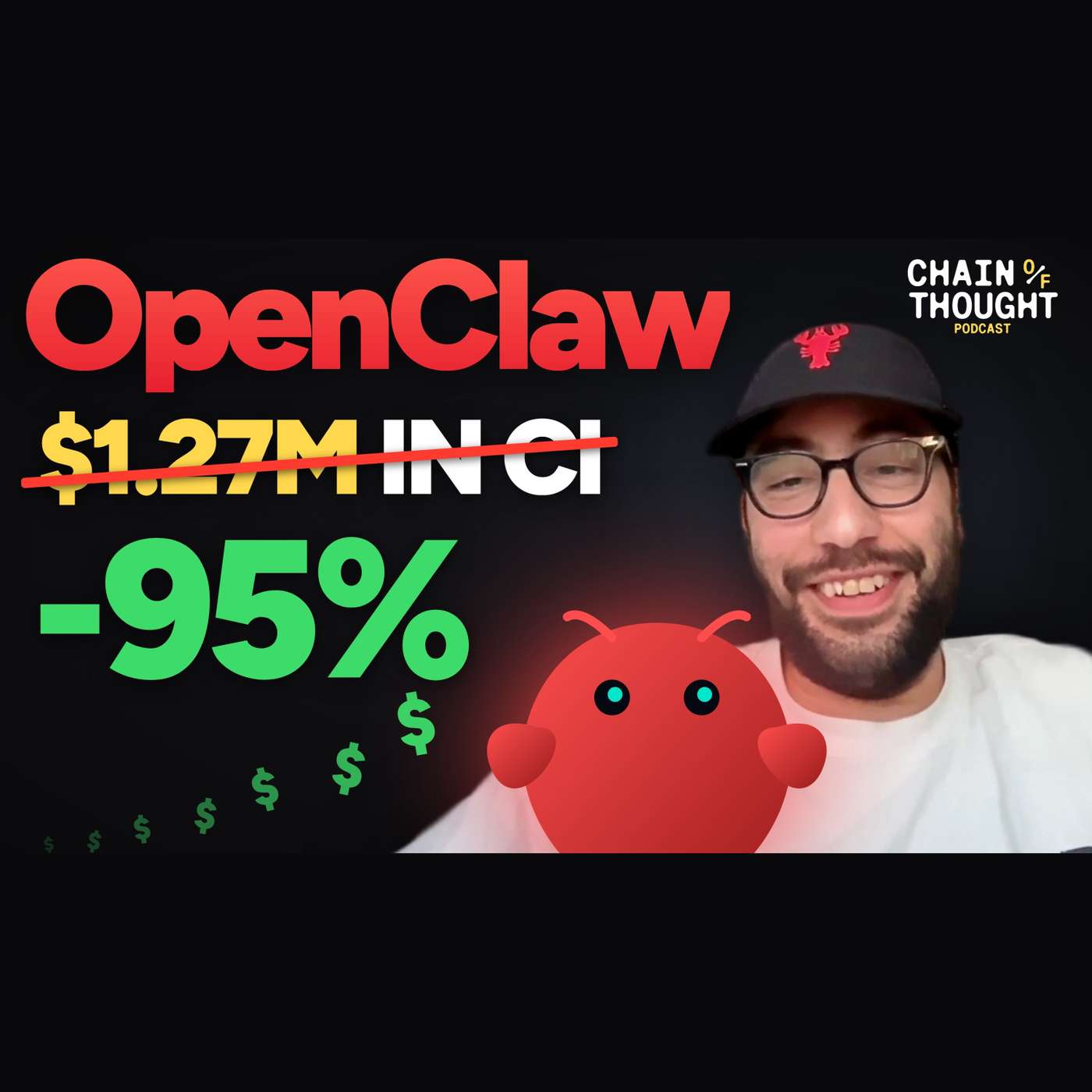
How OpenClaw Cut Their $1.27M CI Bill by 95% and Unlocked Multiplayer AI with Chief Architect Vincent Koc
Description
To celebrate one year of OpenClaw, we sat down with its Chief Architect, Vincent Koc.
OpenClaw merges thousands of pull requests a day. When the CI bill got astronomical and the companies donating the compute said it couldn't stay free, Vincent Koc had about two weeks to fix it.
His biggest lever was running only the tests a change needs, based on what each change touched and what broke before; other optimizations had already cut test volume by half or more. Together, his write-up puts OpenClaw's CI compute at an estimated $1.27M a month at list prices in the peak week, and about $57K a month now: a 95% cut. GitHub and Blacksmith donated the runners, so nobody paid that list price, but the pressure was real.
OpenClaw is the open-source personal AI assistant run by the nonprofit OpenClaw Foundation. Vincent tells Conor why every team building a software factory will hit the same CI wall, a couple of months behind OpenClaw, and how OpenClaw went multiplayer: a team working with the same agents at the same time.
We cover:
- Why the bottleneck moved from code review to CI, and how a CI that chokes drags down agent cycle time until everything grinds to a halt
- Applying DORA metrics to agents: timing every pull request from open to merge
- Proof engineering, and why models built to generate code have to be pushed to delete it, including a million lines of tests
- Running a fleet of devices where agents move work to whichever machine has the disk and memory
- Background "gardening" agents that watch logs for tool failures and upstream the fixes
- How multiplayer started: a shared terminal session with five or six people, where the model could only reply with a full stop
- Why Vincent treats his agent as a tool, not a pet, and why OpenClaw stays maximally configurable
- A flood of AI-generated security reports, and the "fixes" that broke the product
- ClawCon in Shenzhen, hackable badges, and Vincent's spin on the Qwenputer, a CPU inside a Qwen model's weights: he got it running Pokemon Red
Vincent's CI write-up: https://vincent.build/openclaw-ci-cost-reduction/
Connect with Vincent Koc:
Twitter/X: https://x.com/vincent_koc
Website: https://vincent.build
GitHub: https://github.com/vincentkoc
OpenClaw: https://openclaw.ai
OpenClaw on X: https://x.com/openclaw
Connect with Chain of Thought host Conor Bronsdon:
Newsletter: https://newsletter.chainofthought.show/
Twitter/X: https://x.com/ConorBronsdon
LinkedIn: https://www.linkedin.com/in/conorbronsdon/
YouTube: https://www.youtube.com/@ConorBronsdon
More episodes: https://chainofthought.show
Chapters:
(0:00) Cutting a $1.27M CI bill by 95%
(1:04) Why fast AI change is an opportunity
(4:19) Keeping product taste by watching users
(10:21) Applying DORA metrics to agent PRs
(13:38) Making agents delete code with confidence
(16:42) Devices, compute and daily driver models
(25:05) Background gardening agents and abstraction
(31:07) Where the OpenClaw foundation goes next
(33:05) Multiplayer AI and agents that negotiate
(43:31) AI security reports and slop fixes
(46:12) ClawCon Shenzhen and hackable badges
(49:35) A CPU inside model weights
Thanks to Inngest, presenting sponsor of season four of Chain of Thought. Agents in production run long - they call models and wait on APIs and people. But the longer agents run, the more they break. Inng