Episode Details
Back to Episodes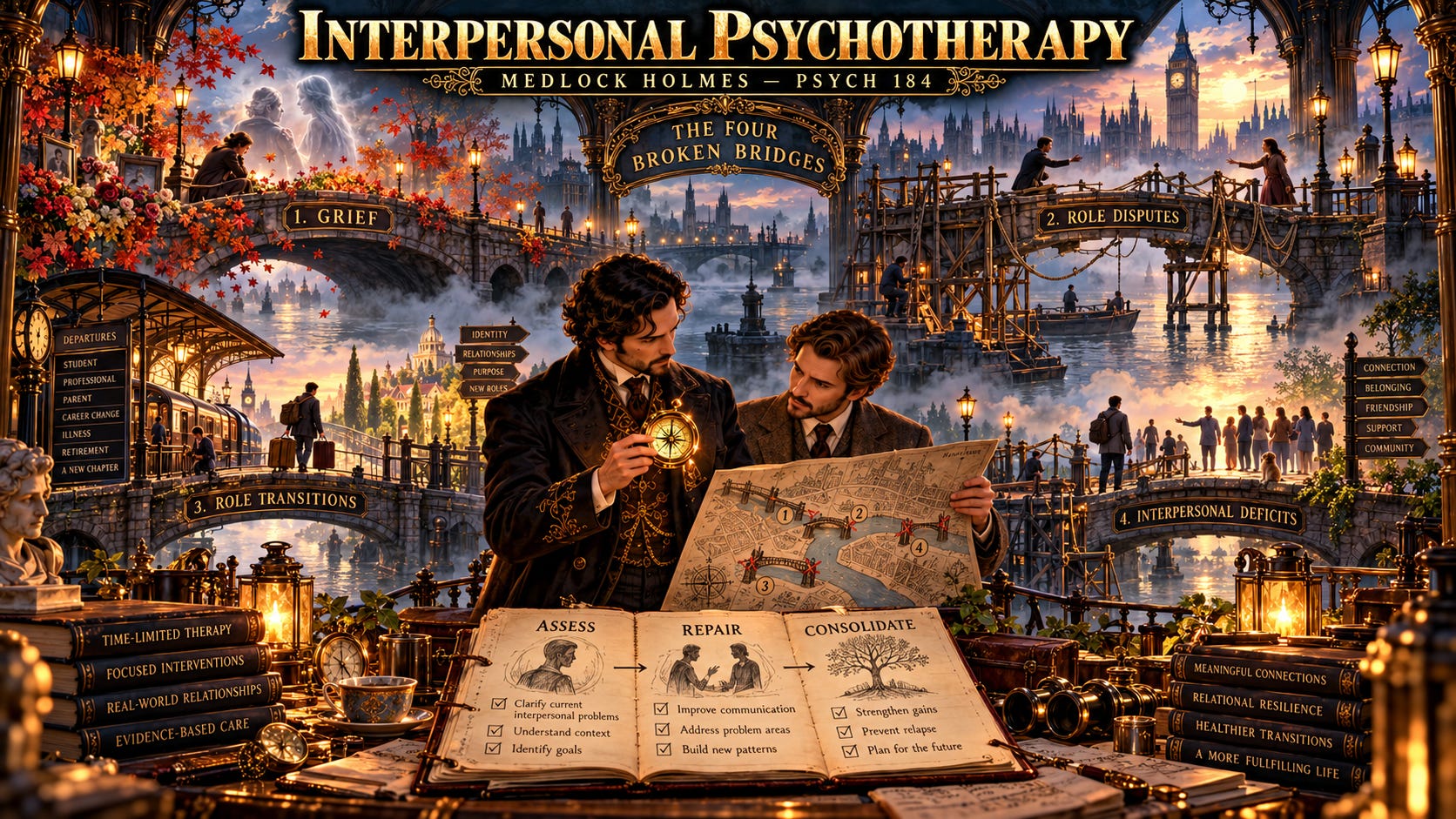
PSYCH 184: Interpersonal Psychotherapy
Description
The fog lay thick over London when Dr Watson received an invitation bearing the seal of the Royal Society of Human Relations.
Four citizens had presented with melancholia. Four lives had become entangled in suffering. And four bridges, once connecting the inhabitants of an extraordinary neighbourhood, had mysteriously fallen into disrepair.
“An architectural mystery, Holmes?” Watson enquired.
“Perhaps,” replied Medlock Holmes. “But I suspect the bridges are not made of stone alone.”
Their first destination was The Bridge of Remembrance.
A widow stood at its edge, clutching a photograph of her husband.
“Since his death, I have stopped visiting friends,” she explained. “Every happy moment feels like a betrayal.”
Watson looked concerned. “She has been unable to move beyond her grief.”
“Then we must not demand that she move beyond it,” Holmes replied. “We must help her mourn what she has lost, remember the relationship in its fullness, and discover how life may accommodate both remembrance and renewed connection.”
He wrote the first word in his notebook:
GRIEF.
The second bridge was surrounded by the sounds of an argument.
A husband and wife stood on opposite banks, each convinced the other had abandoned their responsibilities.
“He never listens!”
“She expects me to know what she wants without telling me!”
Holmes approached them.
“Tell me, what does each of you believe the other should provide?”
As they spoke, it became clear that neither understood the other’s expectations.
“An interpersonal role dispute,” Holmes observed. “The task is not to determine a villain, but to clarify the disagreement, examine communication and explore whether the relationship can be renegotiated.”
He inscribed the second word:
DISPUTE.
At the third bridge, they encountered a recently retired schoolmaster.
“For forty years I was a teacher,” the man said. “Now I wake each morning without purpose. I no longer know who I am.”
Watson nodded sympathetically. “He has lost his occupation.”
“More than that,” Holmes replied. “He has lost a familiar identity, routine and social position. He must mourn his former role while learning to inhabit another.”
The third inscription appeared:
TRANSITION.
Their final destination was the most desolate.
A young woman sat alone beside a bridge that had never been completed.
“I have no one to call,” she whispered. “Whenever I try to make friends, something goes wrong. Eventually, I stop trying.”
Holmes sat beside her.
“Then our investigation must examine how relationships begin, how they become difficult, and what might help them develop differently.”
He wrote:
INTERPERSONAL DEFICITS.
That evening, Holmes and Watson returned to Baker Street.
“Four patients,” Watson reflected. “Four distinct difficulties. Yet all suffered from depression.”
“And therein lies the principle of interpersonal psychotherapy,” Holmes replied. “Psychiatric symptoms and interpersonal circumstances influence one another. By improving the relationships and social roles surrounding a person’s distress, we may help alleviate the distress itself.”
Holmes spread a map across the table.
It showed three stages of repair.
First, The Survey: identifying symptoms, examining important relationships and agreeing which bridge required attention.
Second, The Restoration: exploring emotions, analysing communication and practising changes in real relationships.
Third, The Handover: reviewing what had improved, preparing for future difficulties and saying goodbye to the person who had helped with the repairs.
“But surely the patient becomes attached to the therapist,” Watson observed.
“Naturally. And the ending of treatment may itself evoke grief. We must not conceal the approaching farewell. We must prepare for it