Episode Details
Back to Episodes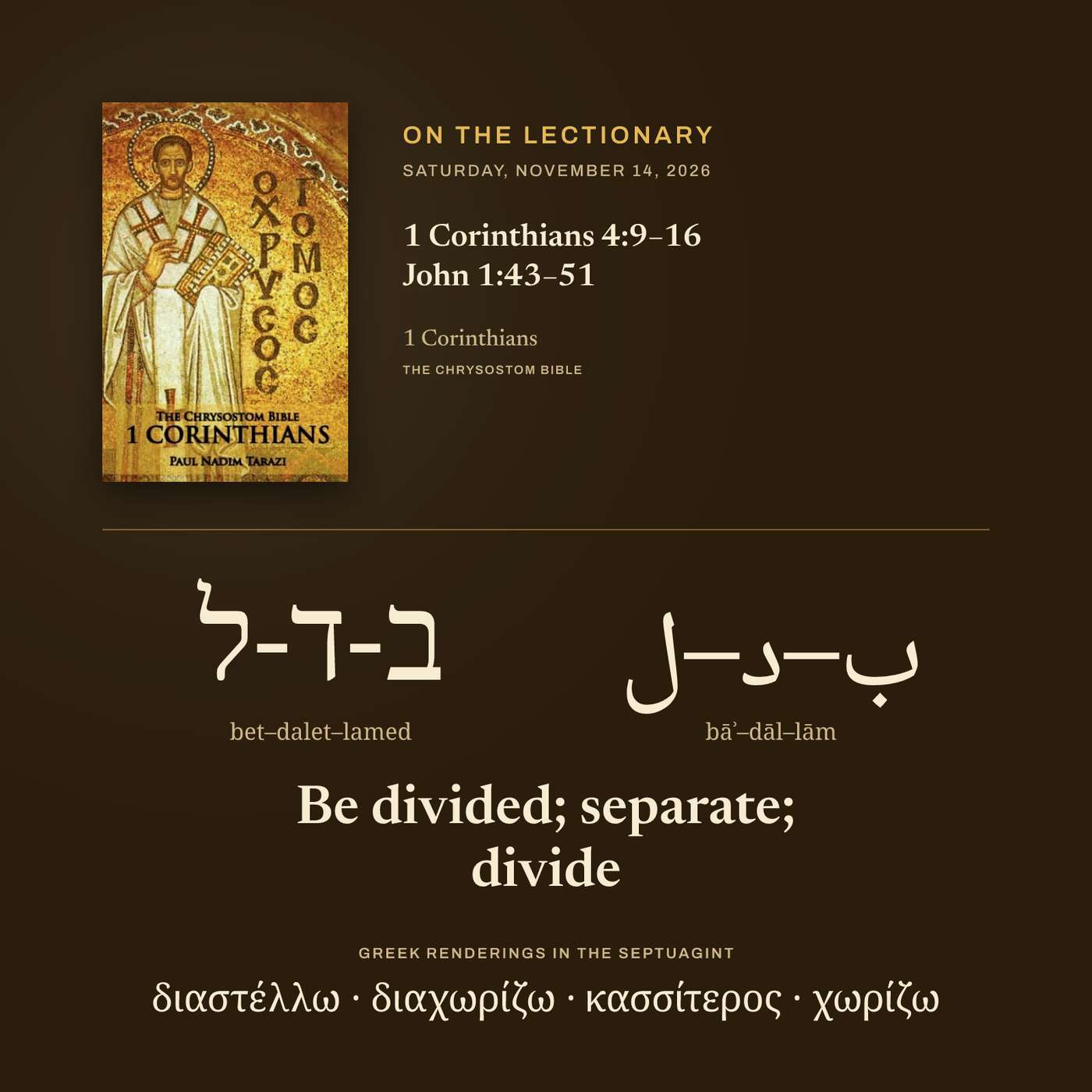
1 Corinthians 4:9-16 · John 1:43-51 · 2 Corinthians 11:1-6 · Luke 9:37-43 — Saturday, November 14, 2026
Description
A daily note from the team at OCABS.ORG, drawing on the published works of Fr. Paul Nadim Tarazi, with citations to his books and lectures.
Readings: 1 Corinthians 4:9-16; John 1:43-51; 2 Corinthians 11:1-6; Luke 9:37-43.
Paul's list of hardships in 1 Corinthians 4:9-16 is not a complaint about bad luck but a description tied directly to his apostolic labor. Fr. Paul notes that the six verbs forming three pairs describe "the apostle's beneficent response to aggressive behavior on the part of the world," and that the closing image of being treated as refuse alludes to gladiators thrown into the arena for the crowd's entertainment. The want, hunger, and homelessness are, in Fr. Paul's reading, "actual and thus real, not psychological or perceived," and the verb for labor specifically marks the taxing effort of preaching the gospel.
Because Paul alone brought the Corinthians the gospel, he alone is their father, while other leaders are only pedagogues, slaves who escorted children to school. Fr. Paul observes that a pedagogue could threaten or beat the children in his charge, which prepares for Paul's later question about coming to them with a rod, and that since a person can have only one father, Paul's plea to be imitated is a parent's urging, not an authority contest among teachers. This same father-child language returns in 2 Corinthians, where Paul describes his jealousy over the church he betrothed to Christ as a pure bride, fearing that, as the serpent deceived Eve, the Corinthians' minds might be led away from sincere devotion to the one gospel Paul preached and toward a different Jesus, spirit, or gospel brought by others.
On the Gospel, the lecture on John stresses the names of those called: Nathanael, called "an Israelite indeed, in whom is no deceit," a phrase Fr. Paul says is the same kind of language Paul uses of himself. Fr. Paul reads Philip, whose name is Greek, as representing the mission to the Gentiles, and Nathanael's name, meaning "God gives" or "God's gift," as reflecting the Jewish leadership's view of their election as recipients of God's gift in the Torah; Nathanael's doubt that anything good can come from Nazareth voices that same leadership's perspective before it yields to recognition of Jesus.
The root pair of the day · ב-ד-ל bet–dalet–lamed, בָּדַל badal · ب–د–ل bāʾ–dāl–lām, بَدَّلَ baddala · be divided; separate; divide. The root pair of the day, as in the Triliteral Root of the Day: בָּדַל (badal) and بَدَّلَ (baddala), be divided; separate; divide. Hear every passage of the pair at ocabs.org. cf. The Consolation of Consonants
Sources: Tarazi, 1 Corinthians: A Commentary, p. 93; Tarazi, 1 Corinthians: A Commentary, p. 93; Tarazi, 1 Corinthians: A Commentary, p. 95; Orthodox Audio Bible Commentary, John (vol. 43), part 1, at 53:41; Tarazi, The New Testament: An Introduction, vol. 3, Johannine Writings, p. 147; Tarazi, 2 Corinthians: A Commentary, p. 196; Tarazi, 2 Corinthians: A Commentary, p. 195; Tarazi, 2 Corinthians: A Commentary, p. 197.
Opening music: Taksim Arbi, Bichi Slama, oud (Tunis, Archives de la Parole, 1930s), public domain. Source: gallica.bnf.fr / BnF.
The digital voice Fāṭima (فَاطِمَة) is named in honor of the learned women of al-Andalus, particularly Fāṭima bint Yaḥyā al-Maghāmī, Fāṭima al-Sharrāṭ, and Fāṭima bint al-Muthannā, whose legacies embody the Andalusian traditions of scriptural scholarship, jurisprudence, education, and wisdom.