Episode Details
Back to Episodes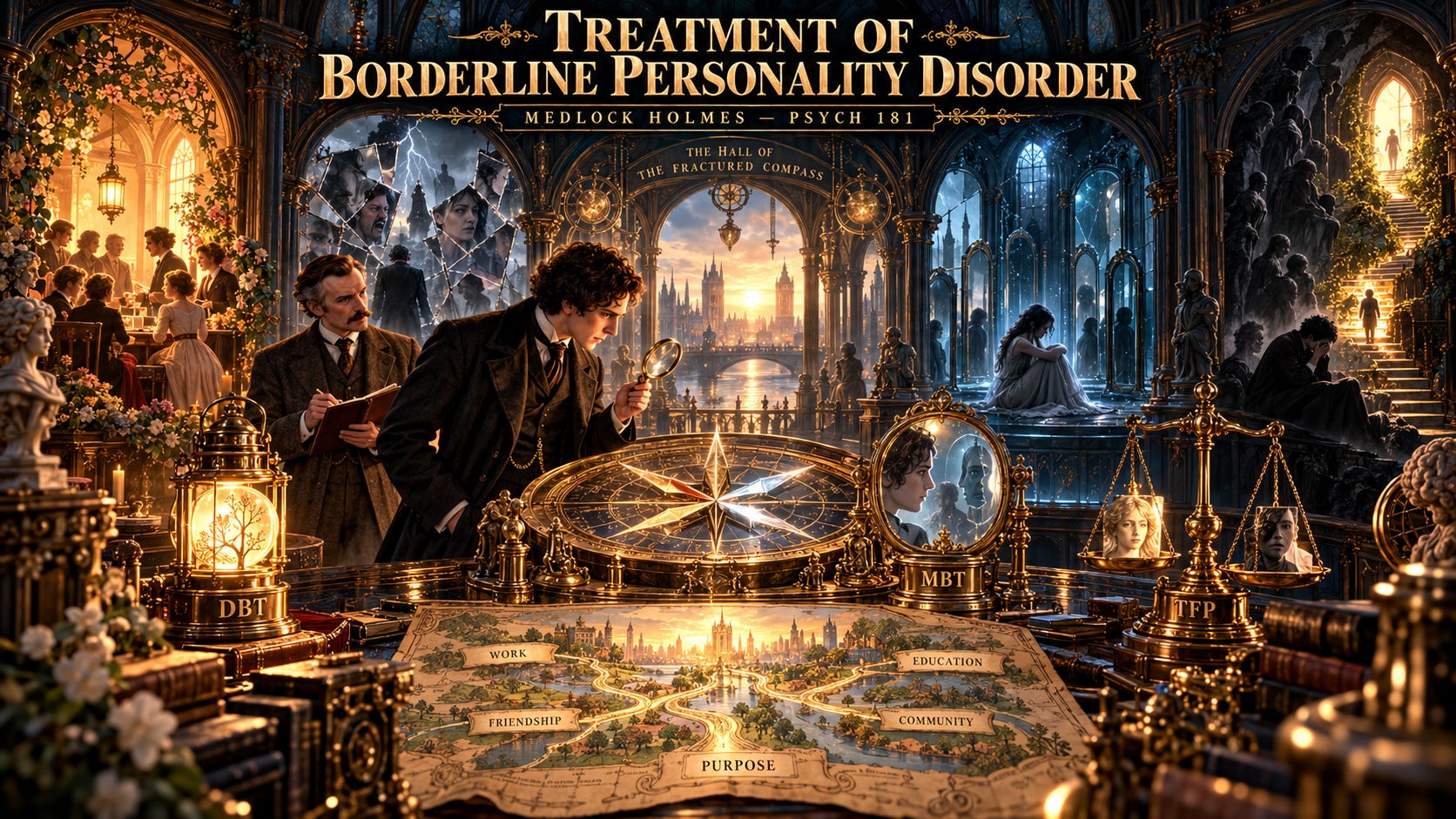
PSYCH 181: Treatment of Borderline Personality Disorder
Description
Medlock Holmes and the Fractured Compass
It was approaching midnight when Dr Watson received an urgent telegram from St Bartholomew’s Hospital.
A young woman named Eleanor had arrived following an episode of self-harm. Earlier that evening, she had been convinced that her closest companion would never abandon her. Hours later, following an unanswered letter, she believed herself utterly despised.
The attending physician was perplexed.
“She was affectionate when she arrived,” he explained. “Then furious. Now she insists that nobody cares whether she lives or dies. We cannot predict what she will do next.”
Medlock Holmes studied the young woman’s belongings. Among them was a curious brass compass whose needle swung wildly whenever another person approached or withdrew.
“The instrument is not defective,” Holmes observed. “It is exquisitely sensitive to the magnetic field surrounding it.”
Watson frowned. “And what does that signify?”
“That we must investigate the relationship between emotional sensitivity, human connection and the fear of abandonment.”
Their investigation began in the Hall of Four States.
The first chamber was labelled CONNECTED. Eleanor appeared hopeful, affectionate and trusting, although her security depended heavily upon another person’s continued attention.
A sudden gust extinguished the lamps.
They entered THREATENED, where fear of rejection transformed into anger, accusations and desperate attempts to restore connection.
Beyond lay ALONENESS, a cold room of fractured mirrors. Here, Eleanor could no longer hold a coherent picture of herself or those around her. Suspicion, dissociation and impulsivity emerged.
The final chamber was DESPAIR, where the compass needle ceased moving altogether.
“An interpersonal cascade,” Holmes murmured. “Connection gives way to threat, threat to aloneness, and aloneness to despair. But the movement can be interrupted.”
Three distinguished physicians awaited them in the next room.
The first carried a lantern labelled DBT.
“Emotions cannot always be prevented,” she said, “but skills can help a person survive distress, regulate emotion and respond effectively.”
The second held a mirror labelled MBT.
“When frightened, we may become certain we know what another person thinks. Mentalization helps us recover curiosity about our own minds and theirs.”
The third carried a carefully balanced pair of scales labelled TFP.
“Apparently contradictory experiences of ourselves and others can gradually become integrated into a more coherent identity.”
Watson looked impressed, but Holmes pointed towards a fourth figure: an ordinary physician holding neither lantern nor mirror.
His notebook bore the initials GPM.
“Good Psychiatric Management,” Holmes explained. “A practical method available to clinicians who have not trained in specialist psychotherapy. It begins by naming the disorder, explaining its treatability, planning for crises and helping the patient build a meaningful life beyond treatment.”
The physician showed Eleanor a different compass. Instead of pointing towards one indispensable relationship, its directions were marked WORK, FRIENDSHIP, LEARNING, PURPOSE and COMMUNITY.
“Treatment,” he explained, “must help you find more than one source of belonging.”
Watson then discovered another troubling feature of the hospital: a locked cabinet overflowing with prescriptions, accumulated across successive admissions.
“Surely these medicines must be the solution?”
“Not to the underlying disorder,” Holmes replied. “Medication may sometimes help particular symptoms or co-occurring illnesses. But no tablet can replace the development of emotional skills, agency and meaningful relationships.”
As dawn approached, Eleanor and her clinicians constructed a plan: recognising warning signs, finding ways