Episode Details
Back to Episodes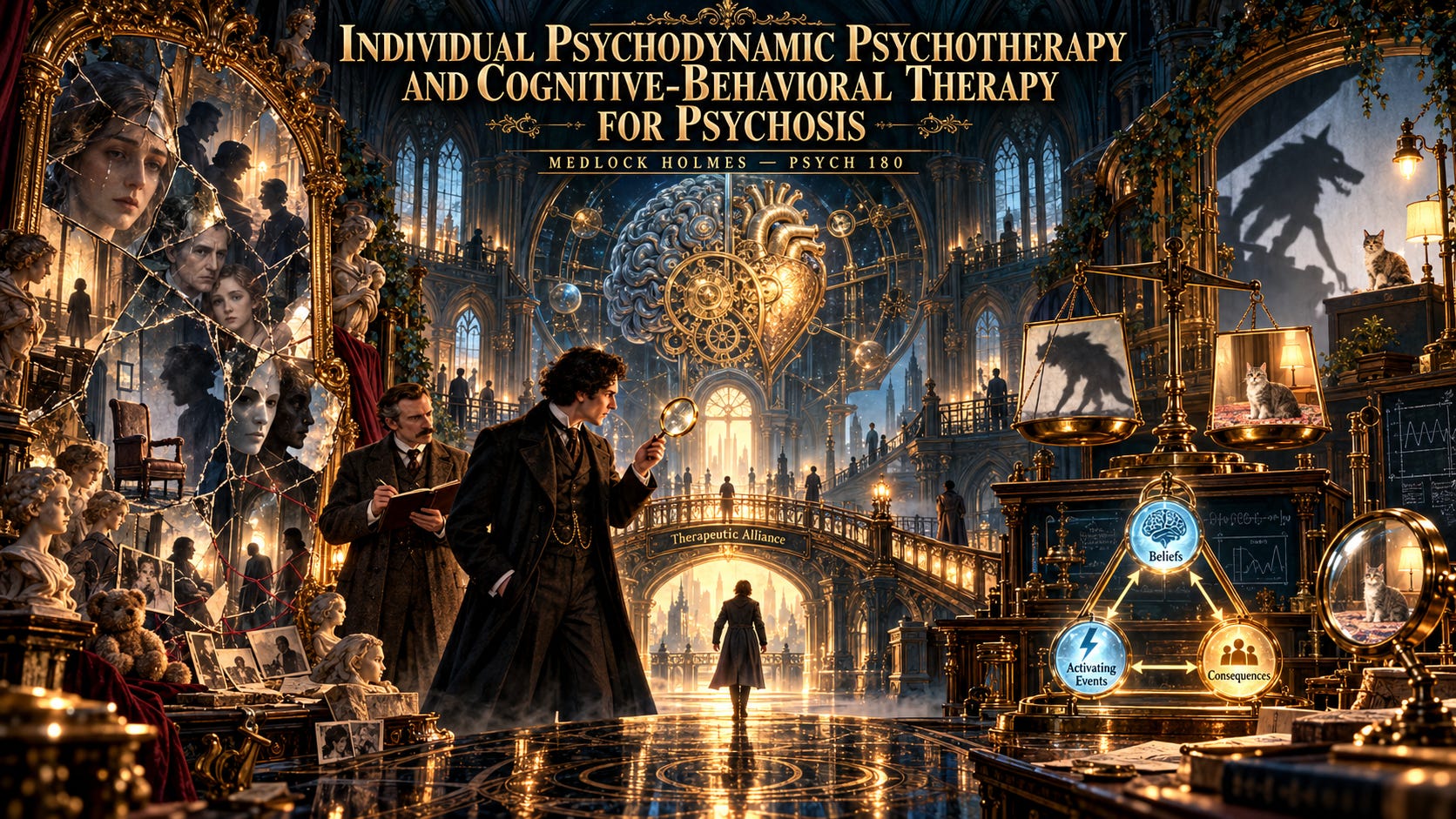
PSYCH 180: Individual Psychodynamic Psychotherapy and Cognitive-Behavioral Therapy for Psychosis
Description
The fog lay thick over London when Dr Watson received an unusual summons.
At the Royal Institute for Disturbed Perceptions, patients spoke of invisible persecutors, mysterious voices and conspiracies concealed within ordinary events. The physicians had catalogued their symptoms meticulously, yet few had asked what these experiences meant to the people enduring them.
Medlock Holmes entered a vast chamber divided by two mirrors.
The first was dark and antique, surrounded by portraits of Bleuler, Jung, Melanie Klein, Sullivan, Fromm-Reichmann and Arieti. Within its glass, the present dissolved into fragments of childhood experience: an abandoned child, a threatening parent, a longing for affection, and feelings too painful to express.
“The psychodynamic mirror,” Holmes explained, “asks what emotional history might be reflected in the symptom.”
The second mirror was polished silver, surrounded by instruments of logic: a magnifying glass, a balance for weighing evidence, and a notebook marked Beliefs, Evidence and Alternatives.
“And this,” Watson observed, “asks whether the patient’s interpretation of events can withstand examination.”
“Precisely. But neither mirror tells the whole story.”
Their first visitor was a man who heard an accusatory voice whenever he approached someone he loved. Holmes noticed that the voice intensified when the man feared rejection. Rather than treating the experience as meaningless, he explored its emotional associations, discovering a familiar expectation of humiliation and abandonment.
Yet Holmes did not assume that every hallucination concealed a decipherable childhood message. The man’s experience was real to him, even if its apparent external source remained uncertain.
Their second visitor was a woman convinced that a household animal intended to murder her. Watson initially wanted to contradict her belief outright.
Holmes stopped him.
“Argument will only turn us into another adversary. First understand the fear; then examine the inference.”
Together they explored the evidence, the practical plausibility of the feared event and alternative explanations. The woman’s conviction did not immediately disappear, but her terror diminished.
The investigation continued through three interconnected rooms.
In the Chamber of Concrete Metaphors, the inscription I feel threatened transformed into I am being pursued. In the Hall of Voices, internal experiences appeared to originate from invisible speakers. And in the Gallery of Social Defeat, repeated rejection and trauma cast long shadows over expectations of other people.
Holmes and Watson discovered that the most effective investigation did not force patients to choose between psychological meaning and rational examination.
Psychodynamic psychotherapy could explore attachment, unconscious conflict and the emotional significance of symptoms. Cognitive-behavioural therapy could examine appraisals, reasoning biases and behavioural responses. Both depended upon collaboration, curiosity and a trustworthy therapeutic relationship.
As dawn broke, Watson asked which mirror was superior.
Holmes smiled.
“The question is not which mirror is correct, Watson. It is which reflection helps this particular person recover hope, understanding and freedom.”
The detective’s mnemonic: MEANING → EVIDENCE → ALTERNATIVES → NEW RESPONSES → RECOVERY.
Key Takeaways
Chapter 32.6 - Michael D. Garrett, MD
1. The Central Therapeutic Question
* Psychotherapy for psychosis aims to reduce distress, improve functioning and support recovery, not simply eliminate hallucinations or delusions.
* Psychodynamic psychotherapy for psychosis (PDTp) explores the emotional meanings, interpersonal experiences and unconscious conflicts associated with psychotic symptoms.
* Cognitive-behavioural therapy for psych