Episode Details
Back to Episodes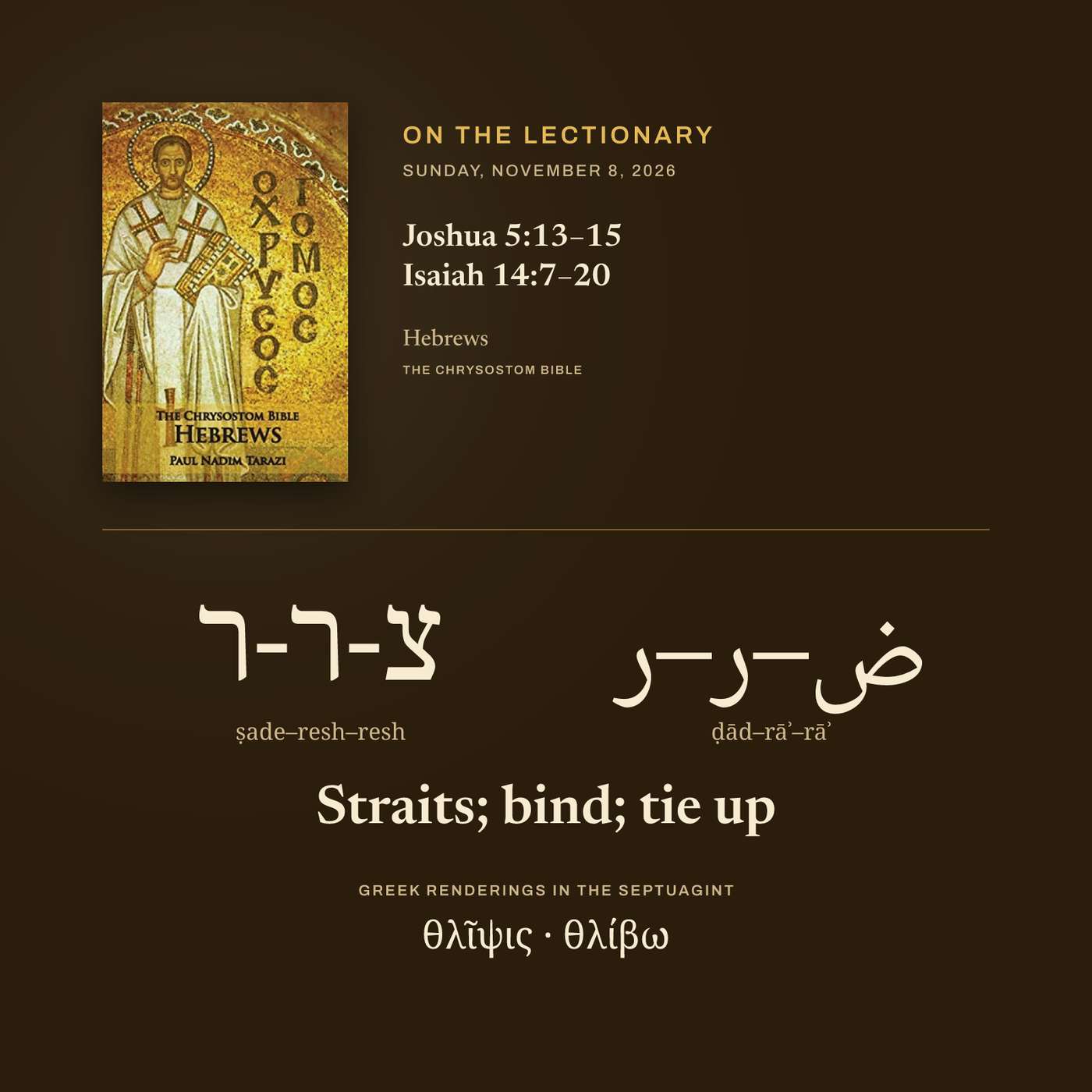
Joshua 5:13-15 · Isaiah 14:7-20 · Matthew 28:16-20 · Hebrews 2:2-10 · Luke 10:16-21 · Ephesians 2:4-10 · Luke 8:41-56 — Sunday, November 8, 2026
Description
A daily note from the team at OCABS.ORG, drawing on the published works of Fr. Paul Nadim Tarazi, with citations to his books and lectures.
Readings: Joshua 5:13-15; Isaiah 14:7-20; Matthew 28:16-20; Hebrews 2:2-10; Luke 10:16-21; Ephesians 2:4-10; Luke 8:41-56.
In Joshua 5:13-15, the one who meets Joshua is not identified as God outright but as "the commander of the Lord's army," and it is this figure, not Joshua, who leads the conquest, just as it was the Lord himself and not Moses who led the people out of Egypt. Fr. Paul notes the deliberate parallel: Joshua is told to remove his sandals "for the place where you stand is holy," the same command given to Moses at the burning bush. Joshua's own task is never military command but fidelity to the Law, reciting it "day and night" so that right behavior, not strategy, secures success; the fighting belongs solely to the commander of the Lord's army.
Isaiah's taunt against the king of Babylon, a mashal or instructional story, pictures a ruler so puffed up he says in his heart, "I will ascend into heaven! I will exalt my throne above the stars of God!" Fr. Paul points out the irony that this self-declared would-be god is, after all, only a man, echoing the psalm's judgment on the "gods" who nonetheless "die like men." Unlike the kings of the nations who "lie in glory, each in his own tomb," this king is cast out like a loathed, unburied branch. The whole scene belongs to a larger pattern in which God's wrath on the nations' arrogance accompanies his plan to bring both Israel and the nations together into a new Zion.
Matthew's closing commission sends the eleven to a mountain in Galilee, where some worship Jesus and "some doubted," a doubt Fr. Paul links elsewhere in the Gospel to the disciples' recurring "little faith" in the context of the open mission to the Gentiles. Jesus declares that "all authority in heaven and on earth has been given to me" and sends the disciples to "make disciples of all nations," a mission Fr. Paul describes as a centrifugal movement initiated by the Lord himself, extending to "the close of the age" when the Son of Man will judge all the nations that have by then been forewarned through this very teaching.
The root pair of the day · צ-ר-ר ṣade–resh–resh, צָרָה ṣarah · ض–ر–ر ḍād–rāʾ–rāʾ, يَضُرَّ yaḍurra · straits; bind; tie up. The root pair of the day, as in the Triliteral Root of the Day: צָרָה (ṣarah) and يَضُرَّ (yaḍurra), straits; bind; tie up. Hear every passage of the pair at ocabs.org. cf. The Consolation of Consonants
Sources: Tarazi, Joshua: A Commentary, p. 32; Tarazi, Joshua: A Commentary, p. 121; Tarazi, Joshua: A Commentary, p. 44; Tarazi, Joshua: A Commentary, p. 72; Tarazi, Land and Covenant, p. 124; Tarazi, Joshua: A Commentary, p. 78; Tarazi, Isaiah: A Commentary, p. 110; Tarazi, Isaiah: A Commentary, p. 107; Tarazi, Isaiah: A Commentary, p. 106; Tarazi, Isaiah: A Commentary, p. 104; Tarazi, Isaiah: A Commentary, p. 110; Tarazi, Isaiah: A Commentary, p. 108; Tarazi, Decoding Genesis 1–11, p. 302; Tarazi, Land and Covenant, p. 224; Tarazi, Decoding Genesis 1–11, p. 297; Tarazi, The New Testament: An Introduction, vol. 4, Matthew and the Canon, p. 210.
Opening music: Taksim Arbi, Bichi Slama, oud (Tunis, Archives de la Parole, 1930s), public domain. Source: gallica.bnf.fr / BnF.
The digital voice Fāṭima (فَاطِمَة) is named in honor of the learned women of al-Andalus, particularly Fāṭima bint Yaḥyā al-Maghāmī, Fāṭima al-Sharrāṭ, and Fāṭima bint al-Muthannā, whose legacies embody the Andalusian traditions of scriptural scholarship, jurisprudence, education, and wisdom.