Episode Details
Back to Episodes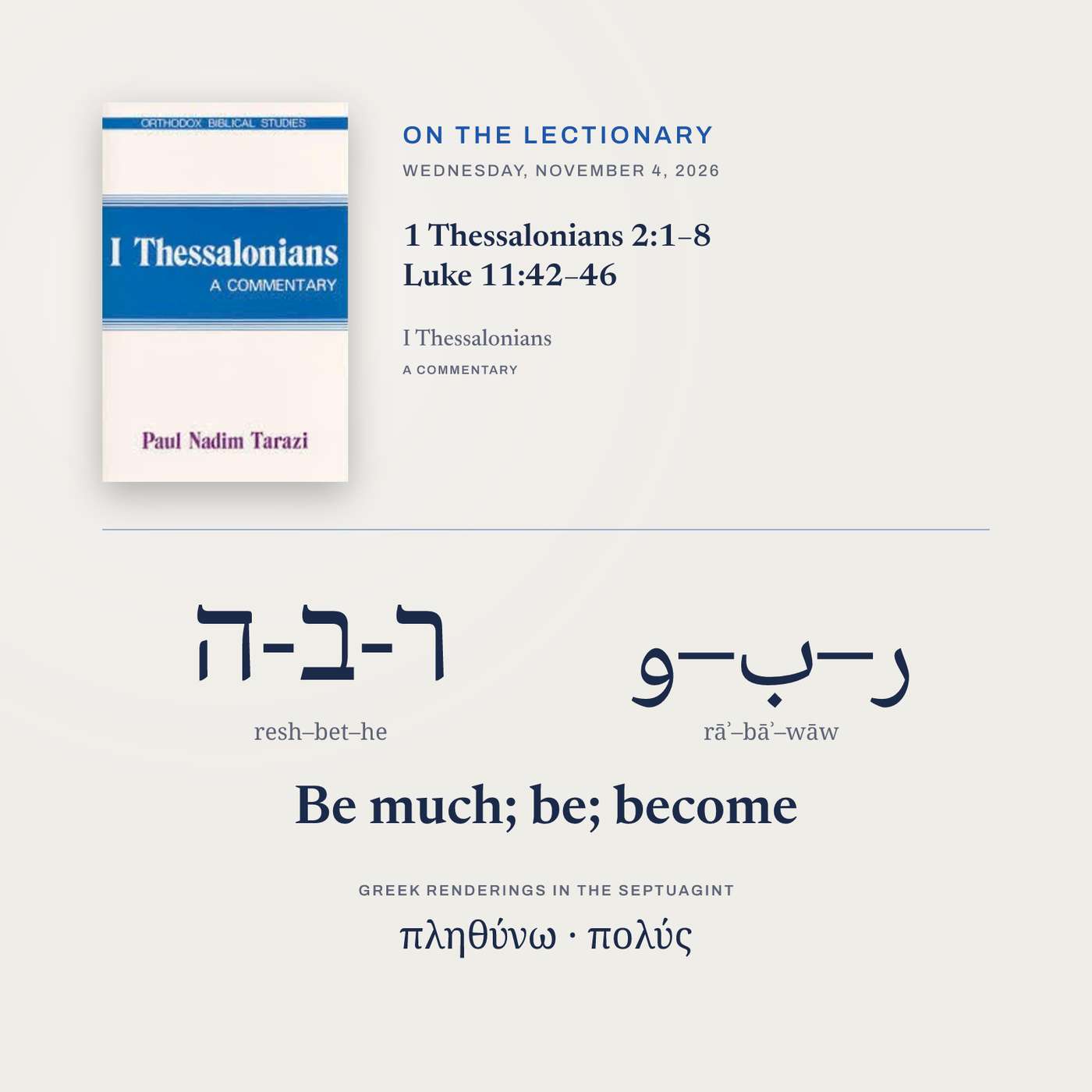
1 Thessalonians 2:1-8 · Luke 11:42-46 — Wednesday, November 4, 2026
Description
A daily note from the team at OCABS.ORG, drawing on the published works of Fr. Paul Nadim Tarazi, with citations to his books and lectures.
Readings: 1 Thessalonians 2:1-8; Luke 11:42-46.
Fr. Paul reads Paul's defense in 1 Thessalonians 2 as part of a running self-defense scattered across his letters. Paul reminds the Thessalonians that his visit, though preceded by suffering and mistreatment at Philippi, was not in vain, and that he spoke the gospel "not to please men, but God, who tests our hearts." Fr. Paul stresses that this is not sentiment but accountability: the heart in Hebrew and Greek usage means the whole mind and will, not feeling, and Paul knows he himself will answer to God for how he preached. He notes that Paul was defending himself against real opponents who questioned his authority, the same kind of charge Paul answers in Galatians and Corinthians.
The image of gentleness Paul uses, like a nursing mother and then a father with his children, is read by Fr. Paul as showing that the apostle's authority was exercised without flattery, greed, or demand for support, even though he had the right to be maintained by those he taught. He gave not only the gospel but "not only the gospel of God but also our own selves, because you had become very dear to us," which Fr. Paul links to the same posture Paul takes elsewhere, laboring with his own hands so as not "to create an obstacle in the way of the gospel," and exhorting each person "to lead a life worthy of God."
The passages do not address the Gospel reading from Luke 11; none of the supplied material treats this woe-saying as bearing on 1 Thessalonians 2, so nothing further can be said connecting the two beyond noting that Fr. Paul elsewhere reads these Lucan woes as naming hypocrisy: neglecting justice and the love of God while loading people with burdens, lawyers who will not "touch the burdens" themselves, and a hiding of the truth that Luke contrasts with the almsgiving, eleimosini, that comes from genuinely loving the neighbor.
The root pair of the day · ר-ב-ה resh–bet–he, רָבָה rabah · ر–ب–و rāʾ–bāʾ–wāw, رِبا ribā · be much; be; become. The pair ben and bunā, meaning son, children, youth, underlies Paul's image of himself as a nursing mother and father to the Thessalonians, whom he calls his own children in the reading. The Greek huios, used for sonship throughout the New Testament, echoes the same bond of begetting and care that Fr. Paul says grounds Paul's gentle, non-flattering authority. cf. The Consolation of Consonants
Sources: Tarazi, The New Testament: An Introduction, vol. 1, Paul and Mark, p. 78; Orthodox Audio Bible Commentary, 1 Thessalonians (vol. 52), part 1, at 0:00; Tarazi, 2 Corinthians: A Commentary, p. 219; Tarazi, Galatians: A Commentary, p. 262; Tarazi, 1 Corinthians: A Commentary, p. 170; Tarazi, Galatians: A Commentary, p. 224; Orthodox Audio Bible Commentary, Luke (vol. 42), part 2, at 14:23; Orthodox Audio Bible Commentary, Luke (vol. 42), part 2, at 3:51; Orthodox Audio Bible Commentary, Luke (vol. 42), part 2, at 12:09.
Opening music: Taksim Arbi, Bichi Slama, oud (Tunis, Archives de la Parole, 1930s), public domain. Source: gallica.bnf.fr / BnF.
The digital voice Fāṭima (فَاطِمَة) is named in honor of the learned women of al-Andalus, particularly Fāṭima bint Yaḥyā al-Maghāmī, Fāṭima al-Sharrāṭ, and Fāṭima bint al-Muthannā, whose legacies embody the Andalusian traditions of scriptural scholarship, jurisprudence, education, and wisdom.