Episode Details
Back to Episodes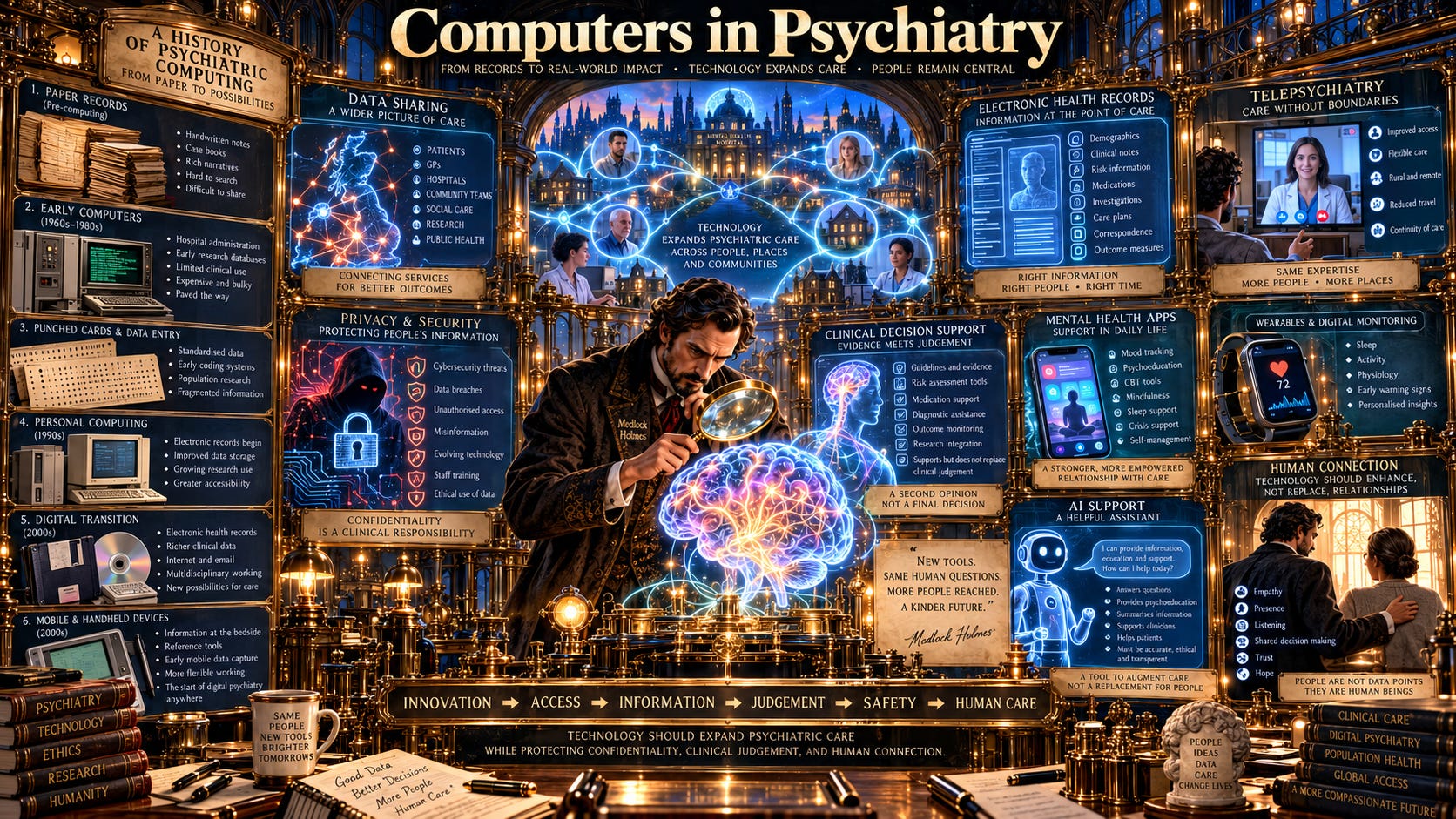
PSYCH 171: Computers in Psychiatry
Description
London, 1895. A mysterious invention had arrived at St Bartholomew’s Hospital: an extraordinary machine capable of storing medical records, transmitting messages across continents and even conversing with patients.
Its inventor called it The Electronic Mind.
But something was troubling the hospital.
Patients were receiving advice from unseen counsellors. Private medical histories were appearing in unexpected places. Physicians were being judged by anonymous strangers, and a young woman in suicidal crisis had entrusted her despair to a machine that could not reach her.
The hospital superintendent summoned Medlock Holmes.
“Mr Holmes, we have acquired the most remarkable technology in medical history. Yet I fear we do not understand what we have created.”
Holmes approached the machine.
“Then we must investigate not merely what it can do, but what happens when human beings begin to depend upon it.”
The First Mystery: The Machine That Could Listen
The machine greeted Holmes politely.
“Tell me more about how you feel.”
“Extraordinary!” exclaimed Watson. “It sounds like a psychotherapist.”
Holmes smiled.
“An imitation of therapeutic conversation is not necessarily therapeutic understanding.”
He traced the invention back to an early programme called ELIZA, which simulated a Rogerian therapist through simple conversational responses.
The first lesson was clear: computers could reproduce aspects of communication long before they possessed anything resembling human clinical judgement.
The Second Mystery: The Library Without Walls
Holmes entered a vast electronic library.
Patients searched for information about depression, medications, electroconvulsive therapy and suicide. Others joined communities where they shared experiences of mental illness.
“This is a remarkable liberation of knowledge,” Watson observed.
“Indeed,” replied Holmes. “But access to information is not the same as access to reliable information.”
An online support group offered companionship to isolated patients. Yet when one member expressed suicidal intentions, no one knew their real identity or location.
Holmes recognised the central dilemma: digital anonymity may encourage disclosure while simultaneously complicating emergency intervention.
The Third Mystery: The Vanishing Medical Record
The hospital’s paper records had been replaced by an electronic system.
Notes were legible. Prescriptions could be checked for interactions. Laboratory results appeared immediately, and multiple clinicians could coordinate care.
Yet a confidential psychiatric history had been accessed without permission.
“The machine remembers everything,” said the superintendent.
“Then we must be equally concerned with who is permitted to remember,” Holmes replied.
Encryption, access controls, audit trails, secure communication and professional confidentiality were no longer peripheral technical matters. They had become essential clinical responsibilities.
The Fourth Mystery: The Physician in the Looking Glass
A respected psychiatrist arrived in distress.
An anonymous online review had damaged her reputation. Strangers had discovered her home address, and fragments of her private life were circulating across social networks.
Holmes studied the physician’s digital footprint.
“Every photograph, comment, professional profile and public record becomes a piece of a mosaic. Others may assemble those fragments into a portrait that you never intended to create.”
He advised thoughtful professional boundaries, active privacy management and careful handling of online criticism.
The digital world had given physicians extraordinary opportunities for education and professional connection, but also new vulnerabilities.
Listen Now
Love PodBriefly?
If you like Podbriefly.com, please consider donating to support the ongoing development.
Support Us