Episode Details
Back to Episodes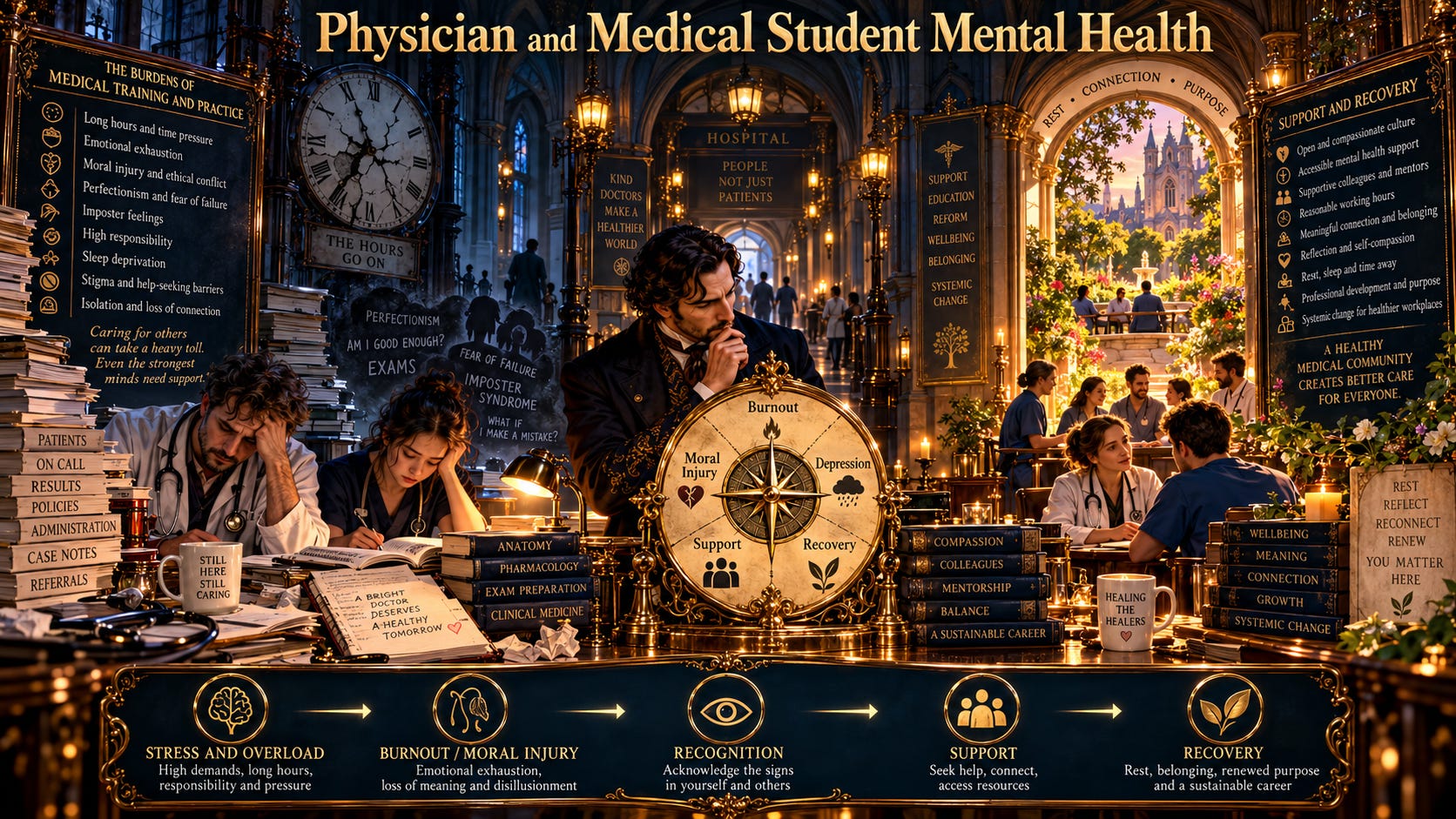
PSYCH 170: Physician and Medical Student Mental Health
Description
The House of the Wounded Healers
It was approaching midnight when Medlock Holmes received an unusual invitation to St Bartholomew’s College of Medicine.
The letter was signed by the Dean.
“Our doctors are exhausted, our students are despairing, and some of our finest physicians have disappeared from the profession altogether. Yet everyone insists that they are coping. We need your help.”
Holmes arrived to find a magnificent hospital illuminated against the London fog. Its wards were busy, its laboratories thriving, and its reputation impeccable.
But behind the grand façade, something was profoundly wrong.
The First Chamber: The Three Faces of Burnout
Holmes entered a consulting room where three portraits hung upon the wall.
The first depicted a physician utterly exhausted.
The second showed a doctor treating patients with increasing cynicism and detachment.
The third portrayed a once-proud clinician convinced that nothing they accomplished mattered.
“Three separate illnesses?” asked the Dean.
“No,” replied Holmes. “Three dimensions of the same occupational syndrome: emotional exhaustion, depersonalisation and reduced professional accomplishment.”
He examined the overflowing appointment books, electronic records, endless administrative demands and unanswered messages.
“The physicians are not merely failing to cope with their work. Their work has been designed in ways that make sustained wellbeing increasingly difficult.”
The Second Chamber: The Broken Moral Compass
In the adjoining room stood a physician who had been unable to provide a desperately needed treatment because the hospital lacked the necessary resources.
“I knew what my patient needed,” she whispered. “But the system would not allow me to provide it.”
Holmes recognised something distinct from exhaustion.
“This is moral distress. When professional values collide with institutional constraints, the injury reaches beyond fatigue into the clinician’s sense of integrity.”
The Dean proposed another resilience workshop.
Holmes shook his head.
“Teaching a physician to tolerate an impossible situation does not make the situation acceptable.”
The Third Chamber: The Silent Student
In the medical school library, Holmes discovered a brilliant student sitting alone beside an unopened examination paper.
The student had achieved excellent grades, yet believed herself an impostor.
Every minor error became evidence of personal inadequacy. Every examination felt like a verdict upon her worth.
Holmes opened his notebook.
“Perfectionism may help someone enter medicine, but maladaptive perfectionism can make it difficult to survive medicine.”
He distinguished guilt about a correctable mistake from shame about one’s entire identity.
“One encourages learning. The other may encourage withdrawal, concealment and despair.”
The Fourth Chamber: The Physician Who Could Not Ask for Help
The next room contained a psychiatrist experiencing severe depression.
He knew the symptoms, understood the treatments and regularly encouraged his patients to seek help.
Yet he had told no one.
He feared professional embarrassment, breaches of confidentiality and consequences for his medical registration.
Holmes regarded him thoughtfully.
“Knowledge of illness does not confer immunity from illness. Nor does medical qualification eliminate the need for compassionate care.”
He explained that depression, substance misuse and suicidal distress required appropriate assessment and treatment, not professional shame.
The distinction between having a mental illness and being impaired in one’s clinical practice was essential.
The Fifth Chamber: The Seasons of a Medical Life
Hol