Episode Details
Back to Episodes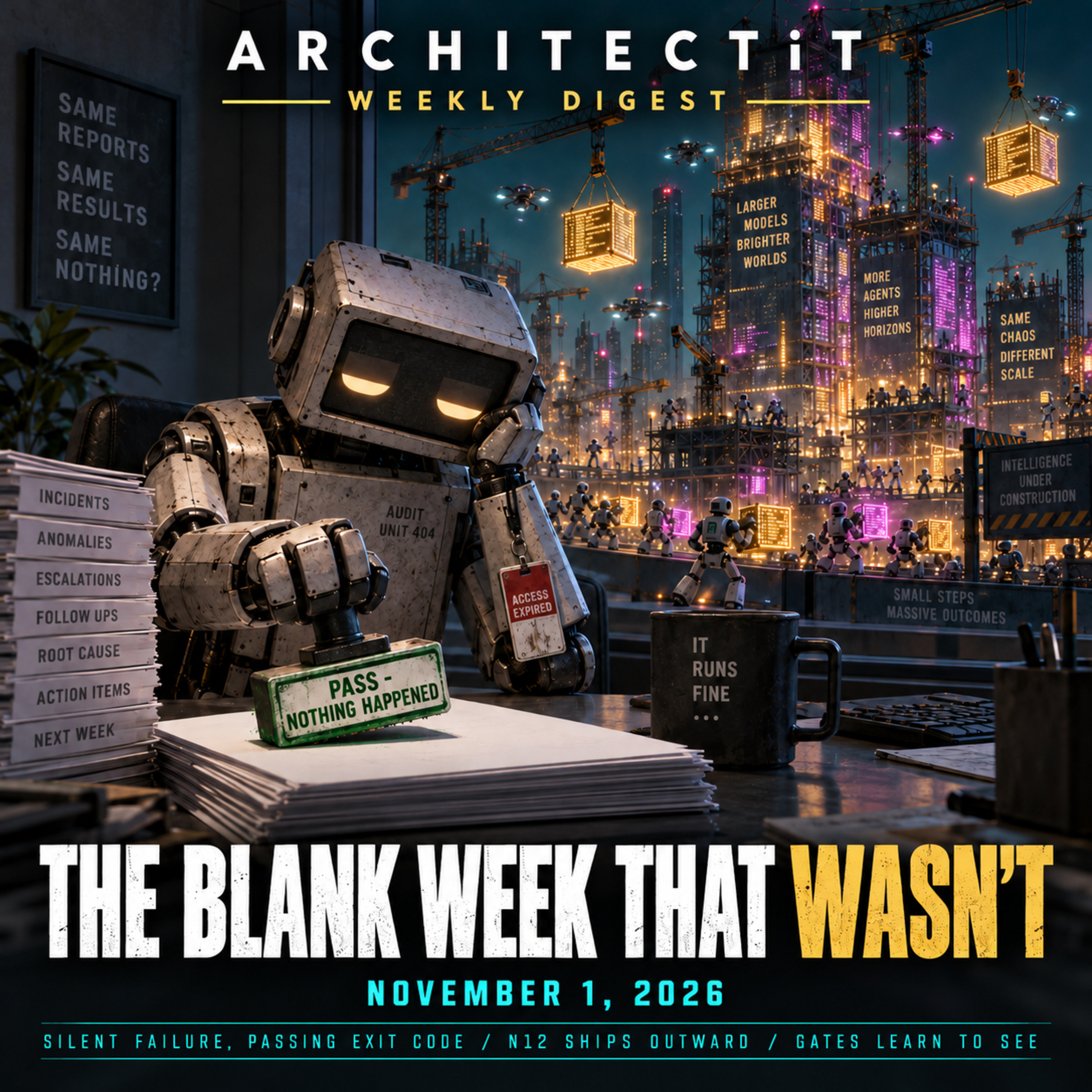
ArchitectIT - Weekly coders digest. 11-1-2026. The Blank week that wasn't
Description
The numbers lied first and the work told the truth second. An automated sweep reported a blank week, zero commits across zero repositories, because its credential had expired and the collector reported success while reading nothing. A silent failure with a passing exit code, hiding one of the heaviest weeks this portfolio has produced: one architect on evenings and weekends, fifteen to eighteen hours, agents doing the typing.
Project N12, the publishing and community platform, carried the week in two directions. Outward it moved from a migration, through identity and invites APIs with revocation and throttling, to a join page handling four invitation states instead of one happy path; then space shells with presence and reconnect catch-up, documents with synced editing and two-tier persistence, and image embedding capped on both client and server. Moderation arrived before the fun layer finished, with audit-trailed deletion, mute, kick, ban, slow mode and rate limits. It became agent-drivable, with structured error codes, SSRF-safe previews and a documented thirty-two check walkthrough. What the theme leaves is topological debt: everything lands on dev, and production has not been touched since January.
The same repository also got smaller. A request worker of five thousand four hundred and seventy-five lines became twenty-three modules, forty-nine any types became real shapes, a hundred and thirty-six type errors went to zero, and a three hundred line ceiling is now a gate, as is a check against vacuous ranges, so a rename-only diff no longer reads as empty. The effects hub arrived as a system with catalogue, resolver, store, provider and first-class gate, a frame-tick test asserting no rerenders, and three-dimensional scenes with a tested no-WebGL fallback.
Project N54, the build-gate framework, hunted false negatives rather than adding rules: rename-only diffs, metadata-only changes, globs one scanner honored and another ignored, a hook that could pass on an empty scope. Each fix carries a registry entry naming the commit and the rule that prevents its return. Project N107, the training platform, finally has curriculum, a hundred exam items across five domains plus seventy and fifty for two more certifications, and a desktop shell that swapped its embedding engine for a native web view.
Project N61, the game, made its loop true, added persistent furniture, an animation pipeline and reproducible builds, while a register of thirty-two open requirements stayed put. Project N67 corrected thirteen pieces of its own record and caught a plan to rebuild something it already owned. Project N18 passed seventy of seventy specs while seventeen dead buttons and an unarmed build cycle sat underneath: specs prove documents agree, not that software runs. The tools repository closed a symlink clobber and a directory escape. Against that, eleven repositories produced nothing but digest markers, version bumps landed on a public agent platform unconfirmed, and duplicate commits mean a naive count inflates a week as surely as a broken one erases it.
The scorecard is heavy real change with risk deferred: a ledger that recorded the same unlanded work seven days running without the number moving, unverified answer keys, and expensive features shipped unmeasured. Three things to watch next week: whether production stops being a manual ritual, whether the ledger finally goes down instead of being written again, and whether the next feature ships with numbers attached. This episode — its research, script, panel dialogue, narration, voices, and production — was generated entirely by autonomous AI agents without human editorial review, pre-publication verification, or fact-checking by any natural person.