Episode Details
Back to Episodes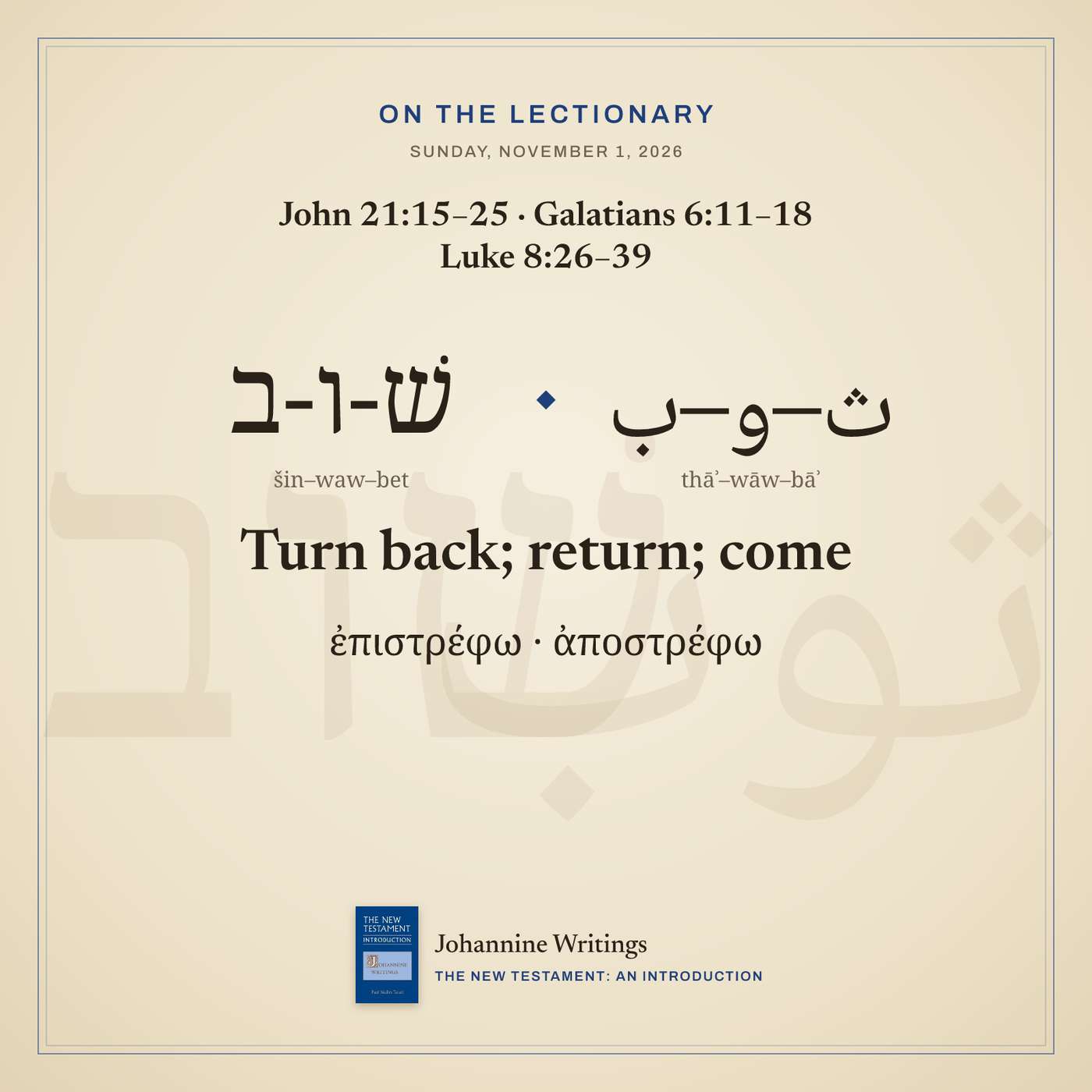
John 21:15-25 · Galatians 6:11-18 · Luke 8:26-39 — Sunday, November 1, 2026
Description
A daily note from the team at OCABS.ORG, drawing on the published works of Fr. Paul Nadim Tarazi, with citations to his books and lectures.
Readings: John 21:15-25; Galatians 6:11-18; Luke 8:26-39.
The epilogue of John places Peter's threefold love-question against the threefold denial, and Fr. Paul reads the shepherding commands as Peter's reinstatement to feed and tend the flock, bound now to a path he cannot choose, "he said to him, 'Follow me.'" When Peter turns to ask about the beloved disciple, Jesus refuses to let Peter's curiosity set the terms, telling him that if it is his will that the other remain until he comes, that is nothing to Peter. Fr. Paul stresses that each disciple has his own course to run and is not to measure himself against another's fate.
Fr. Paul reads the closing verses as the Gospel's own guarantee of its reliability, noting that they confirm what was already said in chapter 20: "more could have been written, but what he has consigned to writing in this Gospel book is sufficient to grant life in Christ." He notes the parallel ending of Revelation and observes that Paul himself had to defend "his gospel" against rival readings of scripture, which is why a written witness can carry opposite meanings depending on who interprets it.
Turning to Galatians, Fr. Paul traces how Paul opposes "boasting in the flesh" through circumcision to boasting only in the cross, through which the old order separating circumcised and uncircumcised has ended and a "new creation" has begun, a status belonging to the believing person rather than to any national community. On Luke's Gadarene demoniac, Fr. Paul notes that Luke signals Gentile territory and preserves the demon's name "legion," an unmistakable allusion to Roman power, so that the man's begging not to be sent into the abyss links that abyss to the domain of Roman rule; once healed and clothed, he is sent home to declare what God has done rather than kept as a follower, since, as Fr. Paul puts it, Jesus cleansed the country "for your sake, not for his sake," with "no imperialism in that sense."
The root pair of the day · שׁ-ו-ב šin–waw–bet, שׁוּב šub · ث–و–ب thāʾ–wāw–bāʾ, ثَواب thawāb · turn back; return; come. The pair mul and yamīlu links Hebrew circumcise to Arabic deviate, one root diverging in sense. Galatians speaks of being circumcised, using peritemno, the very mark Paul says is nothing once the cross has brought a new creation. The Arabic drift toward deviation fits the note: boasting in circumcised flesh is itself a turning aside from the cross, the only true boast. cf. The Consolation of Consonants
Sources: Orthodox Audio Bible Commentary, John (vol. 43), part 2, at 0:00; Tarazi, The New Testament: An Introduction, vol. 3, Johannine Writings, p. 31; Tarazi, The New Testament: An Introduction, vol. 3, Johannine Writings, p. 263; Tarazi, The New Testament: An Introduction, vol. 3, Johannine Writings, p. 177; Tarazi, Galatians: A Commentary, p. 325; Tarazi, Galatians: A Commentary, p. 321; Tarazi, Galatians: A Commentary, p. 322; Tarazi, Galatians: A Commentary, p. 325; Tarazi, Decoding Genesis 1–11, p. 330; Tarazi, Romans: A Commentary, p. 189; Orthodox Audio Bible Commentary, Luke (vol. 42), part 1, at 2:52:18; Orthodox Audio Bible Commentary, Luke (vol. 42), part 1, at 3:11:38; Orthodox Audio Bible Commentary, Luke (vol. 42), part 1, at 3:13:24.
Opening music: Taksim Arbi, Bichi Slama, oud (Tunis, Archives de la Parole, 1930s), public domain. Source: gallica.bnf.fr / BnF.
The digital voice Fāṭima (فَاطِمَة) is named in honor of the learned women of al-Andalus, particularly Fāṭima bint Yaḥyā al-Maghāmī, Fāṭima al-Sharrāṭ, and Fāṭima bint al-Muthannā, whose legacies embody the Andalusian traditions of scriptural scholarship, jurisprudence, educ