Episode Details
Back to Episodes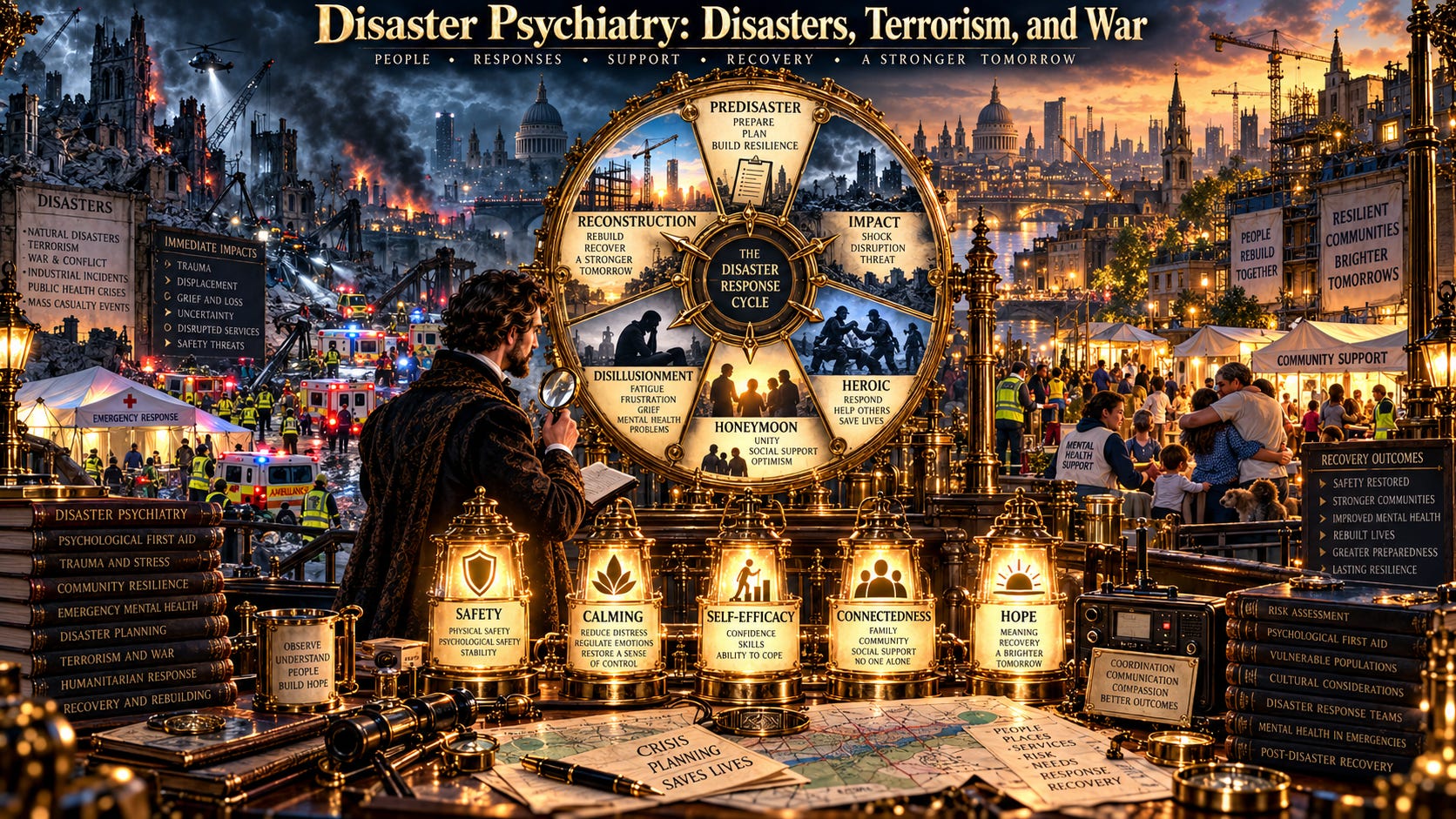
PSYCH 168: Disaster Psychiatry: Disasters, Terrorism, and War
Description
The City That Forgot Tomorrow
It was just after midnight when the first bell rang.
Then came another. And another.
Across London, telegraph lines fell silent, railway stations emptied, and a strange orange glow appeared beyond the rooftops. A catastrophic explosion had struck the industrial quarter. Thousands were displaced, hospitals were overwhelmed, and rumours of a deliberate attack were spreading faster than the smoke.
Medlock Holmes was summoned to the Ministry of Public Safety.
The commissioner had one question.
“How do we treat an entire city that has been traumatised?”
Holmes replied, “First, Commissioner, we must discover what the city actually needs.”
He led his companion through five districts of the devastated metropolis.
The First District: The Geography of Fear
In the ruins, Holmes encountered frightened survivors, exhausted rescuers, grieving families and children searching for their parents.
Some were trembling. Others were strangely calm. A few had become irritable, while many were determined to help.
The commissioner assumed that everyone required psychiatric treatment.
Holmes disagreed.
“Distress after catastrophe is often an understandable response to an extraordinary event. We must not mistake every frightened person for a psychiatric patient.”
He pointed to four overlapping circles on his notebook:
DISTRESS REACTIONS - HEALTH-RISK BEHAVIOURS - PSYCHIATRIC DISORDERS - RESILIENCE
The circles overlapped, but they were not interchangeable.
The Second District: The Clock Tower of Recovery
The great clock tower had stopped at the moment of the explosion.
Inside, Holmes discovered six chambers representing the psychological course of disaster.
The first contained warnings and uncertainty: Predisaster.
The second was filled with shock and confusion: Impact.
The third showed neighbours rescuing neighbours: Heroic.
The fourth glowed with solidarity and hope: Honeymoon.
The fifth was darker. Relief agencies were leaving, compensation was disputed, and survivors were exhausted: Disillusionment.
The final chamber contained rebuilding homes, restored relationships and uncertain new beginnings: Reconstruction.
Holmes noticed that the greatest psychiatric difficulties did not necessarily emerge during the explosion itself.
“Some suffering arrives when the world believes the disaster is already over.”
The Third District: The House of False Diagnoses
A soldier had collapsed after days of relentless rescue work. He was confused, withdrawn and unable to concentrate.
One physician suspected depression. Another suggested acute stress disorder.
Holmes asked about sleep, hydration, infection, head injury and exposure to explosions.
The soldier had barely slept or eaten.
“Before assigning a psychiatric diagnosis,” Holmes explained, “we must consider the conditions in which the mind has been forced to function.”
He ordered medical assessment, rest, nourishment, safety and observation.
Nearby, another survivor remained tormented by intrusive memories, avoidance, guilt and persistent hyperarousal.
Holmes recognised that this patient might require more specialised trauma-focused treatment.
Not every distress reaction is a disorder. Not every disorder is merely distress.
The Fourth District: The Five Lamps of Psychological First Aid
In a temporary shelter, Holmes found a young woman desperately searching for her missing brother.
A well-meaning volunteer wanted her to recount everything she had witnessed.
Holmes intervened.
“Her immediate need is not to relive the catastrophe. It is to feel safe, find her brother and regain some control.”
He lit five lamps above the shelter:
SAFETY -