Episode Details
Back to Episodes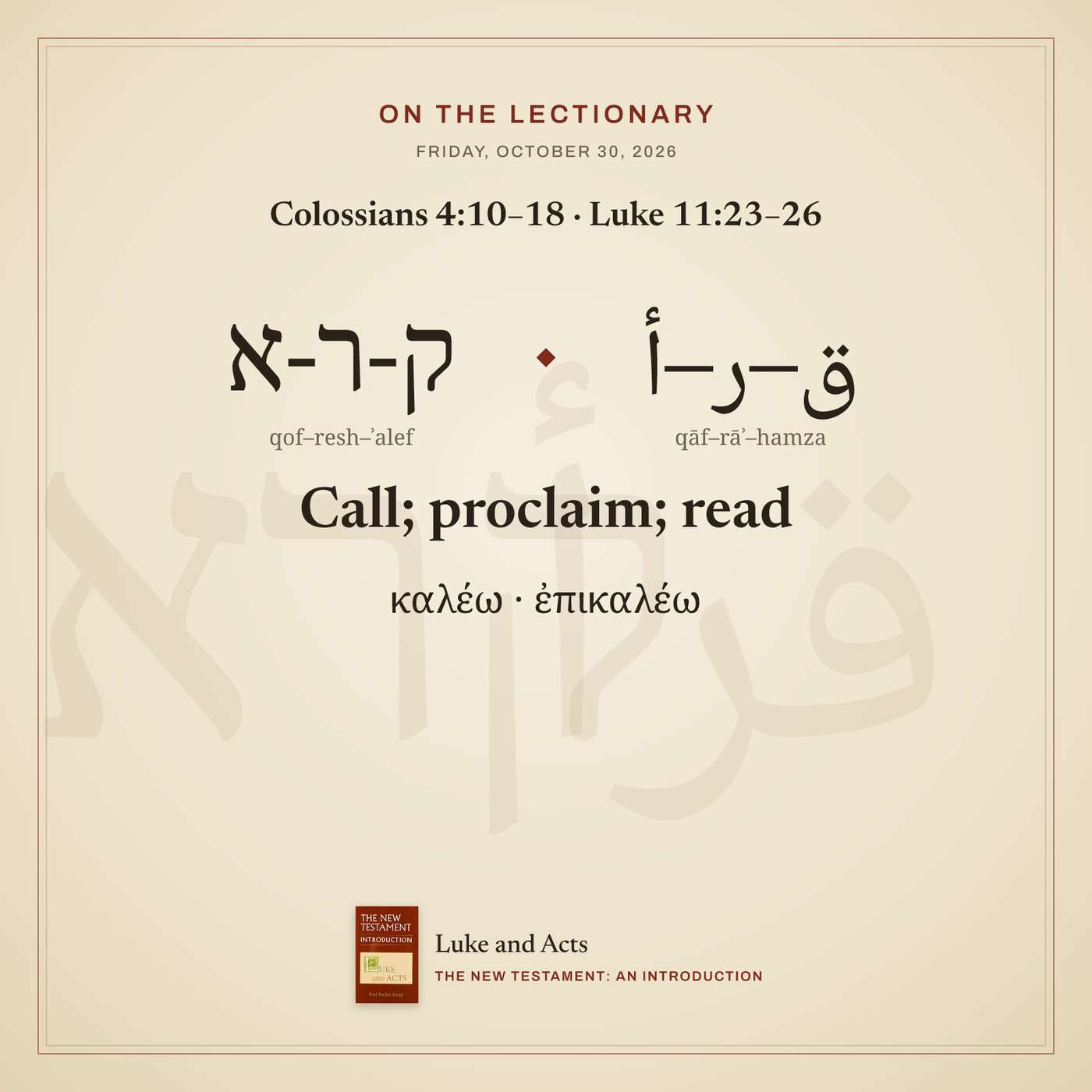
Colossians 4:10-18 · Luke 11:23-26 — Friday, October 30, 2026
Description
A daily note from the team at OCABS.ORG, drawing on the published works of Fr. Paul Nadim Tarazi, with citations to his books and lectures.
Readings: Colossians 4:10-18; Luke 11:23-26.
Colossians ends with a list of names that Fr. Paul reads as more than courtesy. The triad of "men who have been a comfort to me" from the circumcision — Aristarchus, Mark, and Jesus called Justus — is matched by a second triad, Epaphras, Luke, and Demas, drawn from the Gentile side. Fr. Paul notes that the epithet Ioustos was added deliberately to create assonance among the three names, and that Luke here stands for the literary work of Luke-Acts while Demas represents the Gentiles of the empire generally. Read this way, Colossians 4:10-14 functions as the Pauline school's endorsement of Mark and Luke as carriers of Paul's legacy to both Jew and Gentile.
The command that the letter be read also in Laodicea, and the Laodicean letter read at Colossae, is for Fr. Paul the blueprint of a developing canon: Pauline letters meant to circulate among churches as a single body of teaching, a practice he finds echoed later in Revelation's address to all seven churches and in 2 Peter's endorsement of the Pauline corpus. Nympha's house church, like the "bride" imagery elsewhere in Paul, speaks of the church itself. The closing "I, Paul, write this greeting with my own hand" belongs to a set formula shared with 1 Corinthians and 2 Thessalonians, but here it is joined to "remember my chains," a phrase distinguishing Colossians among the three captivity letters.
On the Gospel, Fr. Paul's lectures stress that Jesus allows no neutral ground: "he who is not with me is against me." The parable of the returning unclean spirit teaches that cleansing is not a single event but must be sustained, since the house swept and left empty invites a worse return. He connects this to continual teaching: "the cleansing is continual through the word," requiring that the gospel be preached and the believers' trust strengthened again and again, as Paul does in his own later travels.
The root pair of the day · ק-ר-א qof–resh–ʾalef, קָרָא qaraʾ · ق–ر–أ qāf–rāʾ–hamza, قُرْءان qurʾān · call; proclaim; read. Jesus' saying "He who is not with me is against me" (Luke 11:23) turns on the very range of עִם ʿim, glossed "with; aid; against." The Hebrew usage traces this from Genesis 3:12, "the woman whom you gave to be with me," to the Arabic ʿamma, kin bound together. The note's stress on "no neutral ground" matches this: ʿim holds both togetherness and opposition in one root. cf. The Consolation of Consonants
Sources: Tarazi, Colossians and Philemon: A Commentary, p. 102; Tarazi, Colossians and Philemon: A Commentary, p. 103; Tarazi, Colossians and Philemon: A Commentary, p. 98; Tarazi, Colossians and Philemon: A Commentary, p. 102; Tarazi, Colossians and Philemon: A Commentary, p. 105; Tarazi, Colossians and Philemon: A Commentary, p. 99; Tarazi, Colossians and Philemon: A Commentary, p. 106; Orthodox Audio Bible Commentary, Luke (vol. 42), part 2, at 5:30; Orthodox Audio Bible Commentary, Luke (vol. 42), part 2, at 3:51.
Opening music: Taksim Arbi, Bichi Slama, oud (Tunis, Archives de la Parole, 1930s), public domain. Source: gallica.bnf.fr / BnF.
The digital voice Fāṭima (فَاطِمَة) is named in honor of the learned women of al-Andalus, particularly Fāṭima bint Yaḥyā al-Maghāmī, Fāṭima al-Sharrāṭ, and Fāṭima bint al-Muthannā, whose legacies embody the Andalusian traditions of scriptural scholarship, jurisprudence, education, and wisdom.