Episode Details
Back to Episodes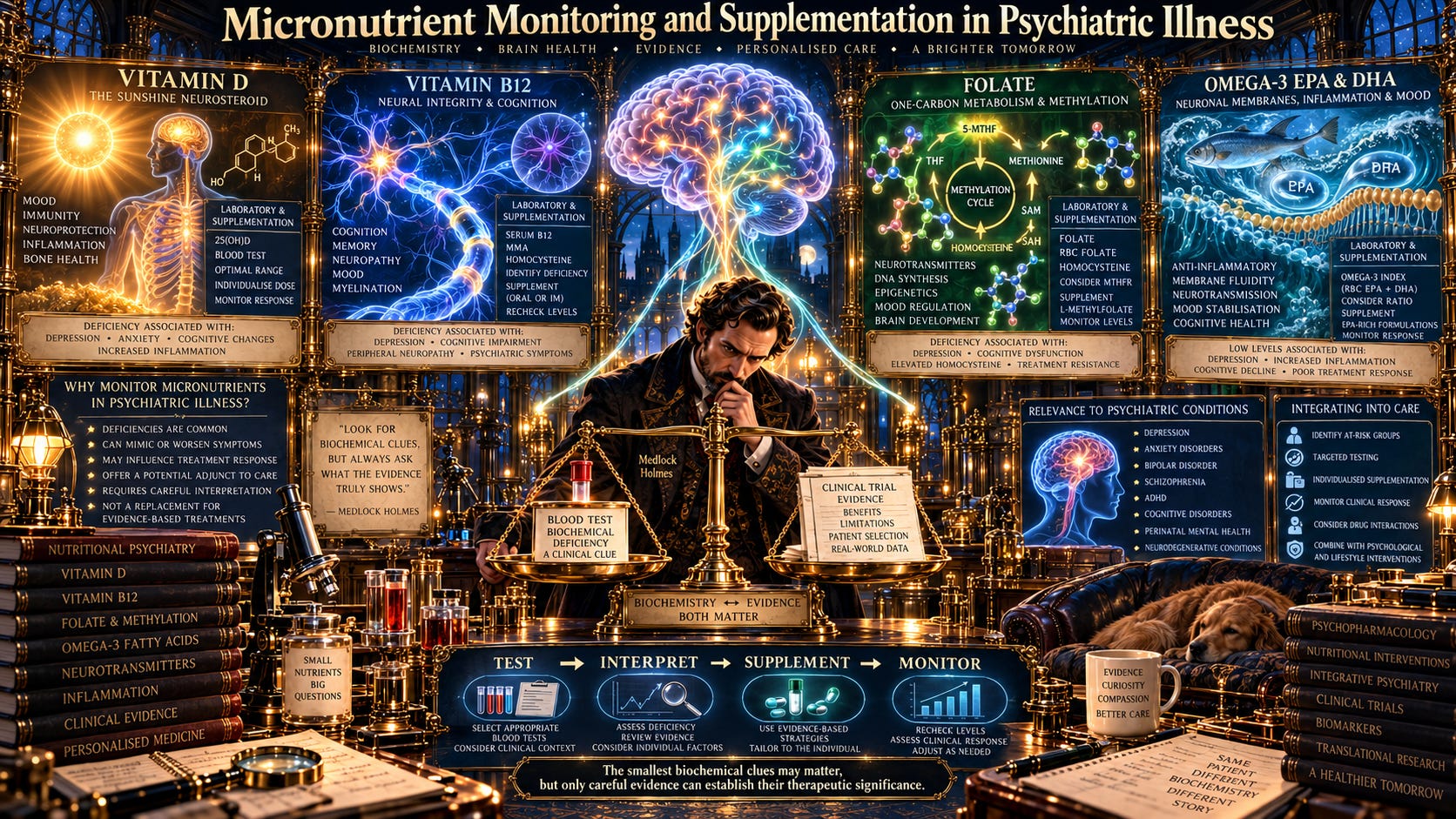
PSYCH 167: Micronutrient Monitoring and Supplementation in Psychiatric Illness
Description
The Laboratory of the Missing Elements
A curious case arrives at Baker Street.
Four patients have been referred to Medlock Holmes. Each has a psychiatric diagnosis. Each has been offered a nutritional supplement. And each has been promised that correcting an invisible biochemical imbalance might transform their mental health.
The first has depression and low vitamin D. The second has cognitive difficulties and borderline vitamin B12. The third has persistent depressive symptoms despite antidepressant treatment. The fourth has ADHD and has been advised to take fish oil.
Their stories sound remarkably similar.
But Holmes suspects that the evidence behind their treatments may be very different.
He leads his companion into The Laboratory of the Missing Elements, a vast Neo-Victorian scientific chamber containing four illuminated stations.
The First Station: The Sunlight Paradox
A glass dome fills with artificial sunlight.
Beneath it sits a bottle labelled Vitamin D.
Holmes discovers that low vitamin D levels have been associated with depression, ADHD and several other psychiatric conditions.
Yet association does not prove causation.
When he examines the clinical trials, he finds evidence suggesting that supplementation may improve depressive symptoms and, when added to methylphenidate, some ADHD symptoms in children.
But there is an important clue: many participants began with vitamin D deficiency or insufficiency.
Holmes writes:
LOW LEVEL → POSSIBLE CONTRIBUTION → TEST → CORRECT → REASSESS
The vitamin may be beneficial, but excessive supplementation can be harmful.
The Second Station: The Disguised Deficiency
The next station contains a neurological examination chart, a blood sample and a microscope.
Its label reads Vitamin B12.
Holmes meets a patient whose forgetfulness, irritability and low mood were initially attributed entirely to psychiatric illness.
A blood test reveals low B12.
The mystery is not whether B12 is essential for neurological function. It is whether supplementing B12 beyond correcting deficiency treats psychiatric disorders.
The evidence for the latter remains inadequate.
Holmes recognises the distinction:
Treating a genuine deficiency is not the same as prescribing a vitamin as a psychiatric medicine.
The Third Station: The Methylation Chamber
The walls are covered with pathways connecting folate, homocysteine and neurotransmitter synthesis.
Here Holmes examines folate and L-methylfolate.
Clinical trials suggest that adding folate to antidepressant treatment may improve depressive symptoms and remission rates.
But questions remain about optimal formulation, duration and whether baseline folate levels predict response.
The chamber also contains a warning: supplementation can have adverse effects, and high-dose methylfolate has occasionally been associated with agitation.
Holmes records:
BIOLOGICAL ROLE + CLINICAL EVIDENCE + PATIENT SELECTION = A MORE DEFENSIBLE TREATMENT DECISION
The Fourth Station: The Sea of Fatty Acids
The final room resembles an underwater observatory.
Two glowing molecules circle a model of the human brain.
They are EPA and DHA, the principal omega-3 fatty acids investigated in psychiatric research.
Holmes discovers that their effects are not interchangeable.
EPA-rich formulations appear more promising for depressive symptoms. Other combinations have been investigated for anxiety, ADHD and mild cognitive impairment.
Yet the same supplements have not demonstrated convincing benefits for core autism symptoms or established Alzheimer’s disease.
A treatment’s usefulness depends on the condition being treated.
The Final Deduction: The Evidence Balance
Listen Now
Love PodBriefly?
If you like Podbriefly.com, please consider donating to support the ongoing development.
Support Us