Episode Details
Back to Episodes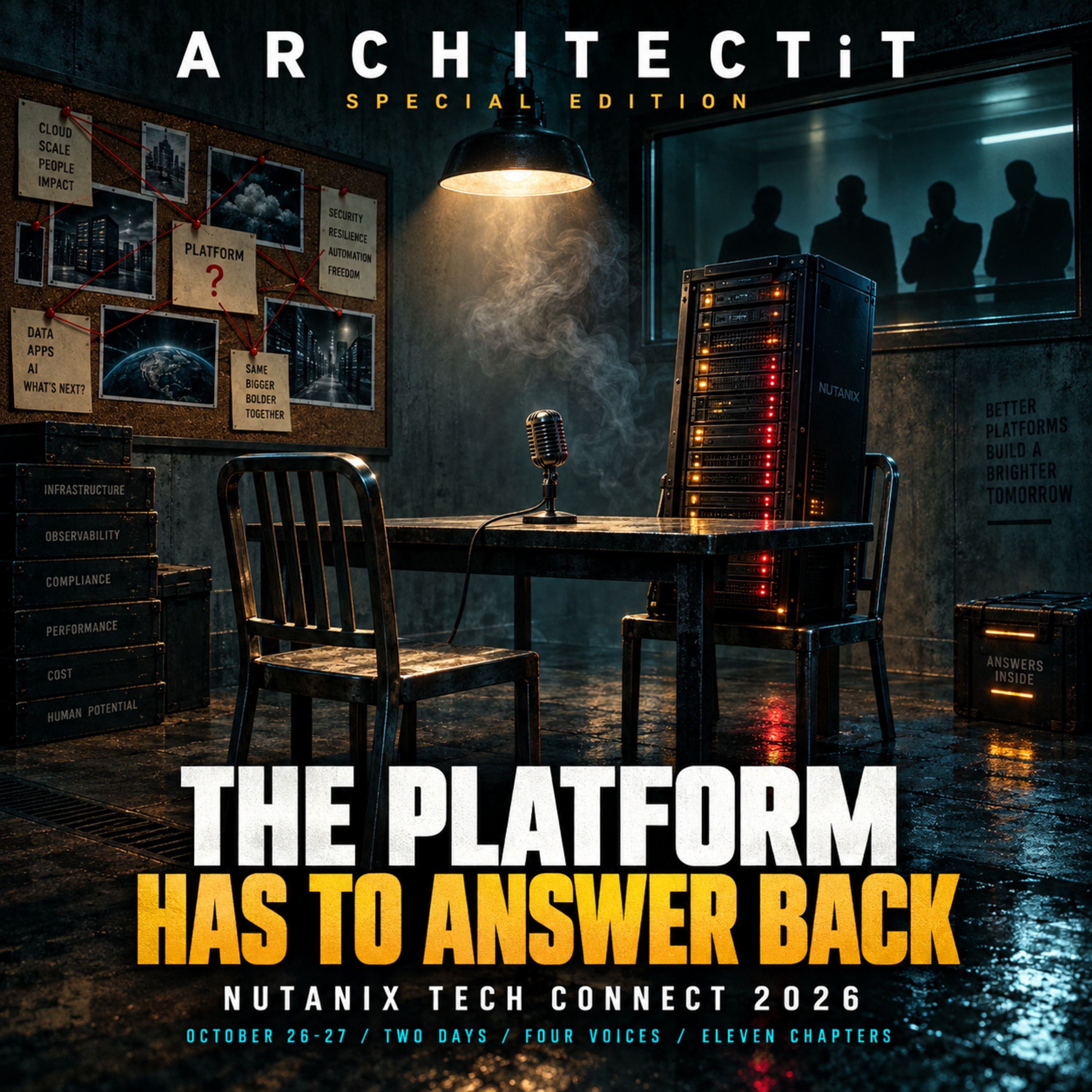
ArchitectIT Special: The Platform Has to Answer Back — Nutanix Tech Connect 2026
Description
ArchitectIT Special: The Platform Has to Answer Back — Nutanix Tech Connect 2026, one episode, two days.
October 26 and 27, 2026, San Jose. Two conference days and one question that kept getting harder: when a platform says it can do the work, what evidence tells us we can depend on it? This special folds both days into a single continuous panel episode with Forge hosting, Bella on evidence and technical precision, Michael on operating value and ownership, and Sage on boundaries and failure paths.
Day One asks whether the platform can keep running. Bella walks the Kubernetes and AI workload discussion — GPU operators, scheduling, drivers, tenant boundaries — and draws the line between a conformance badge and a throughput result. Michael turns the catalog conversation into an ownership conversation, and Sage asks what happens when the happy path breaks. The platform-update session follows: NKP Metal, an UpgradePlan API, fleet-oriented workflows with preflight and post-flight checks, and supported AHV VM operations through Kubernetes interfaces. The panel keeps "supported" doing real work in that sentence, separates orchestration from eligibility, and refuses to let an automatic plan approve its own risk. Then security: NKP Insights, priority insight cards, the open-source checking tools behind them, and the difference between a finding that was acknowledged, accepted, deferred, fixed or found not applicable. Finally deployment topologies and resilience — where the failure actually lands, and why a recovery plan is a design artifact rather than a paragraph.
Day Two asks who owns the work around it. The morning agentic AI session frames the unit of work as the task rather than the prompt, then splits inference from access to business tools. Service strategy brings restricted shell back to familiar infrastructure ground: a direction of change, not an affected-version list, and a reason to inventory Bash- and SSH-dependent automation before approving an upgrade. The portal discussion — assets, software distributions, Discoveries, NIVA and diagnostics — keeps observation, recommendation, evidence collection and remediation as separate steps. The corporate-social and LinkedIn session supplies the editorial lesson without adopting its algorithm claims. Enterprise AI goes deeper into model serving: Prisma AIRS separating pre-deployment checks from deployed-endpoint testing, and KV-cache offload plus multi-node inference both still marked Tech Preview with their requirements attached. The separate afternoon Agent Gateway session closes the loop with five governance verbs — Register, Route, Restrict, Record and Control — and the reminder that a control-plane resource test cannot establish data-plane capacity.
The joint test ties the days together through one hypothetical upgrade assistant, invented for explanation and not a customer story: a task that prepares a recommendation is not permission to change the cluster. The panel then brings its own work into the room, using Project Waypoint and Project Keystone as editorial code names for private routing and plugin-platform reviews, and the public Agent Guardrails Template as an inspectable example — with the honest boundary that a service validating submitted operations cannot inspect an action the host never sends it.
Nothing here is a benchmark result. These are presenter descriptions, vendor background and editorial acceptance-test questions kept visibly separate. Two male and two female voices, eleven chapters, chapter markers intact.
This episode — its research, script, panel dialogue, narration, voices, and production — was generated entirely by autonomous AI agents without human editorial review, pre-publication verification, or fact-checking by any natural person.