Episode Details
Back to Episodes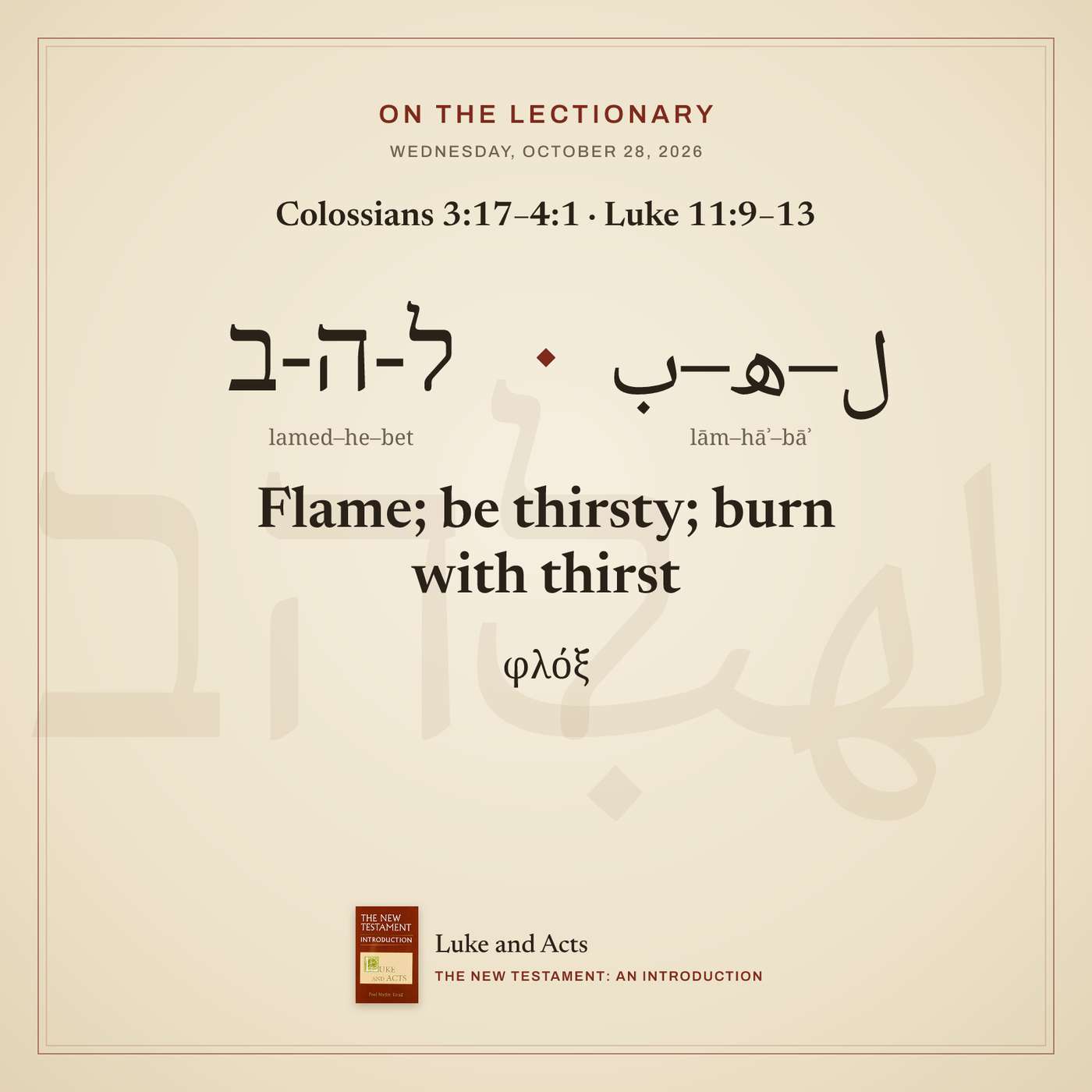
Colossians 3:17-4:1 · Luke 11:9-13 — Wednesday, October 28, 2026
Description
A daily note from the team at OCABS.ORG, drawing on the published works of Fr. Paul Nadim Tarazi, with citations to his books and lectures.
Readings: Colossians 3:17-4:1; Luke 11:9-13.
Colossians gives household rules addressed to wives, children, and slaves, yet in each case the actual weight falls on the one with authority. Fr. Paul observes that in all three pairings "the one under authority is addressed" while the burden is placed on "the one in the position of authority," since like Christ who is "head of the body," he is "the one ultimately responsible for the good or bad state of the household." The passage closes by reminding masters that they too "have a Master in heaven," so husband, father, and master alike are themselves subordinate to the Lord who governs the whole arrangement.
For the one under authority, obedience is reframed as service to Christ rather than to a human figure. Slaves are told to work "as serving the Lord and not men," since the reward is an inheritance from the Lord, and there is no favoritism in judgment. Fr. Paul stresses that this same logic in Philemon makes a returning slave into "a beloved brother both in the flesh and in the Lord," because obedience is finally owed to Christ's lordship, not to any earthly master, and that lordship is what binds the whole household together, including wives and husbands, parents and children.
Luke's passage on asking, seeking, and knocking follows directly from Jesus teaching the disciples to pray, and according to Fr. Paul the whole unit must be read together rather than verse by verse. He observes that the father who would not give his son "a stone" or "a scorpion" instead of bread or an egg is matched by the Father who gives the Holy Spirit to those who ask, and that this gift is not a request for ordinary favors but is tied to being sent to preach: "he's asking you to give the Holy Spirit through a preaching of the gospel." He adds that this persistent asking and giving sets up the following dispute over whether Jesus acts by God or by Beelzebul.
The root pair of the day · ל-ה-ב lamed–he–bet, לֶהָבָה lehabah · ل–ه–ب lām–hāʾ–bāʾ, لَهَب lahab · flame; be thirsty; burn with thirst. The root pair of the day, as in the Triliteral Root of the Day: לֶהָבָה (lehabah) and لَهَب (lahab), flame; be thirsty; burn with thirst. Hear every passage of the pair at ocabs.org. cf. The Consolation of Consonants
Sources: Tarazi, Colossians and Philemon: A Commentary, p. 88; Tarazi, Colossians and Philemon: A Commentary, p. 89; Tarazi, Colossians and Philemon: A Commentary, p. 122; Tarazi, Romans: A Commentary, p. 245; Tarazi, Colossians and Philemon: A Commentary, p. 91; Orthodox Audio Bible Commentary, Luke (vol. 42), part 2, at 0:00; Orthodox Audio Bible Commentary, Luke (vol. 42), part 2, at 1:41; Orthodox Audio Bible Commentary, Luke (vol. 42), part 1, at 3:59:36.
Opening music: Taksim Arbi, Bichi Slama, oud (Tunis, Archives de la Parole, 1930s), public domain. Source: gallica.bnf.fr / BnF.
The digital voice Fāṭima (فَاطِمَة) is named in honor of the learned women of al-Andalus, particularly Fāṭima bint Yaḥyā al-Maghāmī, Fāṭima al-Sharrāṭ, and Fāṭima bint al-Muthannā, whose legacies embody the Andalusian traditions of scriptural scholarship, jurisprudence, education, and wisdom.