Episode Details
Back to Episodes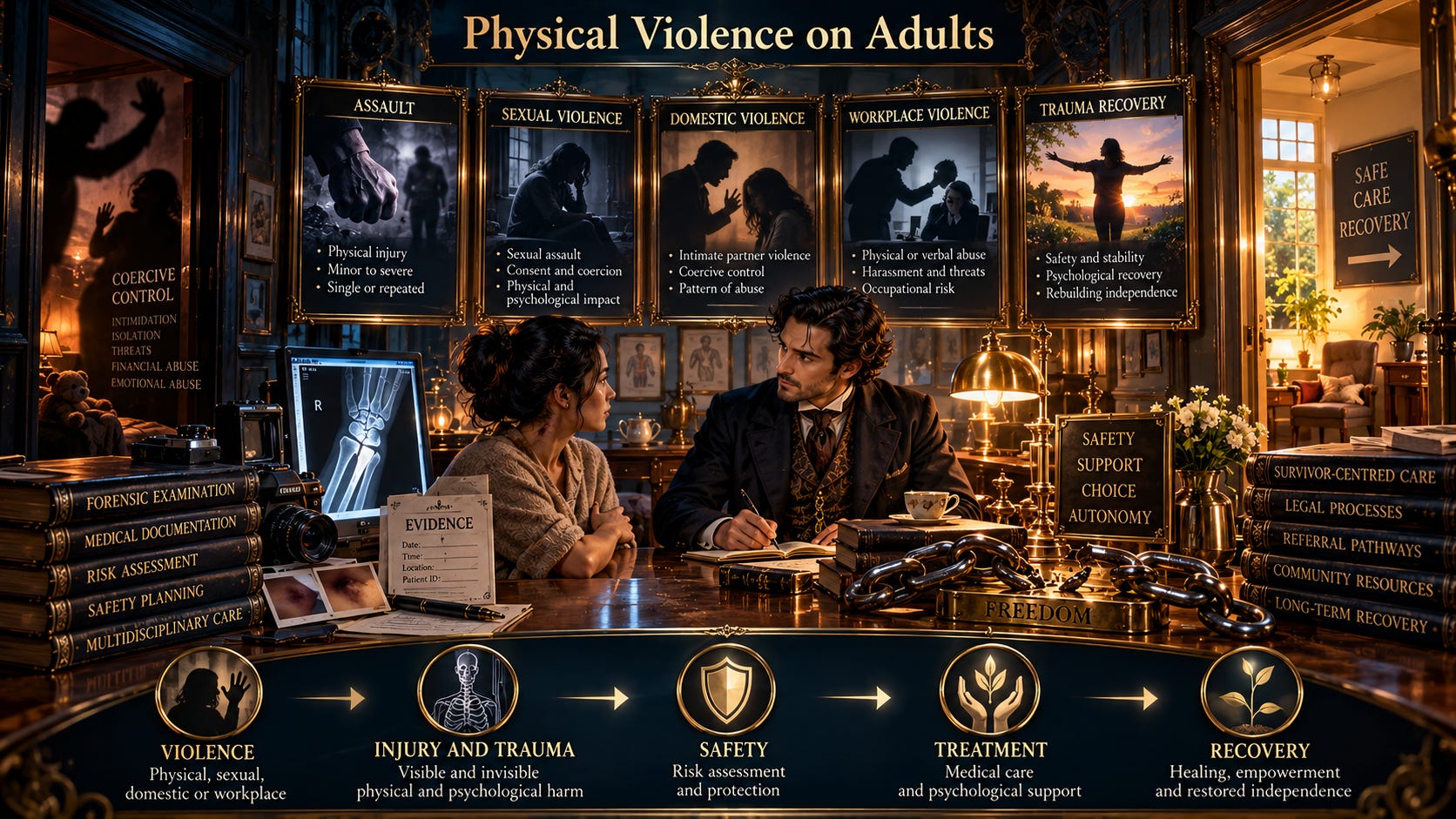
PSYCH 165: Physical Violence on Adults
Description
The House of Broken Safety
A woman arrives at Baker Street with a fractured wrist. She tells Medlock Holmes that she fell down the stairs.
Her husband, standing beside her, answers most of the questions.
Holmes notices three things: the woman’s hesitation, her husband’s insistence on remaining in the room, and the fear that appears whenever she is asked about returning home.
The fracture is visible. The danger is not.
Holmes opens the doors to The House of Broken Safety, where physical violence is revealed not as a single event, but as a complex interaction of injury, power, vulnerability, trauma and survival.
The First Chamber: The Many Faces of Violence
Violence takes different forms: assault, sexual violence, intimate partner violence, workplace aggression and abuse of vulnerable adults.
Holmes discovers that victims are not confined to any particular age, gender or social group.
Some are assaulted by strangers. Others are harmed by people they know, trust or depend upon.
In sexual violence, the familiar image of an unknown attacker is particularly misleading. Many assaults are perpetrated by acquaintances, partners or other known individuals.
In domestic violence, Holmes finds an even more troubling pattern: the repeated use of fear, intimidation, isolation and abuse to establish power and control.
He writes:
VIOLENCE ≠ PHYSICAL INJURY ALONE
The Second Chamber: The Invisible Injuries
Beyond the examination room lies a gallery of symptoms.
A survivor experiences nightmares and intrusive memories.
Another develops depression, anxiety and chronic pain.
A third struggles with shame, emotional numbing, sexual difficulties and substance misuse.
Holmes recognises that the consequences of violence extend far beyond the immediate injury.
Post-traumatic stress disorder, depression, anxiety, substance misuse, dissociation and suicidal behaviour may emerge or persist long after an assault.
He also discovers the importance of social responses. Supportive relationships can promote recovery, while disbelief, blame and rejection may intensify suffering.
The response to trauma can become part of either the injury or the healing.
The Third Chamber: The Interview That Can Harm
Holmes observes a clinician questioning a survivor.
The questions are rapid, the details intrusive, and the patient is repeatedly asked to describe the assault.
The clinician intends to help, but the patient becomes increasingly distressed.
Holmes recognises the danger of inadvertently recreating the experience of powerlessness.
A trauma-informed assessment requires privacy, explanation, choice, sensitivity and attention to the patient’s pace.
The survivor must not be reduced to a collection of injuries or an account of the crime.
Holmes writes:
SAFETY → TRUST → CHOICE → ASSESSMENT → RECOVERY
The Fourth Chamber: The Question of Safety
A patient may be medically stable but still unsafe.
Holmes therefore looks beyond the presenting injury.
Can the patient return home safely?
Does the perpetrator have continuing access?
Is there a risk of further assault?
Are suicidal thoughts, severe dissociation, psychosis or overwhelming emotional distress compromising safety?
Is hospital admission necessary?
What legal and safeguarding responsibilities apply?
Holmes understands that successful treatment begins not with a prescription or psychotherapy, but with establishing safety.
The Fifth Chamber: Rebuilding a Life
The final chamber contains no instruments of investigation.
Instead, there is a therapeutic room, a network of supportive relationships and an open door.
Holmes examines trauma-focused cognitive-behaviou