Episode Details
Back to Episodes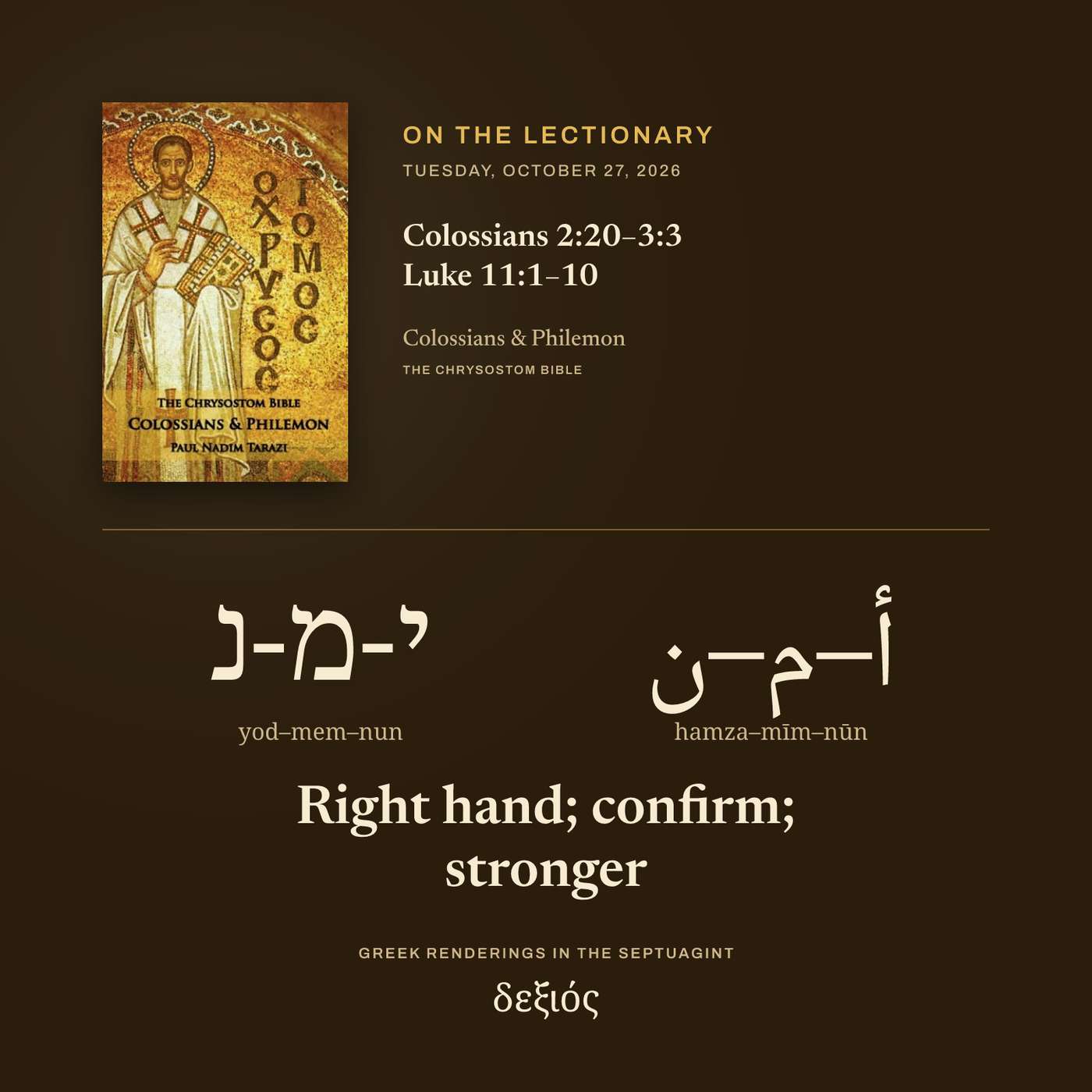
Colossians 2:20-3:3 · Luke 11:1-10 — Tuesday, October 27, 2026
Description
A daily note from the team at OCABS.ORG, drawing on the published works of Fr. Paul Nadim Tarazi, with citations to his books and lectures.
Readings: Colossians 2:20-3:3; Luke 11:1-10.
Colossians presents the community as a household now headed by Christ, seated at God's right hand, and tells them to set their minds "on things that are above, not on things that are on earth." Fr. Paul reads this household imagery against the Roman patrician system: Christ has replaced the paterfamilias, and the believers' citizenship is still ahead of them, not yet possessed. The regulations Paul rejects are dismissed as merely "human precepts and doctrines," things that "perish as they are used" and only seem to be "a word of wisdom in promoting rigor of devotion and self-abasement," yet cannot check self-indulgence.
Fr. Paul ties this warning directly to Galatians, noting that the phrase about the "elemental spirits of the world" is found elsewhere in the New Testament only in that letter, where believers freed by God are warned against turning back to what enslaved them before. Having been delivered from such powers, the Colossians are not to submit to another human authority's precepts about food and festivals. Baptism itself replaces circumcision as the marker of belonging to Christ's body, so that the believer has already "died," and his life is now hidden with Christ, to be revealed in glory only when Christ himself is made manifest.
In Luke, when a disciple asks Jesus to teach them to pray, Fr. Paul stresses that Jesus hands over his own prayer, addressing God simply as Father, a form he says only Jesus used, apart from this one instance given to the disciples. The request for daily bread he connects to the community being fed through teaching, and forgiveness is asked for only as the disciples themselves forgive those in debt to them. The parable that follows, the friend roused at midnight, is read as teaching persistence in asking: "though he will not rise and give him anything because he is his friend," the neighbor nonetheless gets up and gives what is needed, and Jesus tells the disciples to keep asking, seeking, and knocking.
The root pair of the day · י-מ-נ yod–mem–nun, יָמִין yamin · أ–م–ن hamza–mīm–nūn, آمَنَ ʾāmana · right hand; confirm; stronger. Leḥem and laḥm underlie the artos of Luke's Lord's Prayer: "give us day by day our daily bread." The note reads this bread as the community being fed through teaching, not mere sustenance. The friend at midnight who rises to give bread mirrors this persistent asking for what truly feeds. cf. The Consolation of Consonants
Sources: Tarazi, Colossians and Philemon: A Commentary, p. 80; Tarazi, Colossians and Philemon: A Commentary, p. 65; Tarazi, Colossians and Philemon: A Commentary, p. 66; Tarazi, Colossians and Philemon: A Commentary, p. 77; Tarazi, Colossians and Philemon: A Commentary, p. 79; Tarazi, Colossians and Philemon: A Commentary, p. 81; Tarazi, The New Testament: An Introduction, vol. 1, Paul and Mark, p. 108; Orthodox Audio Bible Commentary, Luke (vol. 42), part 1, at 3:54:53; Orthodox Audio Bible Commentary, Luke (vol. 42), part 1, at 3:57:04; Orthodox Audio Bible Commentary, Luke (vol. 42), part 1, at 3:59:36; Tarazi, Galatians: A Commentary, p. 213.
Opening music: Taksim Arbi, Bichi Slama, oud (Tunis, Archives de la Parole, 1930s), public domain. Source: gallica.bnf.fr / BnF.
The digital voice Fāṭima (فَاطِمَة) is named in honor of the learned women of al-Andalus, particularly Fāṭima bint Yaḥyā al-Maghāmī, Fāṭima al-Sharrāṭ, and Fāṭima bint al-Muthannā, whose legacies embody the Andalusian traditions of scriptural scholarship, jurisprudence, education, and wisdom.