Episode Details
Back to Episodes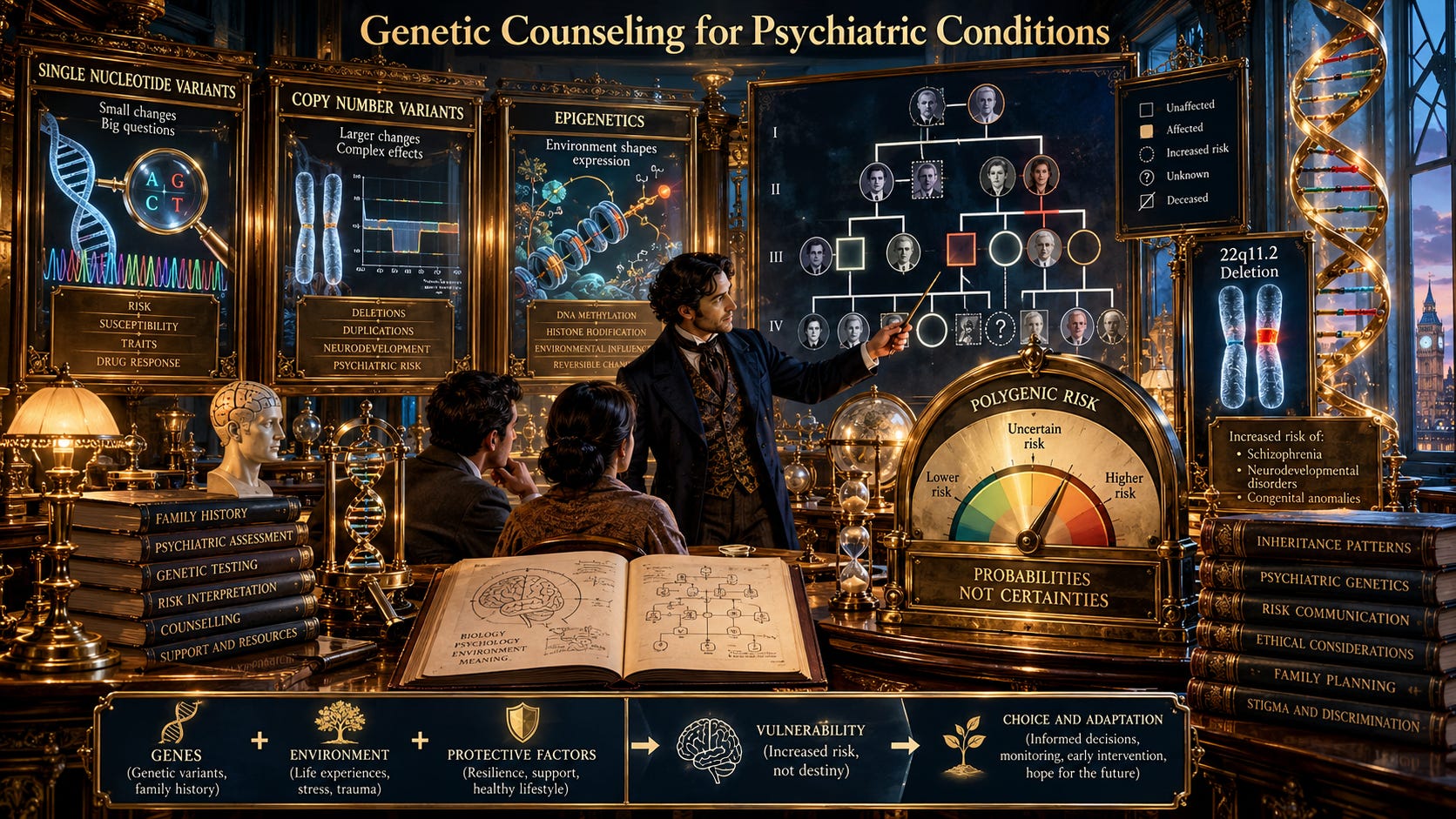
PSYCH 164: Genetic Counseling for Psychiatric Conditions
Description
The House of Inherited Shadows
A sealed letter arrives at Baker Street.
Inside is a family tree spanning four generations. Several names are marked in crimson: schizophrenia, bipolar disorder, depression and obsessive-compulsive disorder.
The accompanying note contains a single question:
“If mental illness runs in my family, is it inevitable that my children will inherit it?”
Medlock Holmes recognises the question immediately. It is not merely an enquiry about genetics. Beneath it lie fear, guilt, responsibility and the desire to protect those we love.
He enters the House of Inherited Shadows, where five mysteries await.
The First Mystery: The Family That Feared Its Future
A woman with bipolar disorder longs to become a mother but fears passing on her illness.
A father with recurrent depression watches his teenage children anxiously, interpreting every emotional fluctuation as a possible warning sign.
A young woman brings Holmes a commercial genetic report predicting an increased risk of psychiatric illness.
And a couple asks whether genetic testing could help them select an embryo guaranteed never to develop schizophrenia.
Holmes examines their questions and discovers a shared misunderstanding:
Genetic vulnerability is not genetic certainty.
Psychiatric disorders generally arise through complex interactions between numerous genetic variants, environmental exposures and protective influences.
The inheritance of susceptibility does not guarantee the development of illness.
The Second Mystery: The Three Genetic Keys
Holmes enters a laboratory containing three illuminated cabinets.
The first contains single nucleotide variants - small alterations in DNA, many of which are common and individually exert only modest effects on psychiatric risk.
The second contains copy number variants - deletions or duplications of chromosomal segments that may carry substantially greater clinical significance.
The third contains epigenetic mechanisms - processes influencing gene expression without altering the underlying DNA sequence.
Holmes discovers that some genetic influences cross traditional diagnostic boundaries. A variant associated with schizophrenia may also influence vulnerability to other psychiatric conditions.
He examines 22q11.2 deletion syndrome, in which a chromosomal deletion can be associated with congenital anomalies, developmental differences and an increased likelihood of psychosis.
The central deduction is:
GENETIC SUSCEPTIBILITY ≠ DIAGNOSIS
The Third Mystery: The Numbers That Mislead
Holmes turns to the family pedigree.
He discovers that the probability of psychiatric illness depends on more than the number of affected relatives.
The degree of biological relationship, age at onset, severity of illness, diagnostic accuracy and clustering of conditions all influence interpretation.
A family history of schizophrenia may increase a relative’s risk substantially above the population average, but most relatives will still not develop schizophrenia.
Holmes also examines polygenic risk scores, which combine information from many genetic variants.
These scores may estimate susceptibility at a population level, but they cannot reliably predict whether a particular individual will develop a psychiatric disorder.
He writes across the blackboard:
HERITABILITY ≠ INDIVIDUAL DESTINY
RELATIVE RISK ≠ ABSOLUTE RISK
POLYGENIC RISK SCORE ≠ CLINICAL DIAGNOSIS
The Fourth Mystery: The Burden of Blame
In a quiet consultation room, Holmes meets a mother who believes she caused her daughter’s eating disorder by passing on defective genes.
Another family believes that psychiatric illness must have resulted from inadequate parenting.
Hol