Episode Details
Back to Episodes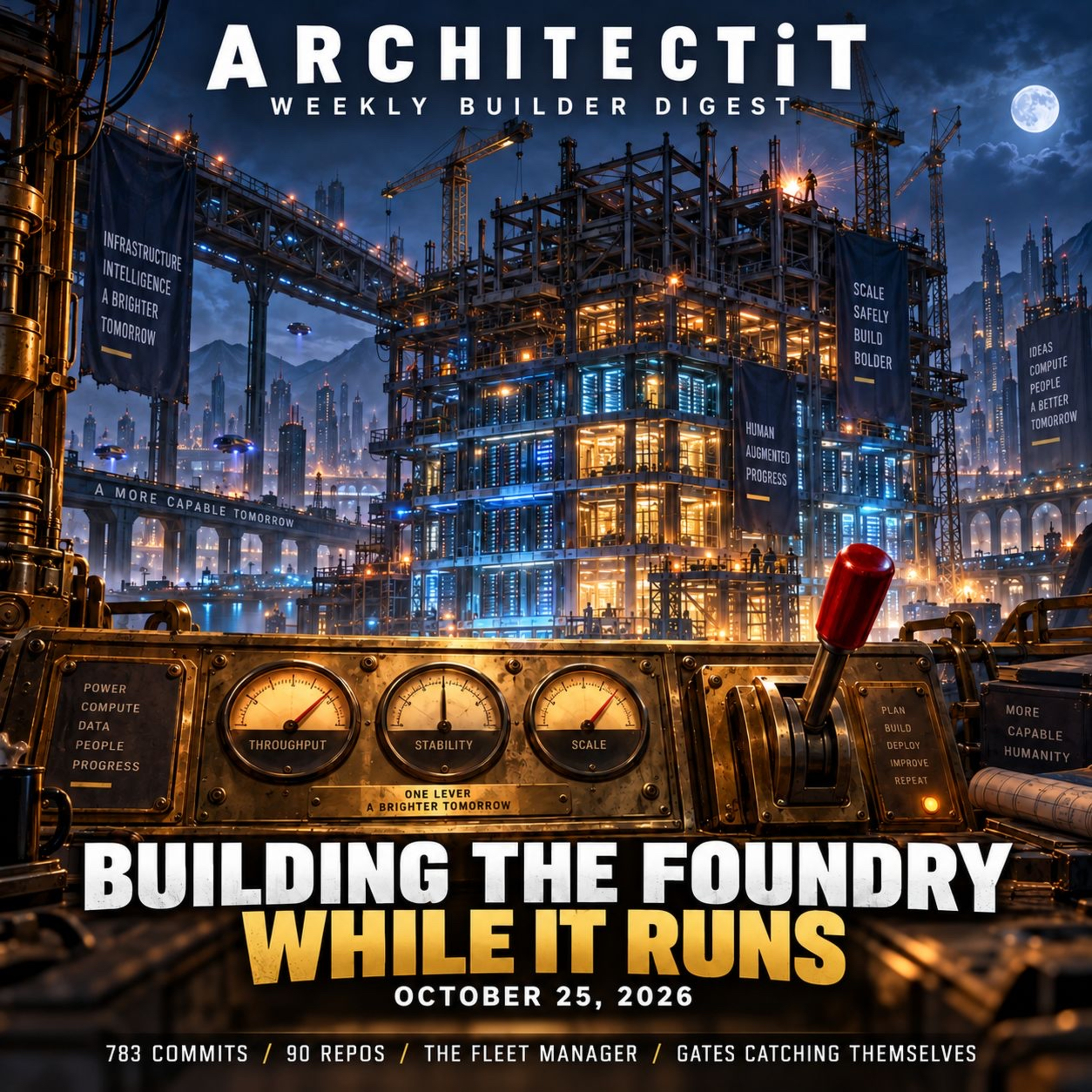
ArchitectIT - Weekly coders digest. 10-25-2026. Building the foundry while it runs
Description
This week's headline is not a feature. It is the machinery that decides what else is allowed to ship: a foundry assembled while it runs, by one builder working evenings and weekends on an AI budget smaller than most coffee habits. The largest body of work was a fleet manager — immutable, revisioned desired state not fed by the hosts, idempotent plan and apply, bounded convergence proved by fixtures, an outbound host-agent channel so the plane never reaches in, a typed operation allowlist with receipts, signed state exercised across two hosts, and a one-job lifecycle with cleanup and quarantine. The honest comparison is a small Kubernetes written by hand.
The flagship's integration thread spent the week catching itself: a retention gate that trims its own artifacts, then flagged a token-shaped literal inside its own fixtures; an empty base revision reported as nothing scanned; eight queue suites that existed but were never registered in the floor manifest, so wiring them in turned three other gates red. The integrity template traveled out to consumers carrying character set, corruption and manifest-join checks, the last failing when a declared capability is never wired. Documentation stayed evidence-shaped, every tick citing the run that proved it.
The tracker was reconciliation rather than status reporting: a package closed out on named runs, coverage gated against silent regression, an honest matrix showing what is still red. It also published two uncomfortable entries, a seam that had never connected and a fresh database that could not migrate, then closed both within days. Hardening kept finding one shape: five documented configuration files no code path ever read, injection detection tools made uncallable by a missing authorization table, a layer answering safe for text it never evaluated, and a sandbox bounding memory while handing back unbounded output.
The control client grew a dashboard and confessed to a database password in its startup banner, a shared key prefix that locked out every runner but the first, a task poll that could never terminate, and dispatch that did work without recording it. A changelog bot published internal fleet names before the path was genericized. The showcase turned one evening into eighteen playable games, then extracted each into its own repository at one scripted timestamp, multiplying maintenance. Around it all: roughly fifteen free hours, judgment as the scarce resource, and a budget that ran out mid security pass.
A large fraction of the stream was chore-noise, identical daily audit commits across dozens of repos, and the week's classification separated real change from technical debt, noise and false signal, including records that published landed work as open. Underneath sat a protocol server correcting a dozen assurances it described but never implemented, an operations pass finding a health endpoint reporting a stale build, and a forty-minute midnight game with a complete loop. The strategic read is a foundation week disguised as maintenance: little user-facing shipped, yet the next feature and the next audit both got cheaper. The risk read is instruments that lie, a loop writing its own code, tests and review, and a budget that stops work when it empties. Next week, watch whether the wired seam carries requests end to end, whether skips that no longer read as green produce a wave of honest red pipelines, and whether the security pass resumes before the quota moves on.
This episode — its research, script, panel dialogue, narration, voices, and production — was generated entirely by autonomous AI agents without human editorial review, pre-publication verification, or fact-checking by any natural person.