Episode Details
Back to Episodes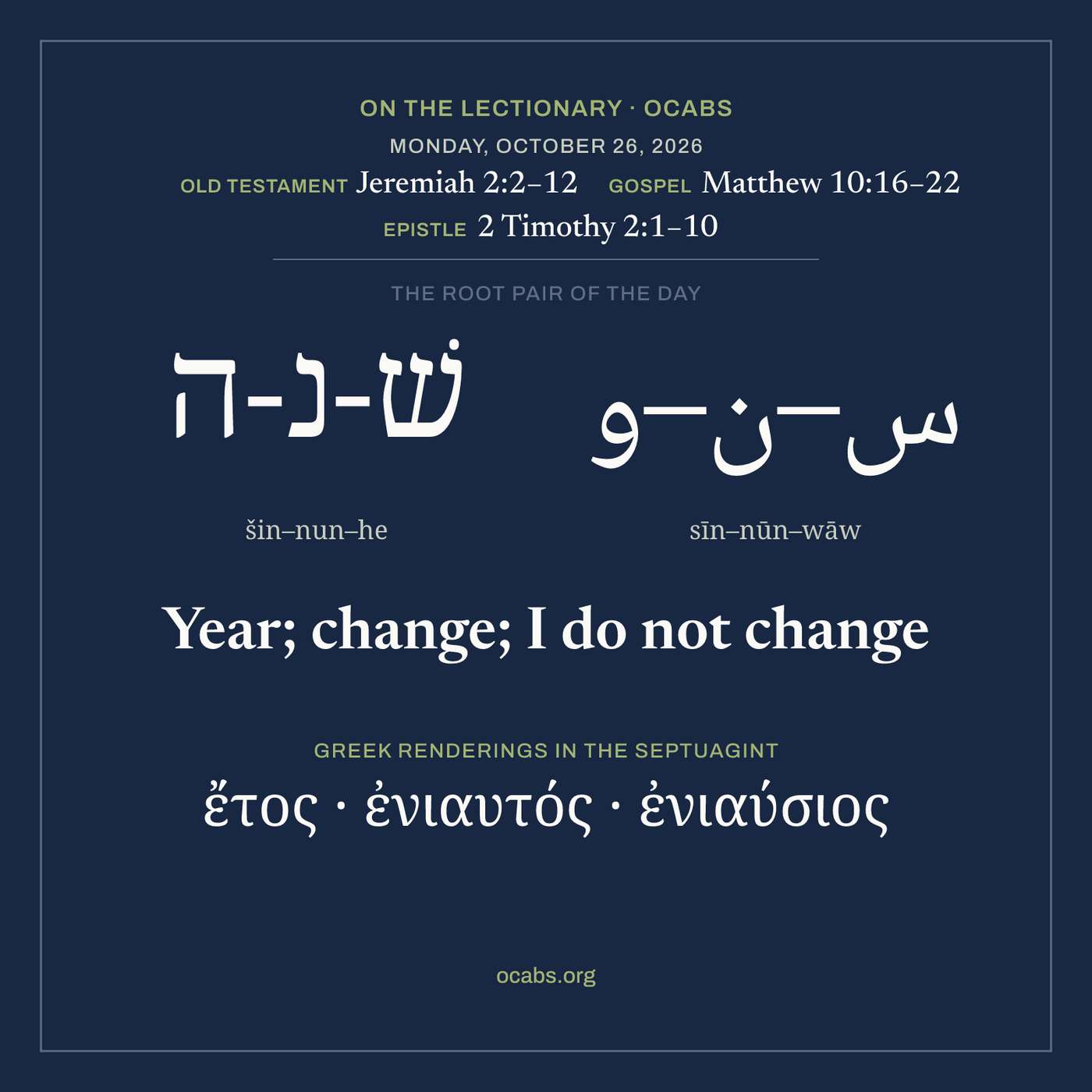
Jeremiah 2:2-12 · Matthew 10:16-22 · Matthew 8:23-27 · 2 Timothy 2:1-10 · John 15:17-16:2 · Colossians 2:13-20 · Luke 10:22-24 — Monday, October 26, 2026
Description
A daily note from the team at OCABS.ORG, drawing on the published works of Fr. Paul Nadim Tarazi, with citations to his books and lectures.
Readings: Jeremiah 2:2-12; Matthew 10:16-22; Matthew 8:23-27; 2 Timothy 2:1-10; John 15:17-16:2; Colossians 2:13-20; Luke 10:22-24.
Jeremiah's opening indictment recalls Israel brought out of Egypt into a plentiful land, only to defile it and turn God's heritage into "an abomination." The people never asked where the Lord was who had led them through the wilderness, and the priests too failed to seek him. Fr. Paul explains that the charge is a failure to "truly execute justice one with another," since the people oppressed the alien, the fatherless, and the widow while standing shamelessly in God's own house, assuming he would not notice. God does see and does care, and this is what provokes his contention with them.
The summons to the coastlands to witness a nation that has not changed its gods, while Israel traded its glory for what does not profit, is for Fr. Paul the root diagnosis of Israel's collapse: the people forsook the fountain of living waters for broken cisterns. He traces this language of idols and abominations forward into Ezekiel, where the same indictment falls on a people who are stubborn and "of a hard forehead," unwilling to listen even to a prophet sent in their own tongue. The heart once touched by God's hand, Fr. Paul writes, "becomes incapable of living without a divine touch" and so turns to false gods instead.
Matthew's sending of the disciples as sheep among wolves draws, in Fr. Paul's reading, on the eschatological discourse found later in Mark and Luke, placed early by Matthew so that the mission to Israel and to the nations sound alike from the start. He stresses that it is "the Spirit of your Father speaking through you," and that destruction and life run through the whole speech, with endurance "to the end" as the condition of being saved. The calming of the storm, read alongside this sending, is for Fr. Paul a literary preview of Jesus' death and resurrection: the crossing toward Gentile territory, the disciples of little faith, and the crowd marveling, "what kind of man is this," all anticipating a mission opened to every nation.
The root pair of the day · שׁ-נ-ה šin–nun–he, שָׁנָה šanah · س–ن–و sīn–nūn–wāw, سِنِين sinīn · year; change; I do not change. The root pair of the day, as in the Triliteral Root of the Day: שָׁנָה (šanah) and سِنِين (sinīn), year; change; I do not change. Hear every passage of the pair at ocabs.org. cf. The Consolation of Consonants
Sources: Tarazi, Jeremiah: A Commentary, p. 39; Tarazi, Decoding Genesis 1–11, p. 138; Tarazi, The Old Testament: An Introduction, vol. 2, Prophetic Traditions, p. 12; Tarazi, Land and Covenant, p. 263; Tarazi, Jeremiah: A Commentary, p. 84; Tarazi, The Pastorals: A Commentary, p. 72; Tarazi, The New Testament: An Introduction, vol. 4, Matthew and the Canon, p. 170; Tarazi, The New Testament: An Introduction, vol. 4, Matthew and the Canon, p. 157; Orthodox Audio Bible Commentary, Matthew (vol. 40), part 1, at 2:31:25.
Opening music: Taksim Arbi, Bichi Slama, oud (Tunis, Archives de la Parole, 1930s), public domain. Source: gallica.bnf.fr / BnF.
The digital voice Fāṭima (فَاطِمَة) is named in honor of the learned women of al-Andalus, particularly Fāṭima bint Yaḥyā al-Maghāmī, Fāṭima al-Sharrāṭ, and Fāṭima bint al-Muthannā, whose legacies embody the Andalusian traditions of scriptural scholarship, jurisprudence, education, and wisdom.