Episode Details
Back to Episodes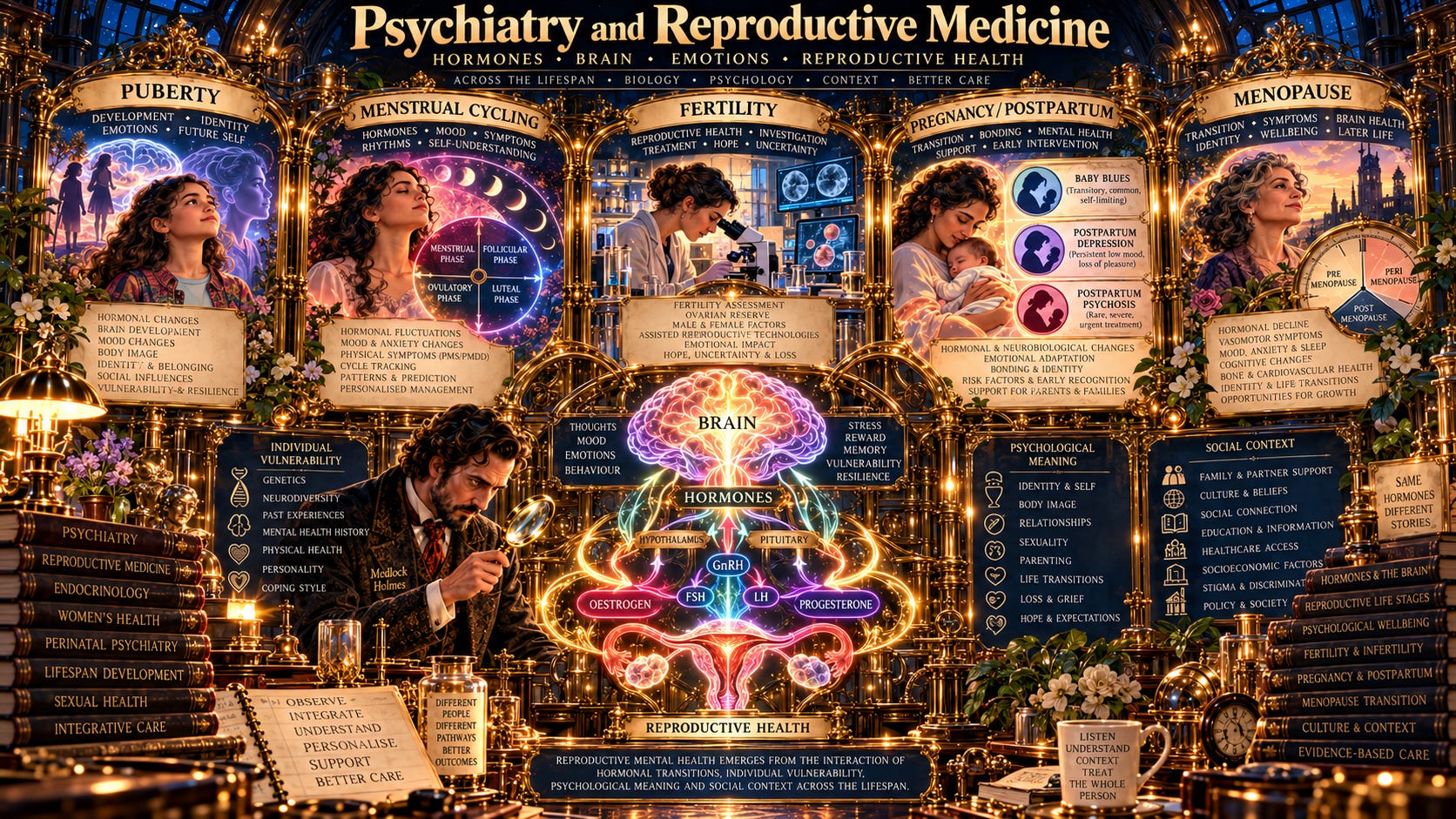
PSYCH 163: Psychiatry and Reproductive Medicine
Description
Medlock Holmes investigates the extraordinary relationship between the reproductive system and the human mind.
On a cold London morning, Medlock Holmes receives an unusual summons from the Royal Institute of Reproductive Medicine.
The Institute’s physicians have encountered a series of apparently unrelated mysteries.
A young woman develops severe depression during the week preceding menstruation, only to recover shortly after bleeding begins.
Another experiences profound psychological distress following repeated unsuccessful attempts to conceive.
A third, previously stable for years, develops a severe depressive episode during pregnancy.
A new mother becomes overwhelmed by terrifying thoughts of accidentally harming her infant, although she desperately wants to protect the child.
And elsewhere in the maternity hospital, another mother has stopped sleeping, begun expressing bizarre beliefs about her newborn and appears increasingly disconnected from reality.
The physicians have investigated each case separately.
Holmes, however, suspects that they share a common thread.
He enters an enormous conservatory divided into five chambers, each representing a different season of reproductive life.
Across the ceiling runs an intricate brass network connecting the ovaries, hypothalamus, pituitary gland, adrenal system and brain.
Holmes studies the machinery.
The reproductive system influences the brain, but the brain also regulates reproduction.
The relationship is not a simple chain of hormonal causes and psychiatric effects.
It is a continuous, bidirectional conversation involving hormones, neurotransmitters, stress physiology, immune signalling, psychological experience and social circumstances.
The First Investigation: The Biological Clockwork
Holmes begins in the Chamber of Development.
He examines how chromosomal signals, gonadal differentiation and hormonal exposure shape reproductive anatomy and physiology.
He traces the emergence of the hypothalamic–pituitary–gonadal axis, the maturation of reproductive function during puberty and the establishment of menstrual cycling.
A brass mechanism displays the central reproductive pathway:
HYPOTHALAMUS → GnRH → PITUITARY → LH/FSH → GONADS → SEX STEROIDS
Yet Holmes discovers that this machinery is highly sensitive to conditions elsewhere in the body.
Stress, inadequate nutrition, excessive exercise, severe illness and changes in energy availability can alter hypothalamic signalling and reproductive function.
In some circumstances, psychological and physiological stress contribute to functional hypothalamic amenorrhoea.
In others, reproductive hormonal fluctuations influence mood, cognition and behaviour.
Holmes identifies the first essential distinction:
Reproductive biology can affect mental health, while mental health and its physiological consequences can affect reproductive biology.
He also recognises that reproductive anatomy, chromosomal characteristics, gender identity and sexual orientation are distinct dimensions of human experience.
Clinical care must therefore be guided by the individual’s anatomy, physiology, identity and preferences rather than assumptions based on gender alone.
The Second Investigation: The Menstrual Clock
The next chamber contains an extraordinary clock with a twenty-eight-day dial.
Its hands move through the follicular phase, ovulation and luteal phase before returning to menstruation.
Holmes observes the coordinated changes in oestradiol, progesterone, gonadotrophins and neuroactive steroid metabolites.
But the mystery is not simply how much hormone is present.
Two patients may experience similar hormonal fluctuations yet have markedly different emotional responses.
The critical issue may be sensitivity to n