Episode Details
Back to Episodes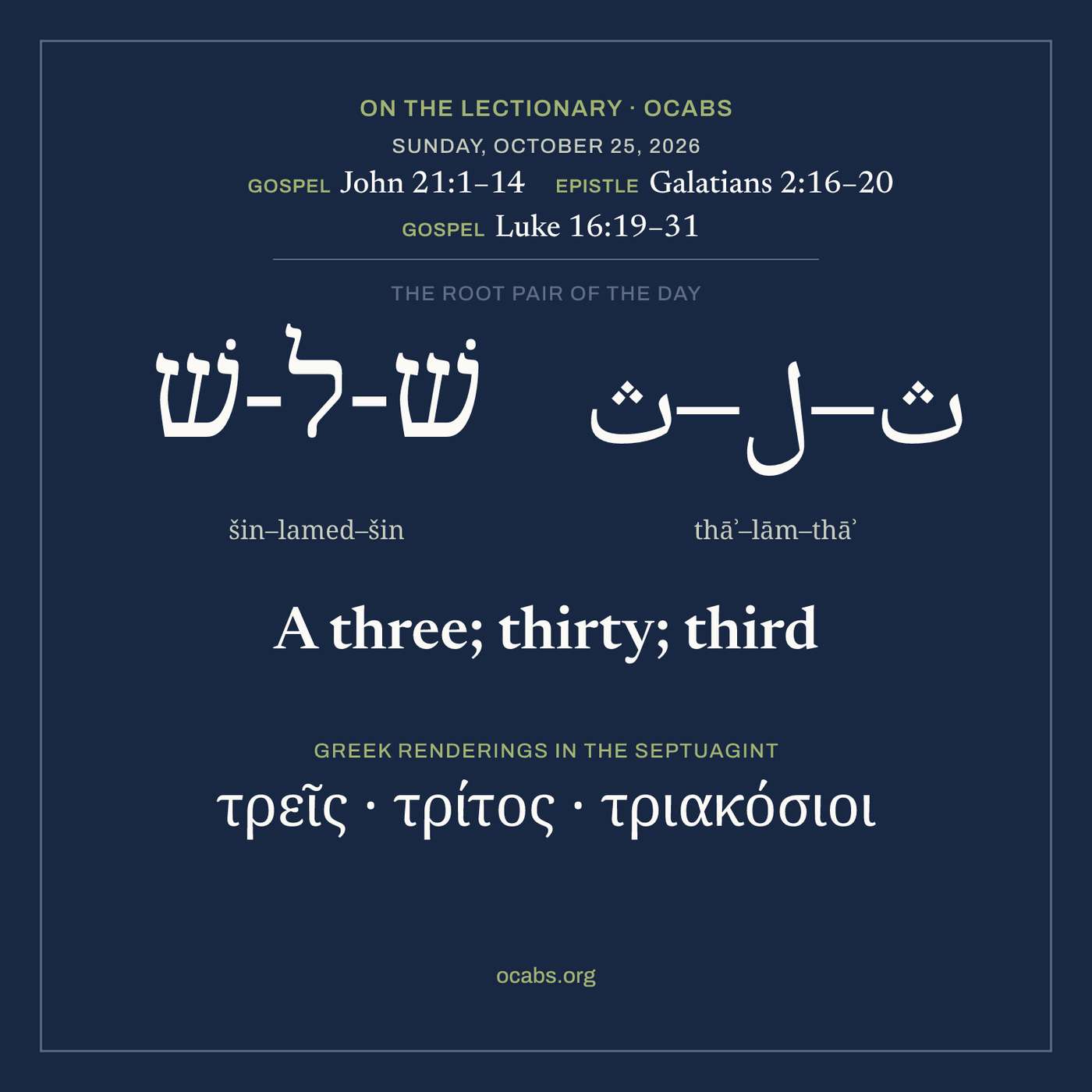
John 21:1-14 · Galatians 2:16-20 · Luke 16:19-31 — Sunday, October 25, 2026
Description
A daily note from the team at OCABS.ORG, drawing on the published works of Fr. Paul Nadim Tarazi, with citations to his books and lectures.
Readings: John 21:1-14; Galatians 2:16-20; Luke 16:19-31.
John's account of the fish catch at Tiberias is built to recall the resurrection itself: the "early morning" when Jesus stands on the shore echoes Mark's resurrection narrative, and the word "already," used in verse 4 and again in verse 14, ties the catch directly to the statement that this was the third time Jesus was revealed after rising from the dead. Fr. Paul reads Peter's situation as a new beginning, since the apostle still does not grasp what the Messiah is about and must learn again, this time through a story of fishing that becomes a figure of mission. Peter's stripping off and putting on of his garment is read against Paul's language of nakedness and clothing in 2 Corinthians, marking Peter's transformation. The catch of one hundred fifty-three fish, numbered as if they were people, signals the Gentiles now grafted in alongside Israel, and the meal that follows, where Jesus takes bread and fish and gives it to the disciples, is read as Eucharistic imagery completing the resurrection revelation, with the number three expressing assuredness and completeness just as Jesus' three days in the tomb did.
Galatians states plainly that no one is justified by works of the law but through faith in Jesus Christ, and that pursuing righteousness by law leads only backward, as if rebuilding what Christ tore down. Fr. Paul notes that Paul here moves from calling Jesus "Christ" seven times to the unexpected title "Son of God," a shift called forth by the mention of self-sacrifice, reminding the hearer of God's fatherhood precisely where Paul speaks of being "crucified with Christ." The law itself put Paul under a curse, a death sentence, so that being crucified with Christ "through the Law" is no abstraction but the real verdict of that curse working itself out.
On the rich man and Lazarus, Fr. Paul reads the final exchange with Abraham as turning on the correct interpretation of scripture, since the brothers will not repent even at a resurrection unless they accept the "word of God" as Paul rightly interpreted it, referring to Moses and the prophets. The torment the rich man suffers uses the same term applied earlier in Luke to the Gentile spirit tormented by Jesus' message, and the rich man cannot be "convinced" by a resurrection because he is already convinced of his own righteousness, the same self-assured stance Romans names as the source of downfall. The name Lazarus is drawn from the Hebrew eli'ezer, meaning God is his help, and Fr. Paul notes it is carried over into John's Gospel for the raising of Lazarus of Bethany, another story of acceptance and rejection of the gospel.
The root pair of the day · שׁ-ל-שׁ šin–lamed–šin, שָׁלֹשׁ šaloš · ث–ل–ث thāʾ–lām–thāʾ, ثَلاثَة thalātha · a three; thirty; third. The root šaloš and thalātha, "three," marks completeness in the note: John 21 names this "the third time" Jesus was revealed after rising, with "already" in verses 4 and 14 tying the fish catch to the resurrection pattern of three days in the tomb. The Greek tritos appears in Mark 9:31's "on the third day he will rise," the same assurance the note finds repeated in John's third revelation. cf. The Consolation of Consonants
Sources: Tarazi, The New Testament: An Introduction, vol. 3, Johannine Writings, p. 259; Tarazi, Decoding Genesis 1–11, p. 140; Tarazi, The New Testament: An Introduction, vol. 3, Johannine Writings, p. 261; Tarazi, The New Testament: An Introduction, vol. 3, Johannine Writings, p. 263; Tarazi, Galatians: A Commentary, p. 26; Tarazi, Galatians: A Commentary, p. 87; Tarazi, Galatians: A Commentary, p. 82; Tarazi, The New Testament: An Introduction, vol. 2, Luke and Acts, “The Prodigal Son (11–32)”; Tarazi, T