Episode Details
Back to Episodes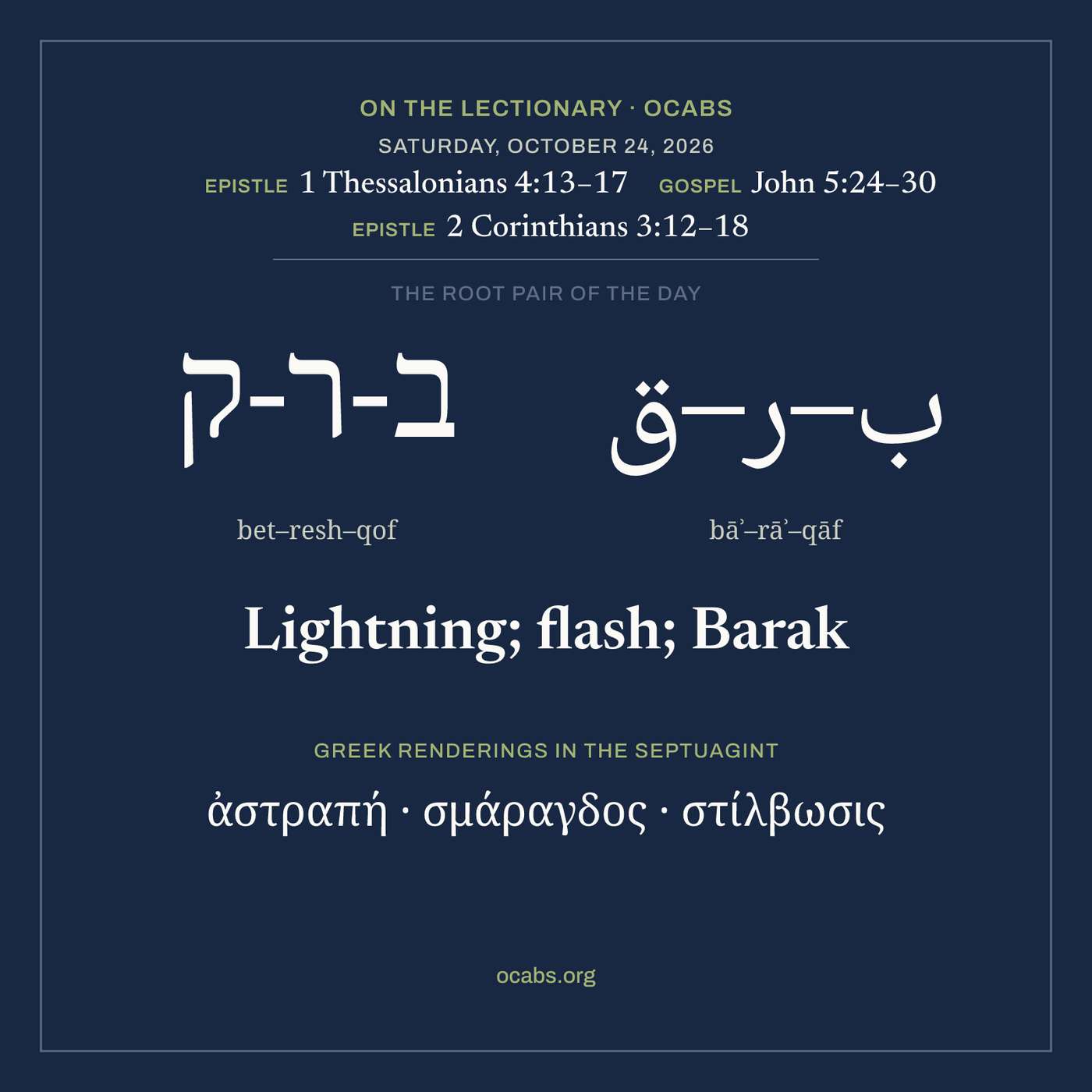
1 Thessalonians 4:13-17 · John 5:24-30 · 2 Corinthians 3:12-18 · Luke 7:1-10 — Saturday, October 24, 2026
Description
A daily note from the team at OCABS.ORG, drawing on the published works of Fr. Paul Nadim Tarazi, with citations to his books and lectures.
Readings: 1 Thessalonians 4:13-17; John 5:24-30; 2 Corinthians 3:12-18; Luke 7:1-10.
Paul tells the Thessalonians not to grieve over those who have died, because the same Lord who died and rose will bring the dead with him at his coming. Fr. Paul stresses that Paul calls this teaching "the word of the Lord," meaning it is church teaching about the risen and reigning Christ rather than Paul's private opinion. The sequence given is deliberate: the dead in Christ rise first, and only then are the living caught up together with them, so the point is not timing but that the dead and the living will be together with the Lord forever. Paul closes this section with the call to comfort and build one another up.
The Gospel repeats in John's idiom what Thessalonians promises: a voice that raises the dead. Fr. Paul notes that this is the classic text read at Orthodox funerals, where all in the tombs hear the Son of Man's voice and come out, some to resurrection of life and some to resurrection of judgment. He underscores that this authority to judge is given to Jesus precisely as son of man, and that Jesus judges only according to what he hears from the Father, seeking the Father's will and not his own. Fr. Paul reads this together with the raising of Lazarus, where the same word for voice used of the Son of Man calls Lazarus out, though Lazarus will die again, unlike the resurrection unto life Jesus teaches here.
The epistle to the Corinthians turns to Moses' veil, read on this day alongside the resurrection texts. Fr. Paul shows that Paul contrasts himself as minister of the new covenant with hardened leaders who still read the old covenant as if it had not passed, a veil lying "over their minds." Whoever turns to the Lord has the veil removed, and Paul identifies that Lord with the Spirit, where there is freedom; Fr. Paul explains that Spirit functions like wind, active and apparent, so that with unveiled face believers are changed from glory to glory.
Sources: Tarazi, I Thessalonians: A Commentary, p. 191; Tarazi, I Thessalonians: A Commentary, p. 174; Tarazi, I Thessalonians: A Commentary, p. 189; Tarazi, Philippians: A Commentary, p. 164; Orthodox Audio Bible Commentary, John (vol. 43), part 1, at 1:44:55; Orthodox Audio Bible Commentary, John (vol. 43), part 1, at 3:31:22; Tarazi, 2 Corinthians: A Commentary, p. 87; Tarazi, 2 Corinthians: A Commentary, p. 88; Tarazi, 2 Corinthians: A Commentary, p. 93; Tarazi, 2 Corinthians: A Commentary, p. 94.
Opening music: Taksim Arbi, Bichi Slama, oud (Tunis, Archives de la Parole, 1930s), public domain. Source: gallica.bnf.fr / BnF.
The digital voice Fāṭima (فَاطِمَة) is named in honor of the learned women of al-Andalus, particularly Fāṭima bint Yaḥyā al-Maghāmī, Fāṭima al-Sharrāṭ, and Fāṭima bint al-Muthannā, whose legacies embody the Andalusian traditions of scriptural scholarship, jurisprudence, education, and wisdom.