Episode Details
Back to Episodes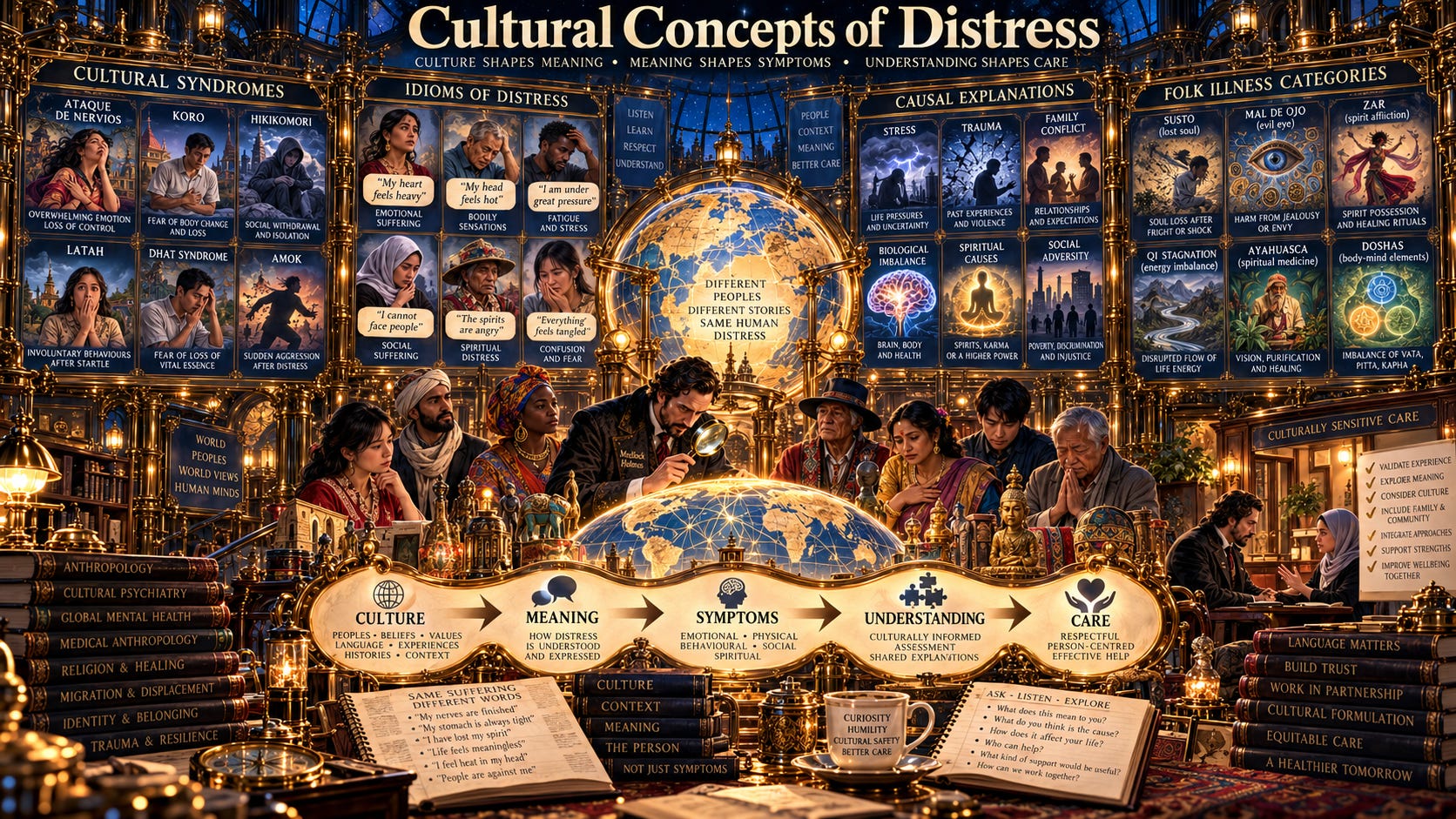
PSYCH 161: Cultural Concepts of Distress
Description
understanding how culture shapes the experience, expression, explanation and treatment of psychological distress.
The Museum of Untranslated Suffering
Medlock Holmes receives an unusual invitation to the Museum of Untranslated Suffering, an extraordinary Neo-Victorian institution containing thousands of accounts of human distress collected across continents and centuries.
The curator presents Holmes with a puzzle.
A young woman from the Caribbean experiences sudden screaming, crying, trembling and a sense of losing control following a family confrontation. Her relatives call it ataque de nervios.
A Cambodian refugee experiences dizziness, neck tension and overwhelming fear. He believes that disturbances in the circulation of khyâl, a wind-like bodily substance, may cause a stroke.
A Korean woman describes years of suppressed anger, accompanied by chest pressure, bodily heat and emotional suffering. She calls her illness hwa-byung.
A Chinese patient complains of exhaustion, poor concentration, insomnia and a weakened nervous system. His diagnosis is shenjing shuairuo.
Meanwhile, a young man in Zimbabwe tells his family that he is suffering from kufungisisa - thinking too much.
Holmes notices that the museum’s Western diagnostic catalogue offers possible explanations for every presentation: panic disorder, depression, somatic symptoms, trauma-related disorders or dissociation.
Yet something remains missing.
The psychiatric diagnosis may describe the symptoms without fully explaining what those symptoms mean to the person experiencing them.
The Four Languages of Distress
Holmes discovers four interconnected galleries.
The first contains cultural syndromes - recognisable clusters of symptoms, experiences and behaviours that acquire particular meanings within social and cultural contexts.
The second contains idioms of distress - familiar expressions through which people communicate suffering. These include phrases such as nerves, thinking too much and having a heavy heart. They may describe ordinary adversity, severe psychiatric illness or experiences somewhere between the two.
The third contains cultural explanations - beliefs about why suffering has occurred. A person may attribute illness to emotional suppression, disturbed bodily energies, spiritual forces, interpersonal conflict or traumatic events.
The fourth contains folk or popular illness categories - broader systems of understanding affliction, which may incorporate syndromes, symptoms, explanations and social circumstances.
Holmes realises that these categories overlap. A single expression may describe a syndrome, communicate distress and offer an explanation for its cause.
The Problem with the Old Catalogue
In a dusty archive, Holmes discovers the former classification of culture-bound syndromes.
He immediately recognises the flaw.
It assumes that certain forms of suffering are culturally specific while Western psychiatric diagnoses are somehow culturally neutral.
But depression, anxiety, trauma and psychosis are also understood through historically and culturally shaped concepts.
Culture does not merely decorate an underlying biological disorder. It may influence which bodily sensations receive attention, which emotions are acceptable to express, how symptoms are interpreted, when help is sought and what treatment seems credible.
Holmes replaces the old catalogue with a more sophisticated principle:
CULTURE SHAPES EXPERIENCE → EXPRESSION → EXPLANATION → HELP-SEEKING → TREATMENT → OUTCOME
The Gallery of Misdiagnosis
The next gallery contains portraits of patients whose suffering was misunderstood.
A spiritual experience has been mistaken for psychosis without adequate contextual assessment. A somatic expression of depression has