Episode Details
Back to Episodes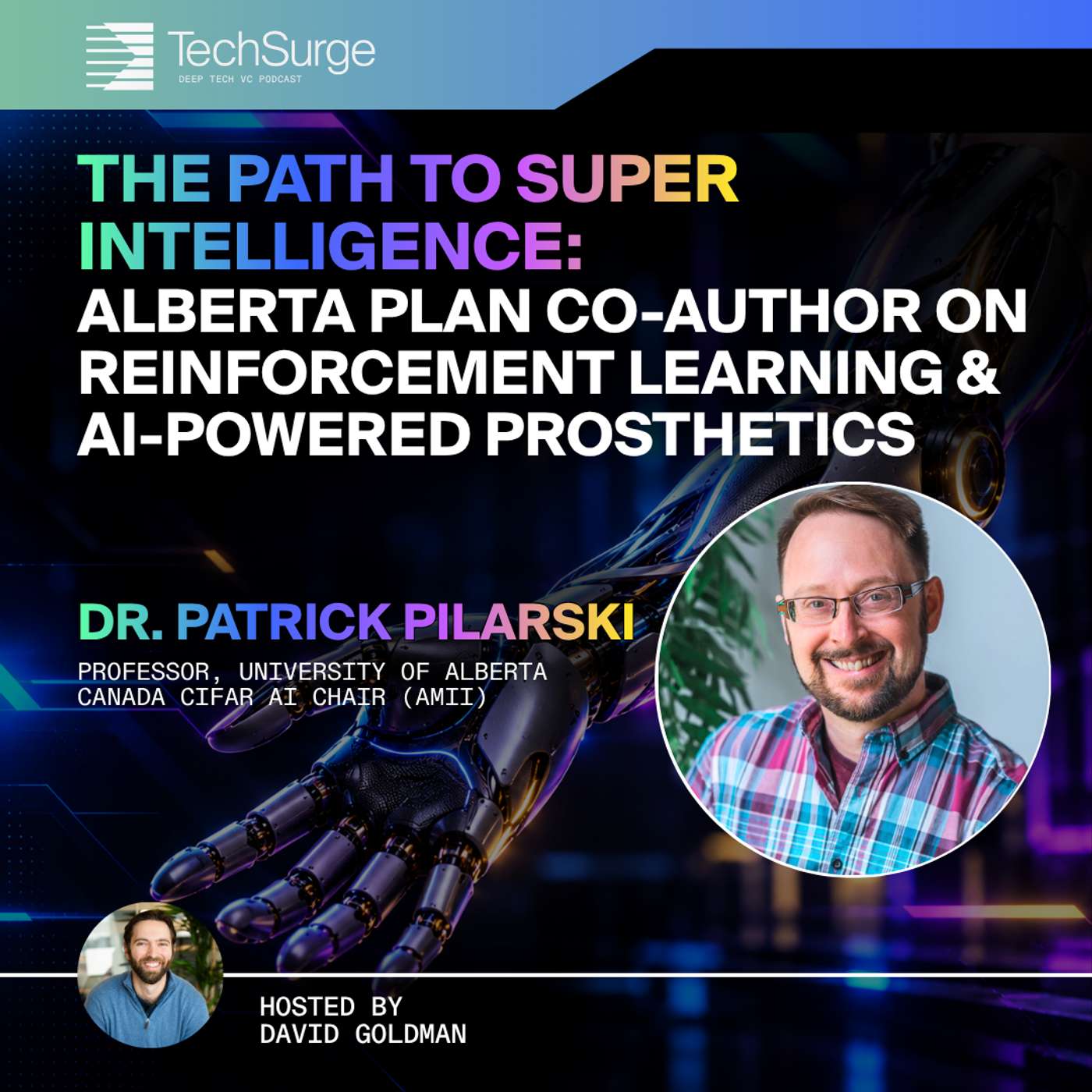
Are LLMs a Dead End? The Case for AI That Learns From Experience
Description
In this episode, Dr. Patrick Pilarski, co-author of the Alberta Plan alongside Richard Sutton and Michael Bowling, makes the case for a radically different kind of AI: one that never stops learning, builds its own understanding from raw experience, and gets more out of limited compute rather than more data centers. A Canada CIFAR AI Chair (Amii) and professor at the University of Alberta, Pilarski also leads a lab that builds robotic prosthetic limbs that learn to anticipate what their users intend to do before they do it.
In this conversation, Pilarski joins TechSurge to unpack why his co-author Rich Sutton has publicly called LLMs a dead end, how the Alberta Plan’s “temporal uniformity” differs from how today’s AI labs bolt reinforcement learning onto pre-trained models, and why he believes AI safety problems in today’s LLM agents are really reinforcement learning problems the field has studied for decades.
The conversation covers:
✅ Why Richard Sutton argues large language models are a dead end
✅ The four core commitments of the Alberta Plan for AI research
✅ Why “temporal uniformity” rejects the idea of separate training and deployment phases
✅ Patrick’s upcoming move to ExperienceFlow.AI as Head of Edge Superintelligence
✅ Why he doesn’t believe the AI data center build-out locks the industry into one path
✅ How reinforcement learning’s lessons on exploration and reward specification apply to AI agent safety
✅ Inside his lab’s work on AI-powered prosthetic limbs that predict user intent
✅ Supernumerary limbs and the future of human augmentation
Guest Links:
Patrick Pilarski: Canada CIFAR AI Chair and Fellow at Amii, Professor in the Department of Medicine at the University of Alberta, co-author of the Alberta Plan, and co-lead of the BLINC Lab. Incoming Head of Edge Superintelligence at ExperienceFlow.AI.
University of Alberta faculty page: https://sites.ualberta.ca/~pilarski/#teaching
BLINC Lab: https://blinclab.ca
Further Reading and Resources
The Alberta Plan – Pilarski’s contrarian roadmap for AI, co-authored with Richard Sutton and Michael Bowling, built around continual learning, temporal uniformity, computational efficiency, and multi-agent interaction.
arXiv paper: https://arxiv.org/abs/2208.11173
The Bitter Lesson – Richard Sutton’s influential essay, referenced in the conversation, arguing that scaling compute consistently beats hand-crafted human knowledge in AI research.
http://www.incompleteideas.net/IncIdeas/BitterLesson.html
Reward Is Enough – The paper discussed in the episode, arguing that sufficiently rich reward signals alone can give rise to the full range of abilities associated with intelligence.
ScienceDirect: https://www.sciencedirect.com/science/article/pii/S0004370221000862
AI Agent Safety is a Reinforcement Learning Problem – A paper co-authored by Pilarski, mapping AI agent safety failures onto established reinforcement learning challenges like safe exploration and reward misspecification.
OpenReview: https://openreview.net/forum?id=wvga9chmb6
ExperienceFlow.AI – The company Pilarski is joining as Head of Edge Superintelligence, whose Superintelligence Research Laboratory focuses on continual learning and is led scientifically by Richard Sutton.
Press release:
Listen Now
Love PodBriefly?
If you like Podbriefly.com, please consider donating to support the ongoing development.
Support Us